AI Contract Assistants Become Affordable for Solo and Small Law Firms
AI contract assistants become affordable for solo law firms, helping solo law firms streamline reviews, cut costs, and compete with bigger firms.

AI Contract Assistants Become Affordable for Solo and Small Law Firms
Artificial intelligence is no longer a luxury reserved for BigLaw. New data from 2025 legal tech reports shows that solo and small law firms are rapidly standardizing on cloud-based practice management, e-signatures, and document automation—while a fresh wave of affordable AI “contract assistants” is finally putting advanced drafting and review tools within reach of even the smallest practices. Yet many solo firms are still underinvesting in software, risking a widening productivity gap with more tech-forward peers.
Cloud Legal Tech Is Now the Default for Small Practices
Over the past five years, solo and small firms have quietly become some of the heaviest adopters of cloud-based legal technology. According to Clio’s 2025 Legal Trends for Solo and Small Law Firms, roughly four out of five solo and small firms now use cloud-based practice management software, significantly outpacing larger firms. Core tools include cloud data storage, video conferencing, online payments, and e-signature platforms—technologies that have become foundational to remote and hybrid legal services. (clio.com)
The same report highlights that e-signature tools are firmly embedded in everyday workflows, with more than 70% of solo and small firms using them to streamline client intake, engagement letters, and routine agreements. Firms that combine e-signatures with online intake forms and schedulers report markedly higher revenues and better lead conversion, underscoring how digital workflows directly translate into business performance. (clio.com)
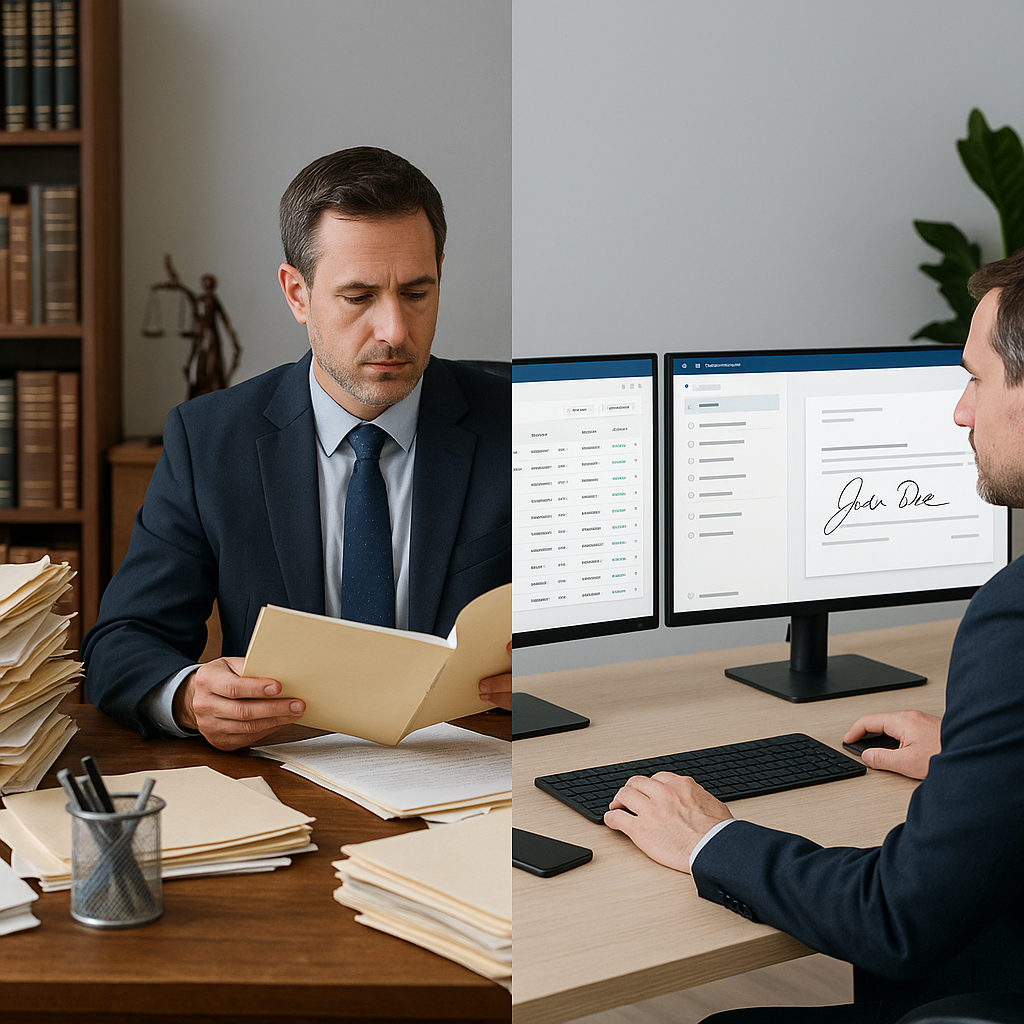
The Investment Gap: Small Firms Spend, Solos Scrimp
Despite strong adoption of cloud tools, solo practitioners still lag behind small firms when it comes to technology investment. Data from the 2025 Legal Trends report shows the average small law firm now spends around 2% of its total expenses on software—roughly in line with broader professional services benchmarks—while solo firms spend only about half that. (irglobal.com)
This aligns with recent American Bar Association TechReport findings, which show that while a majority of small firms budget for technology, only about 41% of solos do the same, and most solo practitioners report spending less than $3,000 per year on legal software. (americanbar.org) For many solos, that budget historically went to basic practice management and billing tools, leaving little room for more advanced automation.
 te>
te>
New data suggests that small firms investing around 2% of expenses in software are better positioned to scale than solos that invest half as much—especially as AI tools begin to separate “tech-forward” practices from everyone else.
AI Contract Assistants Move from Hype to Everyday Utility
While AI in law once meant experimental pilots in global firms, 2025 looks very different. Recent surveys show that generative AI adoption among small firms and solos has more than doubled over the past year, with over half now integrating AI into some aspect of their workflows. (lawnext.com) Task-specific AI contract assistants—tools that help draft, review, and standardize agreements—are at the center of this shift.
These tools typically handle three high-impact use cases for smaller practices:
- First-draft generation: producing initial versions of engagement letters, NDAs, fee agreements, leases, and basic commercial contracts based on prompts or templates.
- Risk-spotting and issue lists: scanning incoming contracts to flag unusual clauses, missing terms, or deviations from a firm’s preferred language.
- Clause playbooks and standardization: suggesting fallback language and aligning documents to a firm’s standard positions, even when working from client paper.
Industry benchmarks indicate that firms embracing advanced technology—including AI-enhanced document workflows—can realize revenue gains of 30–50% compared with less tech-enabled peers, due largely to higher utilization and faster turnaround times. (clio.com) For solo and small firms, AI contract assistants are becoming a practical way to access those gains without adding headcount.
Remote Document Workflows Are Now “Table Stakes”
Client expectations have shifted decisively toward remote-friendly legal services. Cloud-based practice management, secure client portals, and e-signatures are no longer differentiators—they are baseline requirements.
Clio’s 2025 solo and small firm data shows that tools like e-signatures, online intake forms, and automated scheduling are associated with higher revenues, more leads, and better conversion rates. Solo firms using these digital client intake tools report revenue as much as 50% higher than comparable firms that rely mainly on manual or paper-based processes. (clio.com)
For many small practices, AI contract assistants are emerging as the natural next step in this evolution: once documents are flowing digitally, the opportunity shifts from just “signing faster” to “drafting and reviewing smarter.” That’s particularly relevant for high-volume, standardized work—think NDAs, retainer agreements, basic commercial contracts, and simple real estate or employment documents—where automation can save hours per week.
Why Affordability Is Finally Changing the Equation
Historically, AI contract tools were priced and packaged for enterprise buyers, with per-seat licenses that made little sense for a three-lawyer firm or a solo with contract paralegal support. Newer solutions are changing that with flat, predictable pricing and lighter deployment models.
Benchmarks from law firm budgeting guides suggest that healthy small firms typically spend 2–3% of revenue on technology, and up to 4–5% for fast-growing practices. (smokeball.com) For a solo practice, that might translate into just a few hundred dollars a month across all tools—meaning AI has to be both affordable and clearly productivity-enhancing to earn a place in the stack.
This is where modern, small-business-focused platforms such as QuickSign.it are positioning AI contract capabilities as part of a broader, budget-friendly e-signature and document workflow offering, rather than an expensive add-on.
QuickSign’s Take: AI Contract Workflows Without Enterprise Pricing
Unlike enterprise-focused solutions designed for large corporate legal departments, QuickSign is built specifically for small businesses, freelancers, and solo professionals—including small law firms. Its feature set aligns closely with where solo and small firms are already investing: cloud document workflows, e-signatures, and automation that cuts drafting time.
Key capabilities that matter for smaller practices include:
- AI Document Generation for contracts and NDAs: Lawyers can generate draft agreements directly inside QuickSign.it using AI, then fine-tune language to match firm standards. For solos who don’t have the resources to maintain a large template library, this can dramatically shorten the path from intake to signed engagement.
- Effortless sending and signing: The workflow is designed to be simple: upload a PDF, drag and drop signature and form fields, and send. For firms juggling multiple matters with limited staff, minimizing clicks and setup time is crucial.
- Real-time tracking: Built-in status tracking lets attorneys see when clients have opened, signed, or stalled on a document—supporting more proactive follow-up and better cash flow management.
- Flat-rate pricing at $15/month for the whole team: Instead of per-seat licensing, which often penalizes growing teams, QuickSign offers a flat subscription model that fits comfortably within the 2% software-spend benchmark for most small firms.
- Generous free tier: A free option with 2 AI document generations and 1 document send to unlimited recipients lets solos experiment with AI contract workflows before committing budget.
For many solos who have historically underinvested in software, the ability to consolidate e-signature, tracking, and AI document generation into a single, low, flat monthly price lowers both the financial and cognitive barriers to adopting AI.
Practical Takeaways for Solo and Small Law Firms
For practitioners evaluating AI contract assistants and broader cloud legal tech, recent trends suggest several clear steps:
- Benchmark your software spend. If your firm is spending significantly less than ~2% of expenses on software, you’re likely underinvesting relative to peers—and leaving productivity (and revenue) on the table. (irglobal.com)
- Make remote document workflows non-negotiable. E-signatures, online intake forms, and digital payment links are now fundamental infrastructure, not optional add-ons. Ensure every step from initial inquiry to signed engagement can happen online.
- Start with repeatable contracts. Deploy AI assistants where they will have the biggest and safest impact first: NDAs, fee agreements, standard commercial contracts, and other low-complexity documents with well-understood risk profiles.
- Keep humans firmly in the loop. AI should generate and review drafts, but attorneys must retain final review and judgment—especially for higher-stakes transactions and litigation-related documents. This hybrid model is also what bar associations and ethics bodies increasingly expect as AI usage grows. (ft.com)
- Favor tools that integrate with your workflows. For small firms without IT departments, simplicity matters. Cloud-based solutions that combine AI document generation, e-signature, and status tracking—such as QuickSign.it—reduce the need to stitch together multiple vendors.
The Opportunity: Turning Underinvestment into an Edge
The latest solo and small firm legal trends data tells a clear story: cloud-based practice management and remote document workflows have become standard, but meaningful differences in software investment remain. Small firms that commit around 2% of expenses to software are equipping themselves to scale; solos spending half as much risk falling behind as AI moves from buzzword to everyday infrastructure. (irglobal.com)
For many solo and small firms, the path forward doesn’t require enterprise AI budgets or in-house data scientists. It requires a deliberate decision to treat tools like AI contract assistants, e-signatures, and digital intake as strategic investments rather than discretionary costs—and to choose platforms that respect small-firm realities on pricing and usability.
Looking for an affordable e-signature solution? Try QuickSign for free - no credit card required.