AI Contract Reading Gives Independent Agents 60-Second Deal Summaries
Unlock 60-second deal summaries with AI contract analysis, helping independent agents read, compare, and negotiate contracts faster and more accurately.

AI Contract Reading Gives Independent Agents 60-Second Deal Summaries
Independent real estate agents and small brokerages are discovering a new kind of “assistant” that never sleeps, never loses a sticky note, and can read a 15-page purchase agreement in less than a minute. Recent advances in AI contract analysis now allow software to scan real estate contracts, identify the parties, pull out critical dates, and surface key terms into a structured checklist—often in about 60 seconds. For solo agents and lean teams juggling dozens of files, this is starting to change how deals are reviewed, tracked, and closed.
Why 60-Second Contract Reads Matter to Small Brokerages
Real estate contracts have always been a time tax on small operators. A single residential deal can generate multiple versions of purchase agreements, counteroffers, addenda, disclosures, and contingency forms. Every version needs to be read carefully to confirm the price, contingencies, deadlines, and responsibilities—and then those details must be keyed into spreadsheets, CRMs, or transaction checklists.
For transaction coordinators processing 15–25 files a month, that intake work alone often consumes hours each week. Guidance from new AI contract-reading tools in real estate shows that what once took 30–45 minutes per file can be compressed to about 60 seconds for extraction plus a short verification pass. (listedkit.com)
At the same time, AI adoption in real estate is already widespread. A recent survey from Realtor Property Resource (RPR), a subsidiary of the National Association of Realtors, found that 82% of agents are now using some form of AI—mostly for writing and marketing—while expressing ongoing concerns about accuracy and a desire for better training. (housingwire.com) As agents grow more comfortable with AI-generated listing descriptions and social posts, many are now looking at the “back office” side of the business: contracts and compliance.
For small brokerages, the real breakthrough isn’t that AI can read contracts—it’s that it can turn those contracts into actionable, error-checked task lists in under a minute.
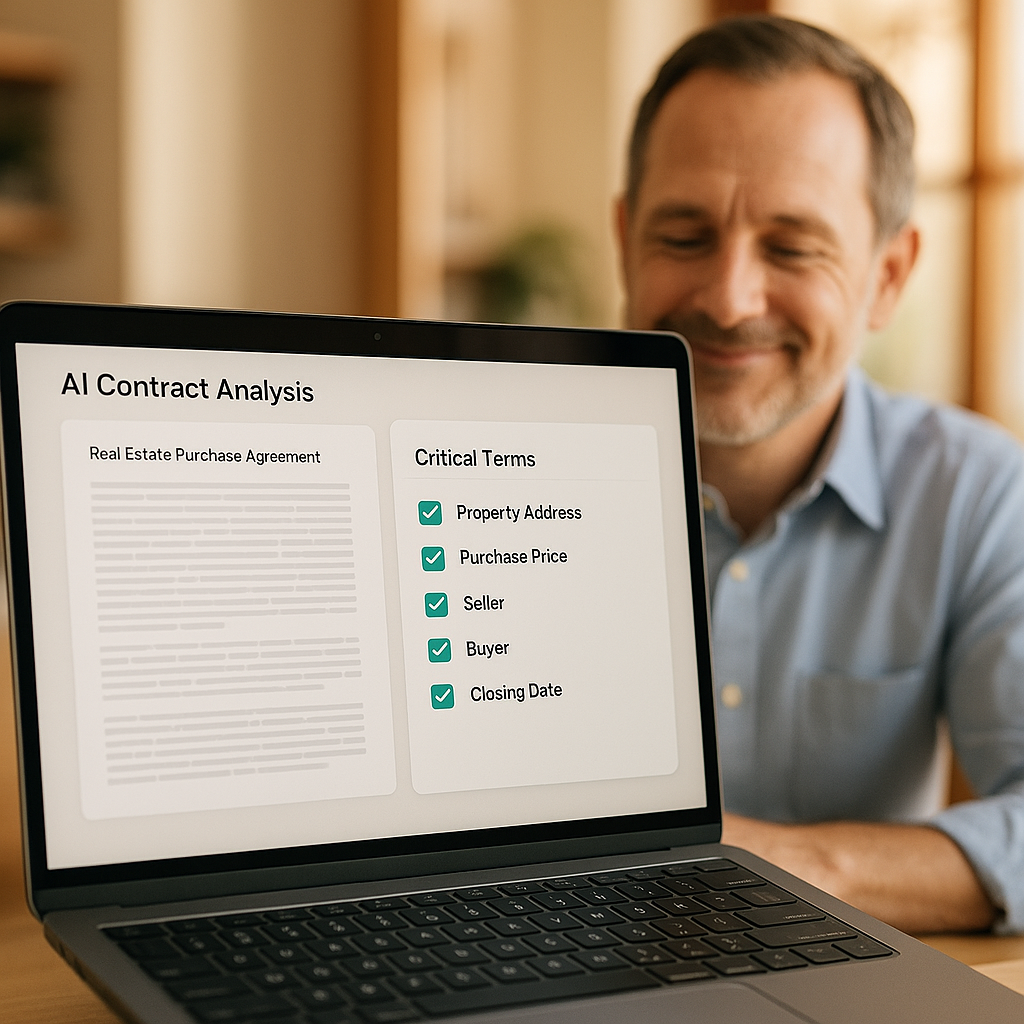
How Modern AI Reads Real Estate Contracts in Under a Minute
Unlike older, template-based systems that needed a custom setup for each state form, newer AI “document intelligence” engines treat contracts as rich, semi-structured documents. When an agent uploads a purchase agreement, the AI visually analyzes the pages, recognizes the layout, and begins extracting entities and relationships.
Product guidance from contract intelligence vendors describes a typical 60-second flow like this: (listedkit.com)
- Identify document type and structure: Residential purchase agreement, counteroffer, addendum, lease, etc., even when the form is from a specific state association or MLS.
- Extract parties and contacts: Buyer and seller names, mailing addresses, agent and brokerage information, lender, title or escrow company, and associated roles.
- Capture property details: Property address, legal description, parcel ID, HOA data where present.
- Pull financial terms: Purchase price, earnest money, down payment, concessions, and key fee allocations.
- Compute critical dates and deadlines: Closing date, inspection deadline, appraisal and financing contingencies, title review periods, and option periods—often calculating relative dates like “10 days after acceptance” into actual calendar dates.
- Flag contingencies and special terms: Home-sale contingencies, repair credits, personal property inclusions/exclusions, and unusual stipulations that make the deal unique.
In commercial real estate and more complex deals, similar tools can also scan leases and purchase agreements to highlight rent escalations, renewal options, maintenance obligations, and encumbrances, producing quick abstracts across many documents. (aicontractreviewtool.com)
The speed and accuracy are no longer theoretical. Benchmark tests in legal document review have shown AI systems scanning multiple contracts in seconds with accuracy rates in the mid-90% range—outperforming human reviewers on both speed and precision in certain standardized tasks. (rew.ca) While real-world performance in messy, handwritten deals can vary, the trajectory is clear: bulk data entry and initial issue spotting are increasingly machine work.
From Raw PDF to Actionable Checklist
What makes this evolution so useful to independent agents is not just extraction, but how the information is organized. Instead of a static PDF in a folder, AI systems can output a structured “deal profile” or checklist that becomes the backbone of a transaction:
- Who is involved? All parties and key contacts, neatly labeled.
- What was agreed? Price, concessions, contingencies, and notable clauses.
- When do things happen? Computed deadlines for inspections, financing, and closing.
- What is missing? Empty fields, inconsistent dates, or references to attachments that haven’t been provided.
Th

What This Means for Solo Agents and Small Teams
For large, enterprise brokerages with in-house legal and operations teams, AI contract analysis is another incremental improvement. For solo agents, boutique brokerages, and independent transaction coordinators, it can be the difference between sustainable growth and burnout.
Industry examples suggest that automating contract intake can save 7–10 hours per month for a coordinator handling 15 transactions, simply by reducing 30–45 minutes of manual reading and data entry per file to about a minute of AI extraction plus review. (listedkit.com) That reclaimed time can be spent on higher-value work:
- Client communication: Proactive updates, clearer expectations, and personalized service.
- Business development: Prospecting, nurturing referrals, and refining marketing.
- Quality control: Double-checking edge cases rather than doing rote typing.
There’s also a risk management benefit. Manual data entry typically carries error rates around 1–4% across industries, and in real estate a single transposed digit in a closing date or purchase price can trigger major headaches. (rew.ca) AI isn’t infallible, but by standardizing extraction and forcing a structured review step, it can actually make it easier to spot discrepancies than when humans both read and type at the same time.
The workflow shift is subtle but powerful: humans move from being primary data entry clerks to final approvers and negotiators.
The QuickSign.it Perspective: Turning Contract Intelligence Into Action
AI-powered contract reading is most valuable when it’s tightly connected to how documents are generated, sent for signature, and tracked. That’s where modern e-signature platforms aimed at small businesses are stepping in.
QuickSign, a modern, affordable e-signature solution built for small businesses and freelancers, approaches the problem from both ends of the workflow:
- AI Document Generation: Instead of starting from a blank template, agents and independent professionals can use AI to generate contracts, listing agreements, or NDAs tailored to their scenario, then refine the language before sending.
- Effortless sending: Upload an existing PDF, drag and drop fields for signatures, initials, and dates, and send in a few clicks—no complex setup required.
- Real-time tracking: See who has opened, viewed, and signed, and which contracts are still pending, all in a single dashboard.
- Small-business pricing: Unlike enterprise-focused solutions that bill per user, QuickSign offers flat-rate pricing at $15/month for the whole team, plus a free tier that includes two AI document generations and one document send to unlimited recipients.
As AI contract analysis tools produce structured summaries of parties, dates, and key terms, platforms like QuickSign can become the natural home for that intelligence—linking the extracted data back to actual signatures and approvals. A solo agent could, for instance, generate a compliant contract with AI, send it for signature, and then rely on AI to read the fully executed agreement and create a closing checklist, all in the same digital ecosystem.
Practical Takeaways: How Independent Agents Can Start Using AI Contract Reading
For business professionals curious about bringing AI into their contract workflows, the barrier to entry is lower than it looks. You don’t need to be a machine learning expert or overhaul your entire tech stack on day one. Instead, small teams can approach AI contract reading in a few practical steps:
1. Start with One High-Volume Document Type
Pick the contract you touch most often—typically the residential purchase agreement or standard listing agreement in your market. Test an AI contract reader on a batch of recent deals and compare its extracted data to what your team entered manually.
- Measure time saved per file.
- Track accuracy on key fields: price, dates, parties, contingencies.
- Note where the AI struggles (e.g., heavily handwritten forms, unusual addenda).
2. Use AI as a Second Reader, Not an Auto-Pilot
Especially early on, think of AI as a second set of eyes rather than an infallible authority. Let the system do the first pass to create a 60-second summary, then quickly verify the extracted data against the original PDF before you approve it.
This verification-first approach aligns with broader legal tech best practices, where AI assists but humans retain final decision-making over risk and compliance. (agilityportal.io)
3. Connect Contract Intelligence to Task Management
The power of a structured checklist is that it can drive concrete actions. Once your AI tool is reliably pulling parties, dates, and critical terms, integrate that data into your existing task or project management system—whether that’s a simple spreadsheet, a real estate CRM, or an operations platform.
- Auto-generate tasks like “Confirm earnest money received by [deadline].”
- Trigger reminders a few days before key contingency dates.
- Feed status updates into your client communication templates.
4. Tie It Into Your E-Signature Workflow
AI summaries are most useful when they’re linked directly to the documents they describe. With an e-signature tool like QuickSign, small teams can centralize their contracts—whether AI-generated or uploaded PDFs—alongside real-time signing status and audit trails.
That means a single pane of glass where you can answer, in seconds, questions like “Has the buyer signed the latest counteroffer?”, “What’s the official inspection deadline?”, and “Did we update the contract when we extended closing?”—without flipping through email chains and paper folders.
The Road Ahead: From Faster Reading to Smarter Negotiations
AI contract reading is still evolving, and independent agents should expect ongoing improvements in areas like handwritten form recognition, state-specific clause interpretation, and multi-document version reconciliation. Research into AI systems designed specifically for long, complex legal agreements suggests that specialized, multi-agent frameworks can outperform general-purpose models in both accuracy and explainability—important traits when real money and liability are at stake. (arxiv.org)
But even in its current form, 60-second contract analysis is already reshaping daily workflows for small brokerages. The practical payoff isn’t just speed; it’s clarity. When every deal starts with a clean, structured summary of who is doing what by when, independent agents can spend less time hunting through PDFs and more time counseling clients, negotiating terms, and building their business.
Looking for an affordable e-signature solution? Try QuickSign for free - no credit card required.