AI Revenue Analytics Tool Targets Cash-Flow Pain for Smaller Law Practices
Boost profit and predictability with our AI revenue analytics tool. Discover how billing automation transforms cash-flow for smaller law practices.

AI Revenue Analytics Tool Targets Cash-Flow Pain for Smaller Law Practices
Cash-flow headaches are nothing new for small and midsize law firms. But a new wave of AI-driven revenue analytics tools is aiming squarely at the invoice-to-cash bottleneck—helping owners spot billing and collections issues earlier, before they turn into staffing freezes, delayed partner draws, or uncomfortable calls to the bank.
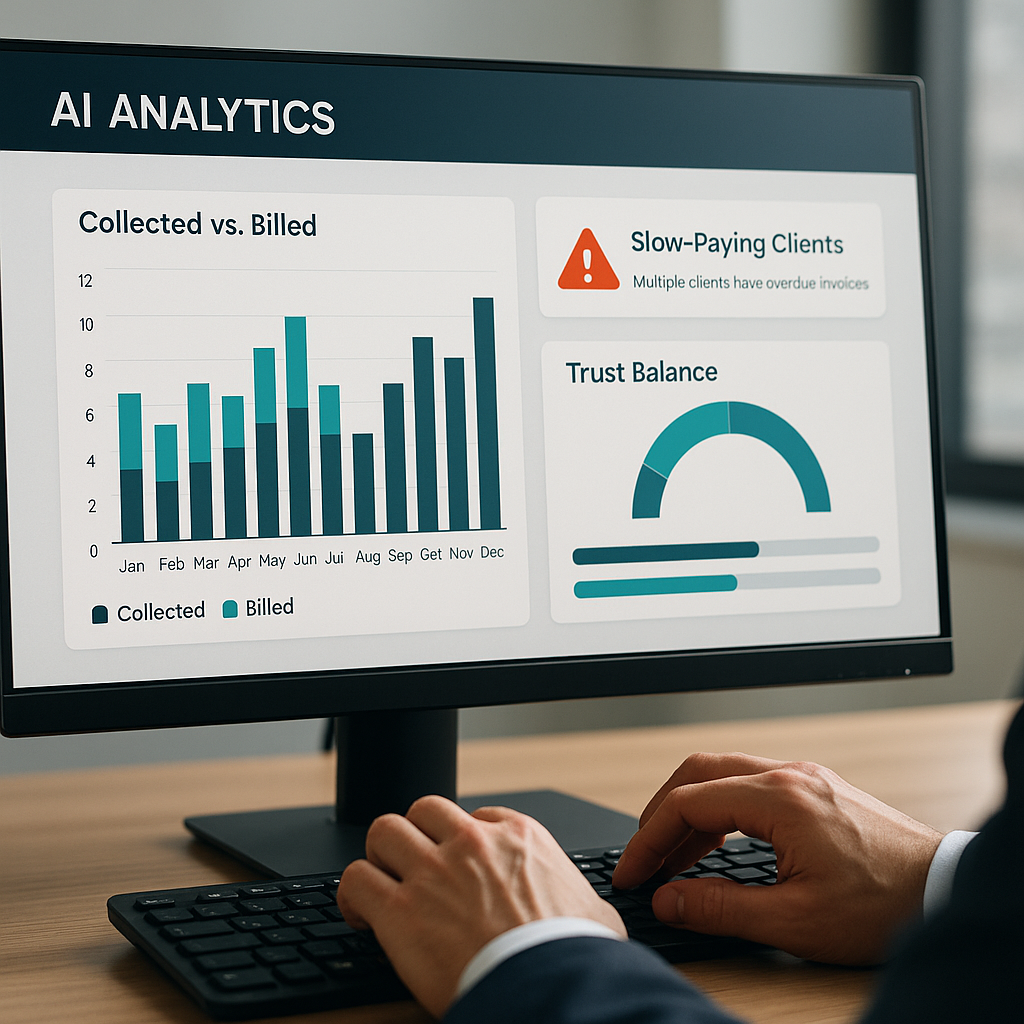
The latest entrant is an AI-powered revenue analytics product designed specifically for law firms that don’t have a dedicated finance team. Instead of sifting through spreadsheets or waiting for an annual accountant review, firm owners get live dashboards and alerts on slow-paying clients, overdue invoices, and trust balances—key indicators that can make or break cash flow for practices with thin margins.
Why Cash-Flow Analytics Is Suddenly a Priority for Small Law Firms
Despite years of talk about “running firms like a business,” many smaller practices still operate on delayed or incomplete financial visibility. For firms under 25 lawyers, partners and managing attorneys often wear the de facto CFO hat—on top of trying to bill hours, win new matters, and manage staff.
Industry data shows how fragile this model can be. Studies of law firm collections consistently find that firms collect only about 86–91% of what they bill, leaving a material slice of revenue on the table due to write-downs, write-offs, and uncollected accounts.(leanlaw.co) Other analyses estimate that small and midsize firms can lose tens of thousands of dollars annually in “collections debt”—the gap between invoices issued and cash actually received—once the cost of attorneys’ unbilled collection time is factored in.(native.legal)
At the same time, clients are taking longer to pay. One advisory report notes that law firms now wait an average of nearly five months—around 146 days—to get paid, a delay that can be especially damaging for smaller practices that lack large cash reserves and must still meet regular obligations like payroll, rent, malpractice insurance, and software subscriptions.(lawfuel.com)
When 10–15% of your annual billings disappear in discounts, write-offs, and late or non-payment, cash-flow management is no longer a back-office concern—it becomes an existential issue for small firms.
Against that backdrop, tools that can watch invoice-to-cash in real time and flag problems early are moving from “nice-to-have” to operational necessity.
Inside the New AI-Driven Revenue Analytics Product
The newly released revenue analytics tool plugs into a firm’s existing practice management and billing systems, then applies AI and rules-based logic to surface patterns that humans often miss until it’s too late. While vendors differ in implementation, the core capabilities cluster around three pillars:
- Client payment behavior analytics – Tracking days sales outstanding (DSO) at the client and matter level, highlighting clients who are trending slower, and estimating the impact on future cash flow.
- Invoice risk scoring – Using past payment patterns, billing history, and matter type to predict which invoices are likely to be paid late or challenged, so firms can adjust follow-up or terms.
- Trust account oversight – Monitoring trust balances, upcoming work, and draw patterns to warn when pending work may outstrip available retainer funds, reducing the risk of non-payment and compliance missteps.
Instead of relying purely on static reports, owners see live dashboards with trend lines: realization and collection rates over time, aging buckets of receivables, and how much cash is “locked up” in bills that are drafted but not yet sent or are waiting on internal approval. This directly addresses a common problem: some firms take weeks just to finalize and send invoices, delaying the payment clock even further.(oddr.com)
The tool’s alerting engine is where AI becomes most visible. Rather than forcing busy partners to interrogate the data, the system pushes insights to them:
- Alerts when a historically prompt-paying client suddenly slips into the 60- or 90-day overdue category.
- Notifications when a practice group’s realization rate drops below a defined threshold.
- Warnings when trust balances for specific matters fall below a safe buffer, based on historic bil
ling velocity.
The promise of these tools isn’t just prettier reports; it’s giving a solo or small-firm owner the same kind of forward-looking revenue visibility a full-time CFO would deliver—without adding headcount.
Why This Matters for Firms Without Finance Teams
Large firms often employ CFOs, controllers, and AR managers to handle collections strategy. By contrast, small shops typically manage billing and collections in the gaps between hearings and client meetings. That leads to predictable patterns:
- Pre-bills sit unreviewed until late in the month.
- Invoices go out in irregular batches instead of on a consistent cycle.
- Follow-up on overdue invoices is ad hoc and emotionally draining, so it gets postponed.
Surveys of small-firm lawyers regularly cite overdue accounts as a chronic headache, with roughly six in ten lawyers reporting that they frequently deal with clients in arrears.(native.legal) The result is a dual burden: lost revenue and non-billable time spent chasing payments.
By automating much of the monitoring and triage, AI revenue analytics tools aim to transform collections from a sporadic scramble into a routine, data-driven process. For example:
- A solo practitioner can receive a weekly summary highlighting the five invoices with the highest risk and suggested outreach steps.
- A small litigation boutique can track how long it typically takes insurance carriers to pay, then adjust retainers and payment terms accordingly.
- Firm owners can see how discounts and write-offs are trending by client or practice area and decide whether pricing needs to change.
Connecting Revenue Analytics to Document and E-Signature Workflows
Invoice-to-cash performance doesn’t exist in a vacuum; it’s tightly linked to how firms generate engagement agreements, scope changes, and payment terms—and how quickly those documents get signed. Unclear fee arrangements and sluggish onboarding are consistently cited as contributors to delayed or disputed payments.(lawfuel.com)
This is where modern document and e-signature platforms fit into the story. Tools like QuickSign already help small firms move faster from “handshake” to signed engagement:
- AI Document Generation can draft tailored engagement letters, NDAs, and retainer agreements in minutes, ensuring that billing terms, late-fee policies, and trust arrangements are clearly defined upfront.
- Effortless sending—upload a PDF, drag and drop signature and payment fields, send—cuts days out of the onboarding cycle and starts the payment clock sooner.
- Real-time tracking shows when clients open, sign, or stall on documents, supporting more proactive follow-up before work significantly outpaces signed terms.
Unlike enterprise-focused solutions that layer on per-seat pricing and complex feature sets, QuickSign offers flat-rate pricing at $15/month for the entire team, along with a free tier that includes two AI document generations and one document send to unlimited recipients—an approachable entry point for solos and small firms watching every line item.
How AI Revenue Analytics and QuickSign Work Together in Practice
On their own, analytics dashboards and e-signature tools each offer incremental improvements. Combined, they can materially change the economics of a small practice’s cash flow.
Consider a four-lawyer firm that historically sends paper invoices at the end of each month and waits 60–90 days for payment on a substantial portion of its work. A modernized workflow could look like this:
- AI-generated engagement letters – Using QuickSign, the firm generates an engagement agreement that clearly sets out hourly rates, retainers, billing frequency, late fees, and acceptable payment methods.
- Digital signature and intake – The agreement is sent electronically for signature, with tracking so staff can see if a client hasn’t opened or completed the document and follow up promptly.
- Automated billing and online payments – Bills are generated through the firm’s billing system on a predictable schedule and delivered via email with online payment links, a practice that has been shown to accelerate payments dramatically, with a majority of online invoices paid within days rather than weeks.(clio.com)
- AI revenue analytics overlay – The new analytics tool monitors how quickly specific clients pay, which invoices are aging, and whether trust balances are at risk of running dry given current work in progress.
- Targeted interventions – When the system flags a client that has slipped from 30-day to 60-day payment behavior, the firm can adjust future retainer requirements or pause new work until balances are current.
Contract clarity plus fast, trackable signatures plus AI-driven revenue monitoring gives smaller firms a practical, affordable way to tighten the invoice-to-cash loop—without building a finance department.
Practical Takeaways for Small Firms and Independent Lawyers
For solos and small firms considering AI revenue analytics, the most important decisions aren’t just about which tool to buy—they’re about how to connect billing, client communication, and document workflows into a coherent system.
1. Start with clean, digital engagement terms
If your engagement letters, scope change documents, and payment terms are inconsistent or still on paper, even the most sophisticated analytics dashboard will only highlight the same underlying problems. Using AI document generation and e-signature platforms like QuickSign to standardize these documents is a high-leverage first step.
2. Shorten the gap between work performed and invoices sent
Every extra week that pre-bills sit in draft or on a partner’s desk is a week of interest-free financing you are providing to clients. Modern billing systems and workflow tools can automate invoice creation; AI analytics can then track how slow internal approvals are and show the cash-flow impact, making it easier to justify process changes.
3. Use alerts, not just reports
Smaller firms rarely have time to dig through multi-tab spreadsheets. Configuring alerts—“clients over 45 days overdue,” “matters with trust balances below two weeks of expected work,” “realization below 80%”—ensures that owners see issues in time to act. That’s where AI’s pattern recognition can outpace manual review.
4. Align collections strategy with client experience
Collections are sensitive in any professional service business. With better analytics, firms can distinguish between chronically slow payers and clients who simply need clearer expectations or more convenient ways to pay (such as online payment links in digitally signed documents). Done well, this reduces awkward phone calls and preserves client relationships.
The Road Ahead: From Gut Feel to Data-Driven Decisions
Law firm leaders have long relied on instinct to manage cash flow: a rough sense of which clients “always pay eventually” or which months tend to be lean. As economic conditions tighten and realization rates come under pressure across the industry, that instinct increasingly needs to be backed by real-time data.(americanbar.org)
AI revenue analytics tools targeted at smaller practices won’t eliminate all the uncertainty, but they can turn the invoice-to-cash cycle from a black box into a set of measurable, manageable levers: client selection, payment terms, staffing, and pricing. When combined with streamlined digital document workflows and affordable e-signature tools like QuickSign—with its flat $15/month team pricing and free starter tier—small firms finally have access to a tech stack once reserved for enterprises.
Looking for an affordable e-signature solution? Try QuickSign for free - no credit card required.