AI Systems for Rapid Statement of Work Drafting Could Cut Admin Time for Small Teams
Streamline projects with statement of work automation. Discover how AI systems speed SOW drafting, cut admin time, and free small teams to focus on delivery.

AI Systems for Rapid Statement of Work Drafting Could Cut Admin Time for Small Teams
Multi‑Agent AI Is Coming for the Most Boring Part of Your Project Work
Drafting a Statement of Work (SOW) has long been one of the most time‑consuming—yet repetitive—tasks for consultants, agencies, and freelancers. Each new client or project needs a detailed document defining deliverables, timelines, responsibilities, and legal terms, and those documents can easily eat up hours of billable time.
New AI research suggests that is about to change. A recent study on a retrieval‑augmented, multi‑agent system for SOW generation showed that AI agents can collaborate to draft complete, customized SOWs in under three minutes—compared to the hours or days usually required when humans start from scratch.(arxiv.org) For small teams that live and die by project margins and speed of turnaround, this points toward a future where SOW creation becomes a fast, largely automated workflow rather than a recurring administrative burden.
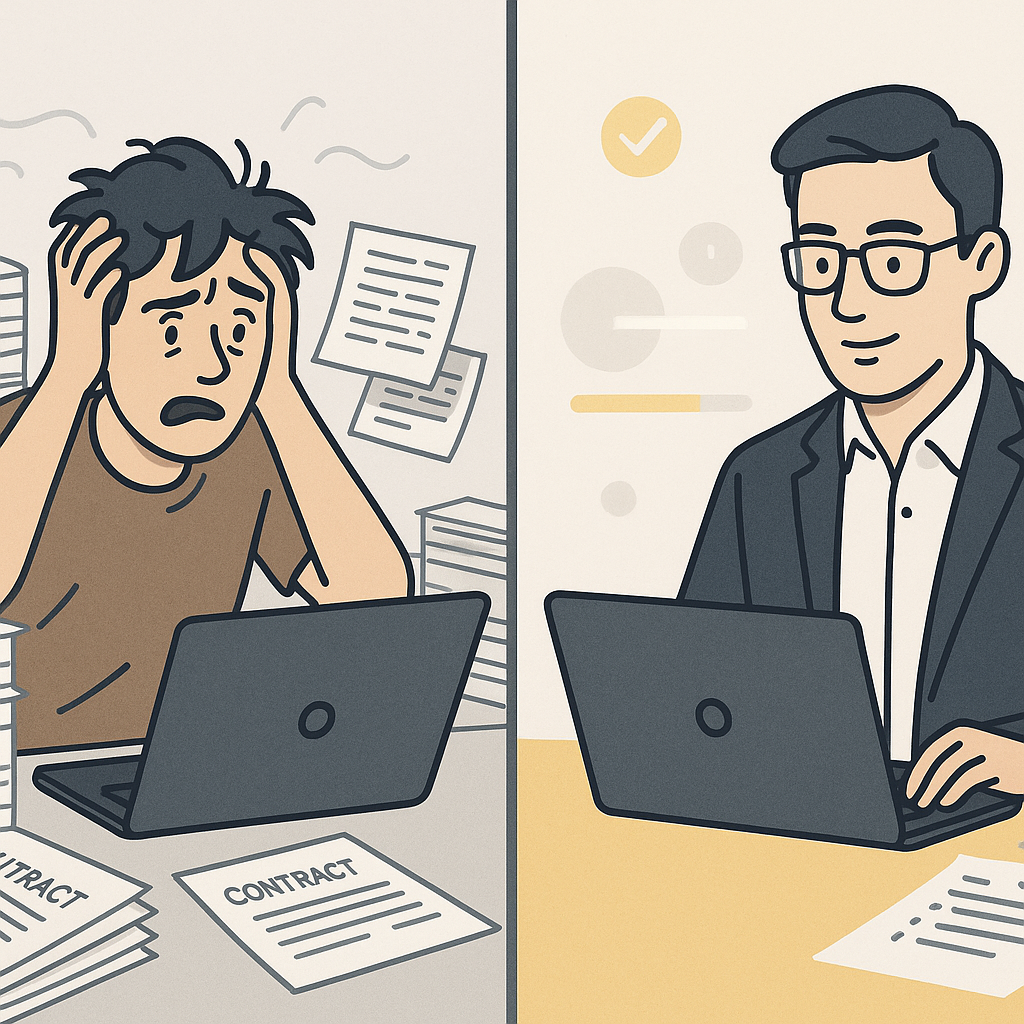
Why SOW Automation Matters for Small Agencies and Freelancers
SOWs sit at the intersection of sales, delivery, and legal risk. They define what’s in scope, what’s not, when milestones are due, and how and when clients will pay. When you run a small agency or solo practice, every hour you spend assembling near‑identical SOWs from old Word files or Google Docs is an hour you’re not prospecting, delivering work, or managing client relationships.
Research on contract automation more broadly shows just how large that opportunity is. A 2025 benchmarking survey found that legal teams using automation could cut contract processing time from 19 days to just 3 and improve efficiency by 73%, yet almost half still rely on email and Word documents alone.(businesswire.com) Another study focused on small businesses reported that 55% of professionals have already used AI to draft, edit, or review contracts, saving about four hours per week—roughly 26 workdays a year.(smallpdf.com)
While these numbers come from legal and contract teams of all sizes, the impact is amplified for small agencies and freelancers who often lack in‑house legal counsel and operate on tighter margins. Faster SOW and contract cycles mean:
- Quicker client onbo
arding and project kick‑off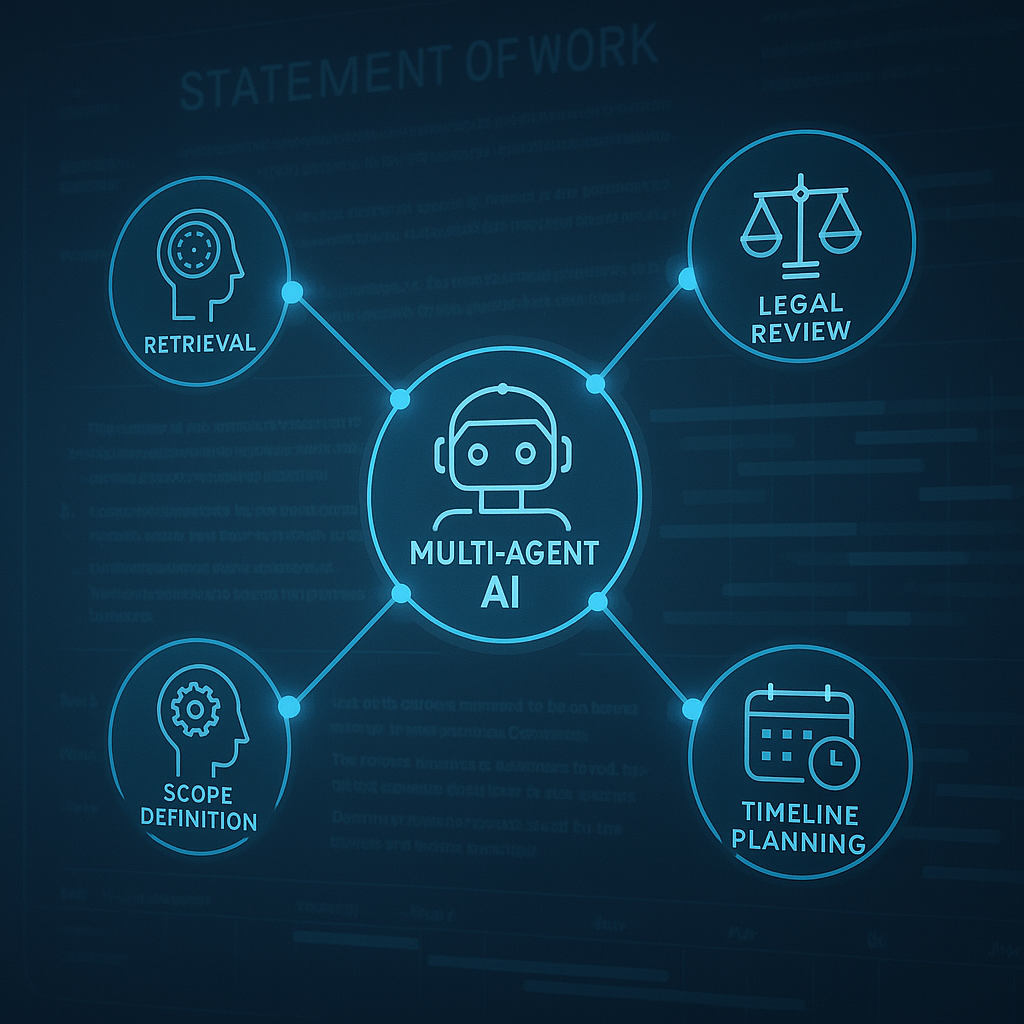
- Less time stuck in email threads revising scope language
- More consistent terms across projects, reducing confusion and disputes
- Lower reliance on expensive, ad‑hoc legal review for every new engagement
What’s New: Multi‑Step Agent Workflows for SOW Drafting
The newest wave of tools doesn’t just “fill in the blanks” on a template. The SOW system described in recent research uses multiple AI agents coordinating in sequence: one agent drafts the SOW, another checks for legal completeness and consistency, and a third formats and polishes the final document.(arxiv.org)
This multi‑agent approach mirrors how a real team might work:
- Drafting agent – Generates an initial SOW based on a project description, prior agreements, or a brief sent by the client.
- Legal/consistency agent – Checks clauses for completeness, flags missing definitions, ensures termination, payment, and data‑protection terms are present and coherent.
- Formatting agent – Structures sections, standardizes headings and numbering, and produces a clean, client‑ready document.
In tests on real‑world business scenarios, the system could complete this whole chain in under three minutes, while maintaining strong accuracy and quality.(arxiv.org) This is consistent with wider research on “agentic” AI workflows, which shows that modular, multi‑agent systems can handle complex, multi‑step tasks more efficiently than a single model working in isolation.(arxiv.org)
Instead of a single AI writing a one‑shot draft, multi‑agent SOW systems orchestrate several specialized AIs—planner, drafter, reviewer, formatter—to mimic how a real project team works, but at machine speed.
Where General‑Purpose Tools Stop—and Specialized SOW Automation Begins
Mainstream tools like Microsoft Copilot in Word already let users generate proposals, project documents, and contracts from prompts or existing files. Microsoft’s own documentation emphasizes that Copilot can start drafts, build documents from prior emails or documents, and expand existing content with just a prompt.(support.microsoft.com) In practice, many small businesses are using these capabilities to draft simple project outlines or basic agreements.
But SOW automation goes a step further in a few important ways:
- Structured outputs – SOWs require clear sections (scope, timelines, milestones, assumptions, exclusions, pricing, legal terms). Agent workflows can enforce this structure automatically.
- Standardized clauses – Instead of asking an AI to “write something,” SOW systems can pull from a library of vetted clauses for IP ownership, data protection, and change control, improving consistency.
- Project‑specific tailoring – Retrieval‑augmented systems can reference prior SOWs, client‑specific terms, or jurisdiction‑specific requirements to adapt each draft.(arxiv.org)
- Embedded checks – Agents can automatically verify that defined terms are used correctly, that governing law matches the client’s location, and that payment terms are aligned with your proposal—similar to AI‑assisted workflows now being used in real SaaS contract processes.(alibaba.com)
How Much Time Can Small Teams Realistically Save?
While the “under three minutes” figure from research environments is impressive, everyday practice for small agencies will likely involve a blend of AI and human review. Based on recent surveys and case studies:
- Professionals using AI for contracts report saving about four hours per week on contract tasks, even after manual revisions.(smallpdf.com)
- One SaaS company that implemented a tiered AI workflow cut contract turnaround from 5–7 days to 18 hours and reduced legal spend by 63%, without enforcement issues over more than a year.(alibaba.com)
- Legal teams adopting drafting automation tools have reported up to 50% reductions in drafting time.(legal.thomsonreuters.com)
Translating those numbers into SOW‑specific scenarios, a small agency that currently spends one to two hours assembling each SOW could realistically bring that down to 10–20 minutes: a few minutes to generate a first draft, plus focused time to adjust scope language and pricing, followed by a quick legal/owner review.
The QuickSign.it Perspective: From Draft to Signature Without the Friction
AI‑assisted SOW generation is only half the story. To realize the full benefit, small teams also need a smooth path from draft to client signature—without adding expensive seats or complex enterprise workflows.
This is where modern, small‑business‑focused platforms like QuickSign.it are positioning themselves. In contrast to enterprise‑oriented solutions that often charge per seat and target large legal departments, QuickSign is built around the needs of freelancers, agencies, and small internal teams:
- AI Document Generation – QuickSign includes AI‑powered document generation for contracts and NDAs, letting teams move from a project summary or questionnaire to a structured agreement in minutes—an approach that closely parallels the multi‑step SOW workflows emerging in research.
- Effortless sending – Once your SOW or contract is ready, the workflow is intentionally simple: upload a PDF, drag and drop signature and date fields, and send for signing.
- Real‑time tracking – Small teams get clear visibility into who has opened, viewed, and signed documents, reducing back‑and‑forth and helping them keep deals moving.
- Small‑team pricing – Instead of per‑seat pricing that scales with headcount, QuickSign offers flat‑rate pricing at $15/month for the whole team, plus a free tier with two AI document generations and one send to unlimited recipients—designed specifically so freelancers and very small shops can experiment with AI workflows without financial risk.
Unlike enterprise‑focused solutions that bundle contract lifecycle management, governance, and complex role‑based access controls, QuickSign focuses on the core workflow that matters most to small businesses: generate a strong, reusable document, send it quickly, and know exactly where it stands.
Practical Steps to Start Automating SOWs Today
Even if you’re not ready to adopt a dedicated SOW automation system, there are practical steps small agencies and freelancers can take right now to benefit from these trends.
1. Standardize Your SOW Structure
Create a master SOW template that includes your preferred sections, boilerplate terms, and language for common scenarios (fixed‑fee vs. retainer, design vs. development vs. consulting). This becomes the “scaffold” for any AI‑assisted system—whether it’s a general‑purpose tool like Copilot or an integrated solution like QuickSign.
2. Use AI for First Drafts, Humans for Final Judgment
Given that most professionals who use AI for contracts still spend some time revising outputs—typically around 30 minutes per document(smallpdf.com)—the most effective pattern is to treat AI as a drafting assistant, not an autonomous lawyer. Let AI generate the initial SOW based on your intake notes, then apply your expertise to confirm scope, protect your margins, and align expectations.
3. Build a Clause Library Over Time
Each time you fix or refine a clause—say, about intellectual property ownership, data protection, or acceptance criteria—save it to a central clause library. Over time, this gives you a curated set of “safe defaults” that AI systems can reference or that you can quickly paste into SOWs, improving both consistency and legal robustness.
4. Connect Drafting Directly to E‑Signature
The biggest win for small teams comes when drafting and signing are part of a single, streamlined workflow. A typical end‑to‑end process might look like this:
- Collect project details via a short intake form or discovery call notes.
- Use AI to generate a SOW or contract draft, using your standardized template and clause library.
- Review and tweak the document for accuracy and commercial terms.
- Export or save as PDF and upload to your e‑signature tool.
- Drag in signature, initial, and date fields; send to the client.
- Track opens, views, and signatures in real time and follow up as needed.
Platforms like QuickSign are explicitly designed to support this pattern, combining AI document generation, simple sending, and tracking into an affordable package aimed at small teams rather than large legal departments.
Risks, Limits, and Guardrails
As with any AI application in legal and commercial contexts, SOW automation carries risks—hallucinated clauses, misaligned governing law, or terms that don’t match what sales actually promised. Surveys show that while 67% of professionals believe AI‑generated contract language is legally enforceable, a meaningful minority still hesitate due to trust, privacy, and ethical concerns.(smallpdf.com)
To mitigate those risks, small businesses should consider the following guardrails:
- Always review before sending – Treat AI outputs as drafts that require human approval.
- Lock down “must‑have” clauses – Don’t allow AI to remove or substantially alter key protections around IP, liability, or data without a conscious decision.
- Document your process – Maintain a simple checklist (e.g., governing law, payment terms, termination, data clauses, signature blocks) to quickly validate each SOW before sending—mirroring real‑world AI contract workflows that have proven effective.(alibaba.com)
- Consult counsel for edge cases – High‑risk deals, unusual jurisdictions, or highly regulated industries still merit professional legal advice.
The Bottom Line for Small Teams
The emerging generation of AI systems for rapid SOW drafting demonstrates that multi‑agent workflows can compress hours of administrative work into minutes, without sacrificing structure or quality. For freelancers and small agencies that repeatedly produce similar project contracts, this is more than a technical curiosity—it’s a practical path to faster deal cycles, more standardized terms, and fewer late‑night editing sessions.
As research and real‑world case studies continue to validate these approaches, the most competitive small teams will be those that integrate AI into their document workflows while maintaining clear human oversight. With tools like QuickSign bringing AI document generation and affordable e‑signature capabilities under one roof, the barrier to entry has never been lower.
Looking for an affordable e-signature solution? Try QuickSign for free - no credit card required.