AI Training Programs Target Solo and Small Firm Lawyers as Practical Legal Tech Goes Mainstream
Discover how new legal AI training programs empower solo and small firm lawyers with practical tools, boosting efficiency as legal tech goes mainstream.

AI Training Programs Target Solo and Small Firm Lawyers as Practical Legal Tech Goes Mainstream
A New Wave of AI Cohorts Built Specifically for Small Practices
A California-based wave of cohort-style training programs is reshaping how solo and small firm lawyers learn to use artificial intelligence in their day-to-day practices. Rather than abstract “future of law” panels, these initiatives focus on hands-on skills: drafting, contract review, litigation support, and document automation powered by chat-based assistants and low‑code tools.
In San Diego, Law Tech AI recently announced two small-group cohorts designed explicitly for California solos and small firms, emphasizing safe, compliant adoption of generative AI for everyday workflows. The founder reports that graduates are saving 10–15 hours a week and seeing profitability boosts of around 30%, largely by offloading first drafts and repetitive document tasks to AI while keeping attorneys firmly “in the loop.” (lawnext.com)
AI training is shifting from “interesting CLE topic” to operational necessity for small firms that need big‑firm efficiency without big‑firm budgets.

Why This Matters for Small Firms, Freelancers, and Legal Ops
For years, legal technology training has skewed toward large firms and corporate legal departments, with expensive conferences and enterprise-focused software at the center. That model rarely fits solos and small partnerships operating on tight margins. But with the rapid rise of generative AI, the economics are changing.
Executive education programs like Berkeley Law’s Generative AI courses show how quickly expectations are evolving. Updated for 2026, Berkeley’s “GenAI for the Legal Profession: Power User Edition” is structured around embedding AI into everyday legal work, teaching lawyers to treat each task—from internal email to complex briefing—as a chance to build AI “muscle memory” and robust hallucination-avoidance habits. (executive.law.berkeley.edu)
At the same time, bootcamps like Berkeley’s in‑person Applied AI Bootcamp for Lawyers focus on prompt engineering for legal research and drafting, as well as operationalizing AI tools in practice. The agenda is telling: extracting useful outputs, supervising AI with human judgment, and developing new “AI-native” legal skills rather than just learning another software interface. (law.berkeley.edu)
For small practices, these trends matter because:
- Clients now expect faster turnaround on contracts, demand letters, and court filings.
- Fee pressure is intense, especially for commodity work like NDAs, simple leases, and uncontested matters.
- Regulators and bar associations are watching closely as lawyers experiment with AI, making security, confidentiality, and supervision critical.
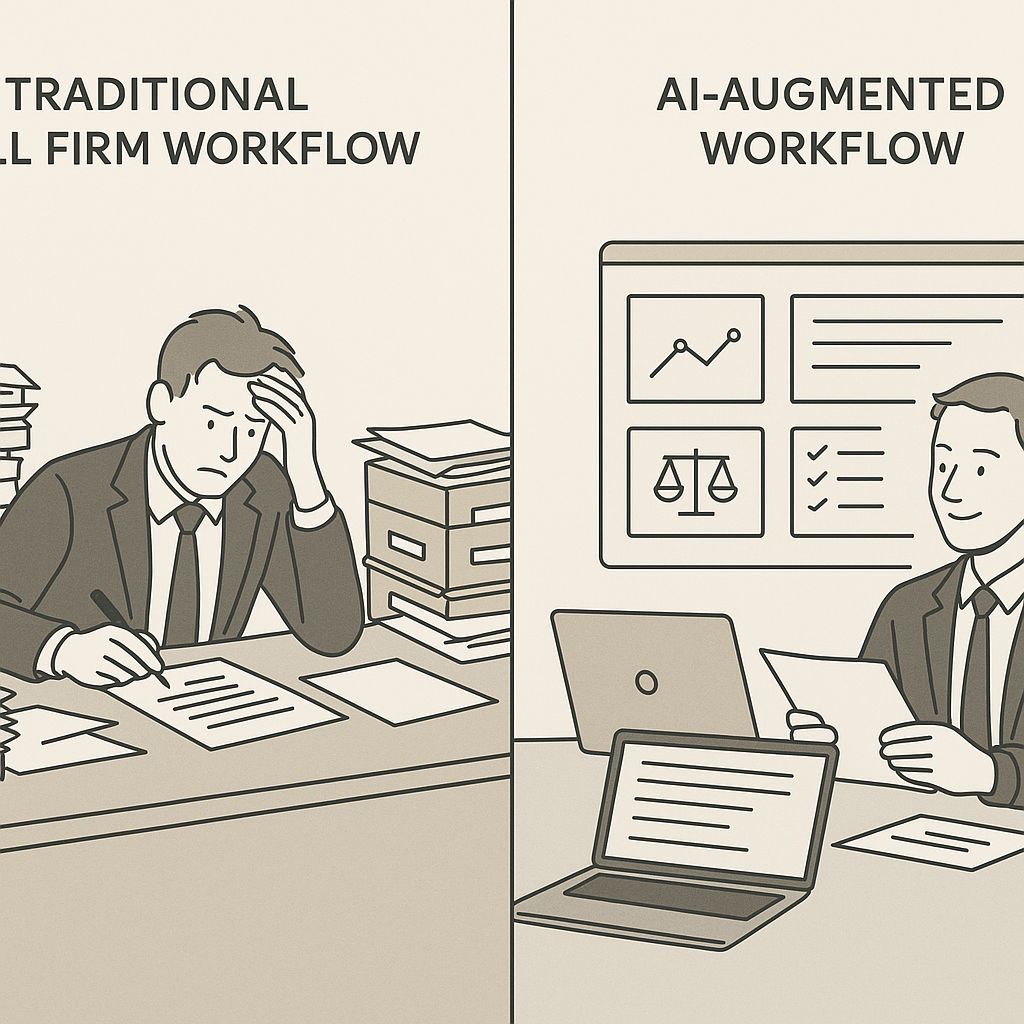
Cohort-style training that blends ethics, security, and hands-on workflows gives solos and small firms a practical way to keep up without building an internal “legal innovation” team. It is, in effect, fractional legal ops plus AI coaching for the smallest shops.
Inside the New AI Cohorts: From Prompting to Privacy
The new California initiatives and similar programs worldwide share a few themes that are particularly relevant to smaller practices:
1. Practical Prompting for Legal Workflows
Cohort curricula typically start with structured prompting for core legal tasks: research memos, contract clauses, discovery outlines, client letters, and checklists. Courses like Udemy’s “Generative AI for Contracting & Legal Drafting” illustrate how detailed and domain-specific this can get, offering hundreds of prompts tailored to CLM (contract lifecycle management), clause generation, redlining, and risk spotting. (udemy.com)
In the small-firm context, this translates directly to:
- Generating first drafts of engagement letters, NDAs, and demand letters.
- Creating playbooks for standard clauses and fallback positions.
- Using AI to summarize and compare contract versions before final attorney review.
2. Hallucination-Avoidance and Human-in-the-Loop Review
A central message of these programs is that AI must remain an assistant, not an autonomous decision-maker. Berkeley’s Power User course emphasizes “human-in-the-loop” workflows and teaches lawyers to critically assess output quality, navigate hallucinations, and turn AI missteps into teachable moments rather than liabilities. (executive.law.berkeley.edu)
Emerging research is reinforcing this discipline. A 2025 academic framework called “LegalGuardian,” for example, demonstrates how masking personally identifiable information (PII) before sending prompts to external LLMs can reduce confidentiality risk while maintaining high-quality outputs. (arxiv.org)
In training programs for solos and small firms, that theory becomes concrete practice:
- Using templates that strip or pseudonymize client data before sending to cloud tools.
- Building checklists for verifying citations, dates, and jurisdictional issues.
- Creating internal policies on where AI can and cannot be used in the matter lifecycle.
3. Secure Use of Chatbots, No-Code, and Low-Code Automation
Beyond drafting, many programs now introduce lawyers to no-code and low-code automation—tools like n8n, Power Automate, and legal-specific platforms that connect intake forms, databases, and document generators into repeatable workflows. Some California‑focused guides highlight tools like Gavel.io, which enables no-code document automation and client portals with strong encryption and compliance controls aimed at smaller firms. (nucamp.co)
For small firms and independent professionals, these skills can streamline:
- Client intake and conflict checks.
- Automatic population of court forms and routine agreements.
- Trigger-based sending of engagement letters and follow-up documents for e‑signature.
Connecting Training to Real-World Tools: Where QuickSign Fits
Training alone doesn’t modernize a practice; it has to be connected to tools that are affordable and usable for small teams. That’s where platforms like QuickSign.it come into play.
Unlike enterprise-focused solutions that charge per seat and bundle in complex feature sets small firms may never fully use, QuickSign.it is priced and designed for solos, boutiques, and independent professionals. The platform combines:
- AI Document Generation for everyday legal documents like contracts and NDAs—an ideal companion to the prompting skills taught in AI cohorts.
- Effortless sending: upload a PDF, drag and drop signature and form fields, and send for e‑signature in minutes.
- Real-time tracking so small teams can see when clients open, view, and sign documents.
- Flat-rate pricing at $15/month for the whole team, avoiding per-seat costs that quickly add up for growing practices.
For lawyers who complete AI training programs and start building automated workflows, the ability to plug AI-generated documents directly into a streamlined e-signature pipeline is critical. Cohorts that teach low-code automation often highlight integrating document generation, practice management, and e‑signature. QuickSign’s straightforward “upload → drag & drop → send” flow fits naturally into those automation chains without requiring a dedicated IT team.
And for firms just getting started, the FREE tier—offering 2 AI document generations and 1 document send to unlimited recipients—gives practitioners a low-risk way to experiment with AI-powered document workflows before rolling them out across the firm.
From Classroom to Practice: How Small Firms Can Act Now
For solos, small firms, and freelance legal professionals, the question is no longer whether AI will affect their practice, but how quickly they can adopt it safely. Cohort-style training programs offer a reasonable on-ramp, but the value comes from what happens after the course ends.
Here are practical steps small practices can take to connect training to daily document workflows:
- Start with one high-volume document type. Pick a common asset—like an NDA, simple services agreement, or engagement letter—and use AI skills from training to create a robust template and a library of approved clause variants.
- Define your hallucination-avoidance checklist. Based on what you learned in your cohort or bootcamp, create a repeatable review process: verify citations, re-check party names and dates, and compare AI-generated language to your firm’s existing standards before sending to clients or opposing counsel.
- Automate the last mile with e-signature. Once a draft is attorney-approved, use a tool like QuickSign.it to standardize how documents are sent, signed, and tracked. This ensures that the time saved upstream in drafting isn’t lost to manual emailing and follow-ups downstream.
- Pilot low-code workflows in one practice area. Apply the low-code skills from your training to build a small workflow—for example, an intake form that populates a retainer agreement, which is then pushed directly to QuickSign for signature. Iterate based on feedback from real matters.
- Document your AI policy. Use templates from your training cohort to write an internal AI policy covering confidentiality, approved tools, supervision standards, and client communication. This not only supports ethical compliance but also reassures clients that AI is being used responsibly.
What’s Next: AI Literacy as a Competitive Edge
Looking ahead to 2026 and beyond, AI literacy is quickly becoming a baseline competency for lawyers, not a niche specialization. The expansion of targeted programs—from California-based cohorts like Law Tech AI’s to global online courses and university-backed bootcamps—signals that the profession is standardizing around a few core skills: practical prompting, hallucination management, secure data handling, and workflow automation. (lawnext.com)
For small firms, the advantage lies in agility. Without layers of bureaucracy, solos and small partnerships can translate new skills into new workflows in weeks, not years—particularly when paired with modern tools that respect small-business economics.
Platforms like QuickSign.it give those firms a concrete way to operationalize what they learn in AI training: generate documents with AI, send them for e‑signature in a few clicks, track status in real time, and do it all on a flat-rate budget designed for small teams.
Looking for an affordable e-signature solution? Try QuickSign for free - no credit card required.