Contract Automation Finally Reaches Solo and Small Law Practices
Discover how contract automation is transforming every small law firm, cutting admin work, boosting accuracy, and freeing lawyers to focus on clients.

Contract Automation Finally Reaches Solo and Small Law Practices
After years of being priced and designed for Big Law, contract automation is rapidly becoming accessible to solo and small law firms. New browser-based tools, AI‑assisted drafting, and small‑firm–friendly pricing tiers are transforming how smaller practices create, review, and manage routine agreements—turning what used to be manual Word templates into scalable, repeatable services.
Why Contract Automation Matters Now for Small Firms
Multiple industry surveys show that AI and automation have moved from buzzword to baseline in legal practice—especially in documents and contracts. A 2025 State of Law report focused on small firms found that generative AI adoption among solo and small practices nearly doubled in a year, jumping from 27% in 2023 to 53% in 2024 as lawyers looked for ways to reduce manual work and improve margins. (lawnext.com)
More broadly, legal AI tools are most heavily used for document review and drafting. One recent analysis of AI in law reports that 77% of lawyers using AI rely on it for document review, and 74% for summarization—areas closely tied to contract work. (allaboutai.com) This is no longer experimental technology: it’s a response to intense price pressure on routine matters.
At the same time, small businesses in general are racing to adopt AI. A 2025 U.S. Chamber of Commerce survey found that 58% of small businesses now use generative AI, up from 40% in 2024, largely via affordable software-as-a-service tools instead of custom systems. (kiplinger.com) For solo and small law practices, that means clients are increasingly expecting the same speed, transparency, and digital convenience from their lawyers that they get from the rest of their business software.
For small firms, contract automation is no longer about “innovation”—it’s about keeping pace with clients who already expect AI‑level efficiency from every service provider they use.

From Manual Word Templates to Browser-Based Workflows
Historically, contract automation for law firms meant expensive, on‑premise document assembly systems or complex template libraries that demanded IT support and dedicated training. For solo practitioners and firms under 10 lawyers, the return on investment often wasn’t there.
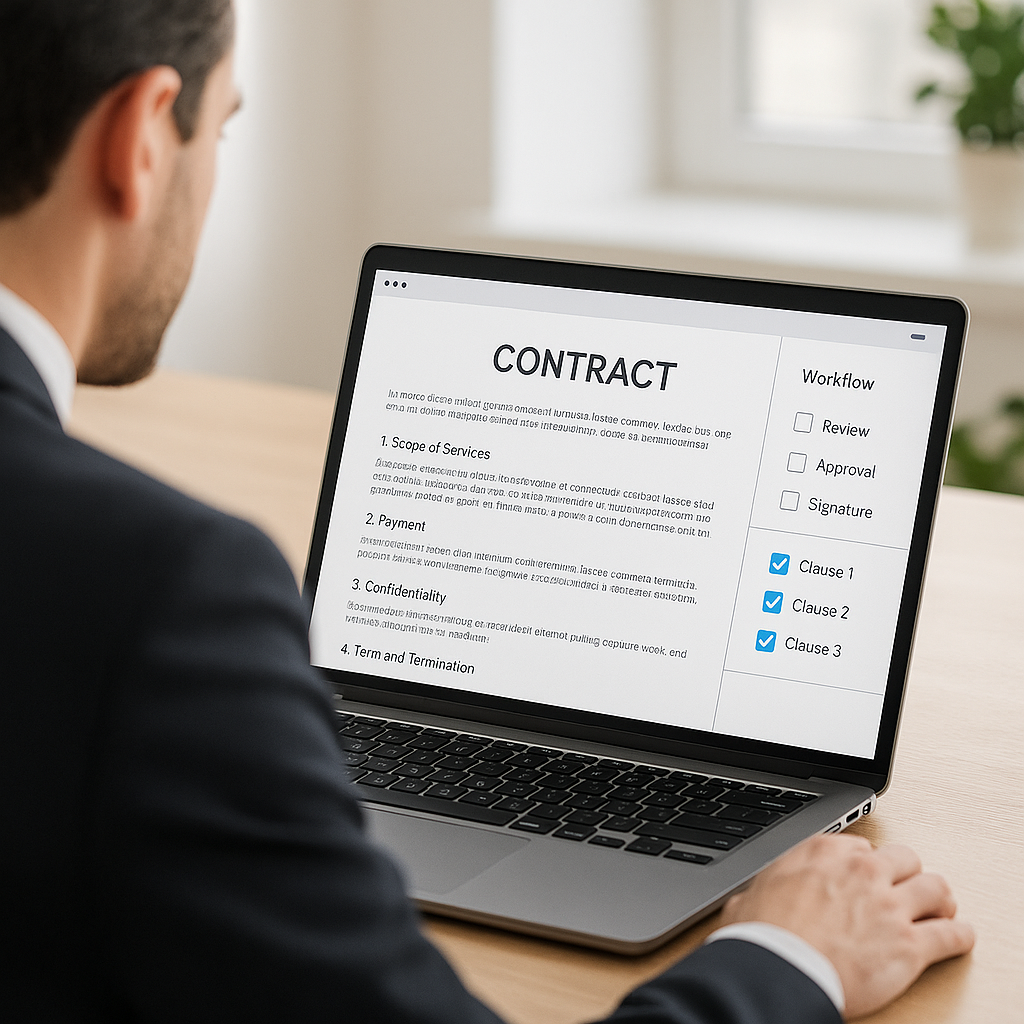
That barrier is eroding quickly. Newer tools—many of them browser‑based with no installation required—offer:
- Template‑driven drafting with web forms that feed directly into contract clauses
- Clause suggestion engines that surface alternative language based on risk level or deal type
- Embedded playbooks that codify a firm’s preferred positions, fallbacks, and red‑flag rules
- Client intake questionnaires that non‑lawyers can complete on their own devices, creating first drafts automatically
Industry analysts tracking AI legal drafting tools note that law firms are adopting these systems to “reduce manual workloads, minimize errors, and improve efficiency in handling complex legal documentation,” with contract creation singled out as a primary beneficiary. (thebusinessresearchcompany.com) While large firms were early adopters, data reveals that small firms are rapidly closing the gap as cloud and browser-based options lower the cost and technical complexity.
Playbooks and Clause Libraries Built for Small Law
One of the most significant shifts is the move from generic templates to structured playbooks tailored specifically to small law firm workflows. Instead of simply reusing old Word documents, firms can now define:
- Standard clauses for core practice areas (e.g., commercial leases, professional services agreements, NDAs)
- Acceptable “fallback” language for negotiations
- Client‑type variations (startup vs. established vendor, landlord vs. tenant, prime vs. subcontractor)
- Jurisdiction‑specific options for governing law, venue, and dispute resolution
AI‑enabled tools can then suggest appropriate clauses based on a short intake or a few key variables. According to recent legal tech trend reporting, AI‑assisted document creation has become one of the top three areas being transformed in law practice, along with research and e‑discovery. (browse-ai.tools) For a small firm drafting dozens of similar agreements per month, that can mean hours saved per engagement.
Intake Questionnaires that Turn Conversations into Contracts
Another increasingly common feature is the use of guided intake questionnaires—either embedded in a firm’s website, sent via secure links, or built into practice management systems. Clients answer structured questions about parties, scope, term, and payment, and the system pushes that data into a contract template.
For solo and small practices that serve small-business clients—government contractors, consultants, cleaning companies,
Pricing Tiers Designed for Solo and Small Practices
Cost has traditionally been the biggest barrier to contract automation. Many early tools were priced per seat and aimed at enterprise users. Surveys of AI adoption in law consistently show that solo and small firms lag larger organizations in broad deployment, due in large part to budget constraints and perceived implementation complexity. (allaboutai.com)
That is changing with the rise of flat‑rate and usage‑based models tailored to smaller teams. Instead of buying 10–20 licenses, a three‑lawyer firm can pay a single monthly fee to access browser‑based contract automation and e‑signature capabilities for the entire team.
Platforms like QuickSign are emblematic of this shift. Unlike enterprise-focused solutions that charge per user, QuickSign offers a flat-rate $15/month plan for the whole team, plus a free tier that includes two AI document generations and one document send to unlimited recipients. That kind of predictable pricing is critical for solo practitioners and small firms that want automation without committing to large software spend.
Where E‑Signature Fits: Connecting Drafting to Execution
Automation doesn’t stop at the draft. For small firms, the real gains come when contract creation, review, approval, and signature flows are tied together end‑to‑end.
QuickSign.it positions itself as an affordable e‑signature hub that small firms can plug directly into their contract automation workflows. Lawyers or staff can:
- Use AI Document Generation to draft common agreements such as NDAs or services contracts
- Upload an existing PDF, drag and drop signature and date fields, and send in minutes
- Track document status in real time—who has opened, viewed, or signed each agreement
Because QuickSign’s free tier supports sending a contract to unlimited recipients, it fits neatly into small‑firm scenarios like subcontractor networks, vendor onboarding, or multi‑party settlements—without multiplying per-seat costs.
Practical Takeaways for Small Law Firm Workflows
For solo and small law practices considering contract automation, the current market dynamics highlight several practical steps:
-
Start with one high‑volume contract type.
Look at the agreements you draft or review most often: NDAs, engagement letters, services agreements, or government subcontracting templates. Automating 60–70% of a single document type often yields better ROI than partially automating everything.
-
Codify your playbook before you automate.
Write down standard positions, acceptable fallbacks, and true deal‑breakers. Many of the new tools can encode these as conditional logic or clause suggestions, but they still need your expertise as the foundation.
-
Use client intake questionnaires to reduce back‑and‑forth.
Replace long email threads with structured forms. Even a simple web form that captures party names, scope, and payment terms can feed directly into a contract template or AI generation workflow.
-
Connect drafting to signature, not just to Word.
A contract that still needs to be printed, signed, scanned, and emailed negates much of the automation benefit. Tools like QuickSign close the loop by turning your draft into a signable, trackable document in a single workflow.
-
Watch ethics and quality controls.
Bar associations and courts continue to stress lawyer responsibility over AI output. Several legal tech commentators highlight the need for audit trails and human review, especially after high‑profile cases of AI‑generated hallucinations in legal filings. (lawnext.com) Build checklists and review steps into your automated processes.
How QuickSign Fits into the Small-Firm Contract Stack
As more small firms embrace AI‑assisted drafting and automated templates, e‑signature becomes the natural front door and backstop for contract workflows. This is the niche QuickSign.it is aiming to serve.
Because QuickSign combines AI Document Generation with a streamlined send‑and‑sign experience, a lawyer at a three‑person firm can move from intake questionnaire to signed agreement in a few steps:
- Use AI to generate a first draft NDA or services contract based on client inputs
- Review and edit in your preferred editor, adding your firm’s standard clauses and risk positions
- Upload the final PDF to QuickSign, drag‑and‑drop signature fields, and send to all parties
- Monitor signing in real time via QuickSign’s tracking dashboard
For practices that already rely on lightweight practice management or CRM tools—and don’t want the cost or complexity of full‑blown enterprise contract lifecycle management—QuickSign’s flat $15/month for the entire team offers a budget‑friendly way to modernize the last mile of the contract process.
Looking Ahead: Automation as a Revenue Strategy, Not a Threat
Some small-firm lawyers still worry that contract automation will commoditize their work. Yet industry data suggests the opposite: firms that adopt AI and automation are often able to shorten contract cycles by 30–40%, reclaim weeks of working time annually, and refocus on higher‑value advisory services. (allaboutai.com)
For solo and small law practices, the opportunity is to package routine contracts—vendor agreements, consulting contracts, subcontractor NDAs—into fixed‑fee products supported by automated templates, playbooks, and e‑signature. That combination can make services more affordable for small-business clients while preserving or even improving profitability for the firm.
Contract automation has finally reached a price point and feature set that makes sense outside of Big Law. The firms that move now—standardizing templates, adopting browser‑based tools, and integrating affordable e‑signature solutions like QuickSign—will be best positioned to serve the next generation of small-business clients who expect their legal services to be as fast and digital as the rest of their operations.
Looking for an affordable e-signature solution? Try QuickSign for free - no credit card required.