Digital Skills Gap Persists as AI Document Tools Proliferate for Small Teams
Discover why the digital skills gap persists as AI document tools surge, and how small teams can drive digital transformation with smarter workflows.

Digital Skills Gap Persists as AI Document Tools Proliferate for Small Teams
AI-powered tools for contracts, proposals, and document management are advancing at a remarkable pace, promising faster deals and leaner operations for small businesses. Yet a growing body of research shows that many small teams, freelancers, and early-stage startups still lack the digital skills, training, and processes needed to benefit from this new wave of automation.
While document automation and e-signature platforms are becoming more affordable and more powerful, experts warn that the “skills and process gap” is widening: the tools exist, but many small organizations are struggling to turn them into everyday productivity gains.
AI Adoption Is Rising, But Capabilities Lag Behind
Recent surveys underscore the tension between enthusiasm for AI and the reality of limited skills on the ground. An OECD survey of more than 5,000 SMEs across seven countries found that about 31% of small and medium-sized enterprises are already using generative AI, and many report that it helps compensate for skill gaps and labor shortages.(oecd.org)
At the same time, other research shows that lack of skills remains a top barrier to effective AI use. A SoftwareOne report on cloud and AI readiness found that 53% of U.S. companies say they lack the skills needed to leverage AI effectively, making skills shortages one of the biggest obstacles in their digital transformation efforts.(softwareone.com)
Small businesses, in particular, feel this strain. A European Commission survey of SMEs across the EU found that three-quarters (74%) face skills shortages in at least one job role, and nearly half (45%) say these shortages directly hinder their adoption of digital technologies.(digital-skills-jobs.europa.eu) For many, that includes foundational tools such as digital document workflows, e-signatures, and contract automation.
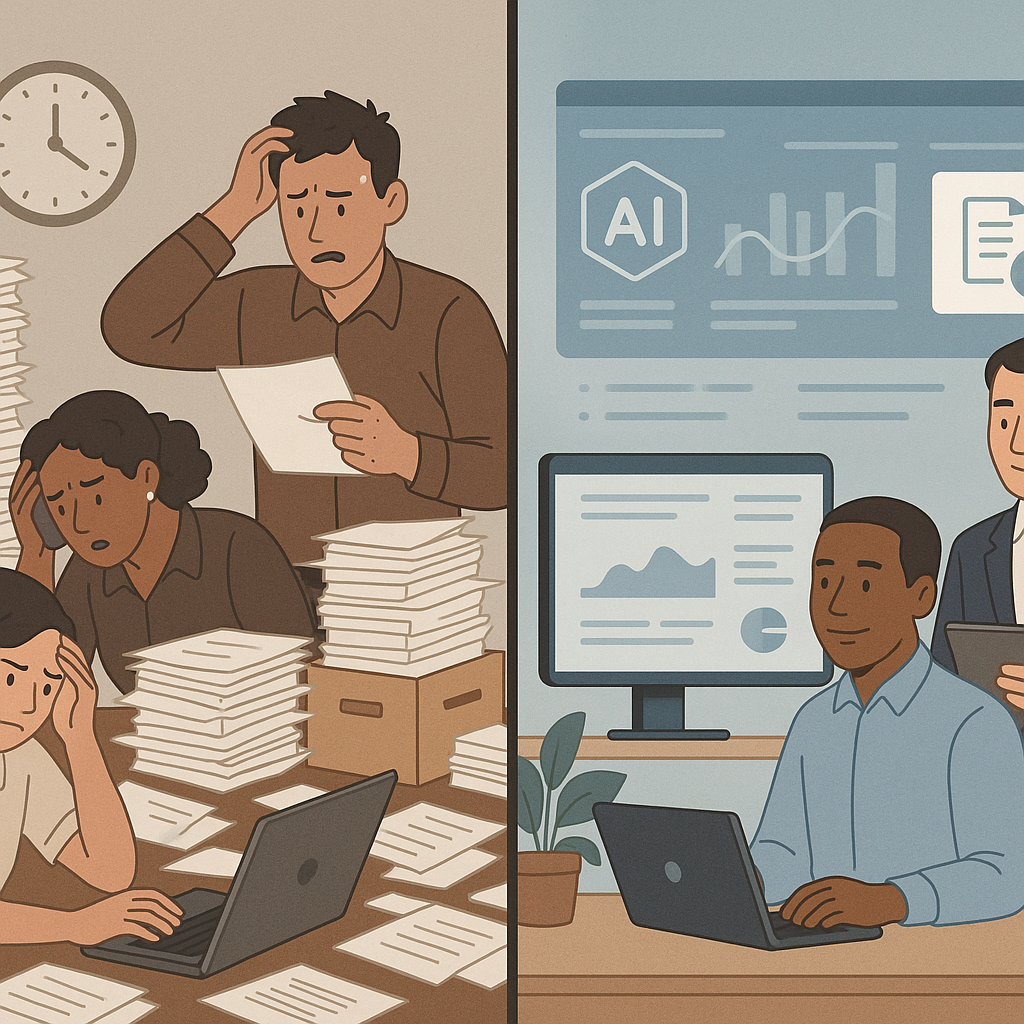
The paradox for small teams in 2025 is clear: AI tools for documents and contracts are more accessible than ever, but the digital capabilities to deploy them well are still unevenly distributed.
Why This Matters for Small Businesses and Freelancers
For solo professionals and small teams, contracts and documents are where work becomes revenue: proposals, scopes of work, NDAs, MSAs, invoices, and renewals. Delays or errors in this layer directly affect cash flow and client trust.
Yet research suggests that many small businesses are still catching up in broader digital skills. VistaPrint’s 2024 “Hobby to Hustle” report, for instance, found that more than half of small business owners describe themselves as “not skilled at all” or only “slightly skilled” in key digital areas like branding, marketing, and design.(smallbusinessanswers.com.au) Similar patterns show up in security and IT, where Sophos data indicates that 96% of SMBs lack at least one critical cybersecurity skill.(itpro.com)
These gaps don’t stop at marketing or security—they spill over into how teams handle contracts and documentation:
- Complex tools go underused. Feature-rich contract platforms can overwhelm non-technical users who just need a simple, reliable way to send a contract and get it signed.
- Inconsistent processes. Without clear workflows or templates, each new contract may be built from scratch, adding risk and slowing down approvals.
- Fragmented toolsets. Many SMBs juggle multiple apps for proposals, signatures, storage, and tracking—raising both the learning curve and the chance of errors.
Still, small businesses know digital tools are now essential. Sage’s 2024 “Small Business, Big Opportunity” survey reports that 73% of U.S. SMBs have increased digital investments, with nearly half citing operational efficiency gains as a key driver of growth.(
s://www.sage.com/en-us/news/press-releases/2024/11/us-smbs-show-high-confidence-as-digital-transformation-drives-growth/?utm_source=openai" target="_blank" rel="noopener noreferrer">sage.com) The challenge is less about willingness to adopt technology and more about knowing how to make it work in lean, time-poor teams.Document Automation Is Improving Faster Than Onboarding
In the document and contract space, generative AI and automation are transforming what’s technically possible:
- AI models can now draft first-pass NDAs, service agreements, and scopes of work in minutes.
- Template-based systems can standardize clauses, pricing tables, and signatures across a business.
- Integrated e-signature platforms can track who has opened, viewed, or signed a contract in real time.
But as various AI adoption studies show, skills shortages and process gaps remain the number-one friction point. A recent synthesis of small business AI statistics notes that skills gaps are the top barrier to AI adoption for 46% of business leaders, even as usage climbs and most current AI users report substantial time savings.(usmsystems.com)
Industry experts argue that the document-automation sector has, until recently, been geared toward larger enterprises with in-house legal teams and IT support. That model assumes the presence of specialists who can own configuration, training, and governance—resources many freelancers and micro-businesses simply don’t have.
For a five-person agency or a solo consultant, “adoption” doesn’t mean a six-month rollout—it means being able to generate a contract, send it for signature, and track it the same day they sign up.
The New Priority: Lightweight Training, Templates, and Playbooks
Emerging research on SMEs and AI emphasizes that investments in tools must be matched with investments in human capabilities. OECD’s generative AI study notes that, while AI can help compensate for skill gaps, structured support is needed to ensure that the gains are widely shared and that smaller firms are not left behind.(oecd.org)
For document automation, that support often looks less like formal “training programs” and more like embedded guidance:
- Ready-to-use templates. Pre-built, legally informed templates for common use cases—NDAs, simple service agreements, contractor agreements, and renewals—reduce the need for teams to draft from scratch.
- In-product education. Tooltips, checklists, and short onboarding flows that teach best practices exactly when users are performing tasks.
- Process playbooks. Simple, role-based guides—“How our agency sends a proposal in five steps,” for example—that translate complex functionality into a repeatable routine.
- Low-friction testing. Generous free tiers or sandboxes where teams can experiment with AI-generated documents and e-signatures before committing budget or rolling out to clients.
This type of lightweight enablement can make the difference between AI-powered document tools that sit idle in a browser tab and workflows that genuinely improve turnaround times and reduce risk.
How QuickSign.it Helps Small Teams Bridge the Gap
As AI becomes embedded in everyday business software, platforms built specifically for small teams have a distinct advantage: they can design around the real constraints of freelancers, agencies, and micro-businesses—limited time, limited budget, and limited appetite for complexity.
QuickSign positions itself squarely in this space, focusing on streamlined, affordable e-signature and document workflows for small organizations rather than enterprise-scale deployments. Several aspects of the platform directly respond to the skills and process gaps highlighted in recent research:
- AI Document Generation for contracts and NDAs. Instead of expecting users to start from a blank page, QuickSign’s AI-powered document generation lets small businesses create common legal documents in minutes, guided by structured prompts. That reduces the need for advanced legal or technical skills and gives teams a consistent starting point for each deal.
- Effortless sending workflow. The core e-signature flow—upload a PDF, drag and drop signature and form fields, then send—is intentionally simple. This helps busy professionals adopt digital signing without needing deep training or IT support.
- Real-time tracking. Built-in status updates—who has received, opened, or signed—give small teams the same visibility that larger organizations get from complex contract lifecycle tools, but without the overhead.
- Affordable, predictable pricing. Unlike enterprise-focused solutions that charge per seat, QuickSign offers a flat-rate plan at $15 per month for the whole team, plus a free tier that includes 2 AI document generations and 1 document send to unlimited recipients. That cost structure lowers the barrier to experimentation and team-wide adoption.
Because tools like QuickSign are designed for non-specialists, the platform effectively bakes lightweight onboarding into the product itself. For many small businesses, this approach may be more realistic than formal training programs that require time and budget they simply don’t have.
Practical Steps for Closing the Skills Gap in Document Workflows
For small businesses and freelancers looking to turn AI document tools into tangible productivity gains, experts point to a few practical strategies:
1. Start With One or Two High-Impact Use Cases
Rather than attempting a wholesale “digital transformation” of all documents at once, identify the workflows where delays hurt most—often proposals, service agreements, or onboarding packets—and focus on those first. Use AI document generation to standardize templates for these critical interactions and build a simple, documented process around them.
2. Build Micro-Playbooks, Not Manuals
For very small teams, multi-page policy documents rarely get read. Instead, create concise playbooks:
- “How we send a new-client agreement” (5–7 bullet points).
- “How we follow up on unsigned proposals after three days.”
- “How we store and tag signed contracts.”
Align these playbooks with the actual steps inside your e-signature and document tool so that each guideline maps to a specific screen or action.
3. Use Templates Relentlessly
Templates are one of the easiest ways to reduce both risk and training overhead. Once you have a contract structure that works, lock it in as a reusable AI prompt or platform template. This lets junior staff or new hires send compliant, on-brand documents without needing to understand every underlying clause.
4. Make Skills-Building Part of Daily Work
Surveys of SMEs show that training investments are increasingly critical to closing digital skills gaps, but they don’t always need to be formal.(digital-skills-jobs.europa.eu) Encourage short, task-based learning: a 10-minute session on how to customize AI-generated clauses, or a quick review of how to use status tracking to prioritize follow-ups.
5. Consolidate Where Possible
Multiple studies highlight that SMBs are often managing a patchwork of digital tools and would prefer a more integrated approach.(prnewswire.com) By consolidating drafting, sending, signing, and tracking into a single platform, businesses can reduce the training burden and the likelihood of errors from moving files between disconnected systems.
The Road Ahead: AI-Powered, Human-Centered Document Work
The message from current research is not that small businesses are falling behind on technology—if anything, they are investing more heavily in digital tools and AI than ever before.(sage.com) The real gap is between what the tools can do and what small teams are realistically prepared and trained to use.
In the document and contract domain, that means the next wave of innovation will be judged not just on how powerful AI features are, but on how seamlessly they fit into the daily lives of non-technical users. Platforms that combine AI document generation, intuitive e-signature workflows, and built-in guidance—at price points that make sense for freelancers and small teams—are likely to set the pace.
Looking for an affordable e-signature solution? Try QuickSign for free - no credit card required.