DocuSign Pushes Beyond E‑Signatures with AI-Powered Intelligent Agreement Management
Discover how DocuSign is transforming contracts with AI-powered Intelligent Agreement Management, pushing beyond e-signatures to streamline every agreement.

DocuSign Pushes Beyond E‑Signatures with AI-Powered Intelligent Agreement Management
DocuSign is accelerating its strategic shift from electronic signatures to full‑scale contract intelligence, rolling out an Intelligent Agreement Management (IAM) platform powered by its new DocuSign Iris AI engine. Positioned as an end‑to‑end system for creating, negotiating, signing, and managing agreements, IAM underlines DocuSign’s bid to be seen less as a point‑solution for signatures and more as the core operating layer for enterprise contracts.
Why This Matters for Business Professionals
For most organizations, contracts remain one of the least digitized yet most business‑critical assets. Revenue, supplier terms, compliance obligations, and risk exposure all live inside agreements that are often scattered across systems and teams. DocuSign’s move into Intelligent Agreement Management directly targets this gap, promising to automate:
- Contract review and redlining with AI‑driven suggestions
- Compliance checks against policies and regulatory frameworks
- Identity verification and authentication of signers
- Risk scoring and flagging of unusual terms or exposures
The company’s recent financial disclosures and product announcements show that IAM is not a side experiment—it is now the centerpiece of DocuSign’s growth strategy. In its fiscal Q4 2025 results, DocuSign credited “rapid traction” of the AI‑driven IAM platform as a key driver behind stronger‑than‑expected earnings and nearly 20% share price gains. (barrons.com)
Key takeaway: The e‑signature box has been checked. The next competitive battleground is who controls the intelligence and workflows around every contract in the business.
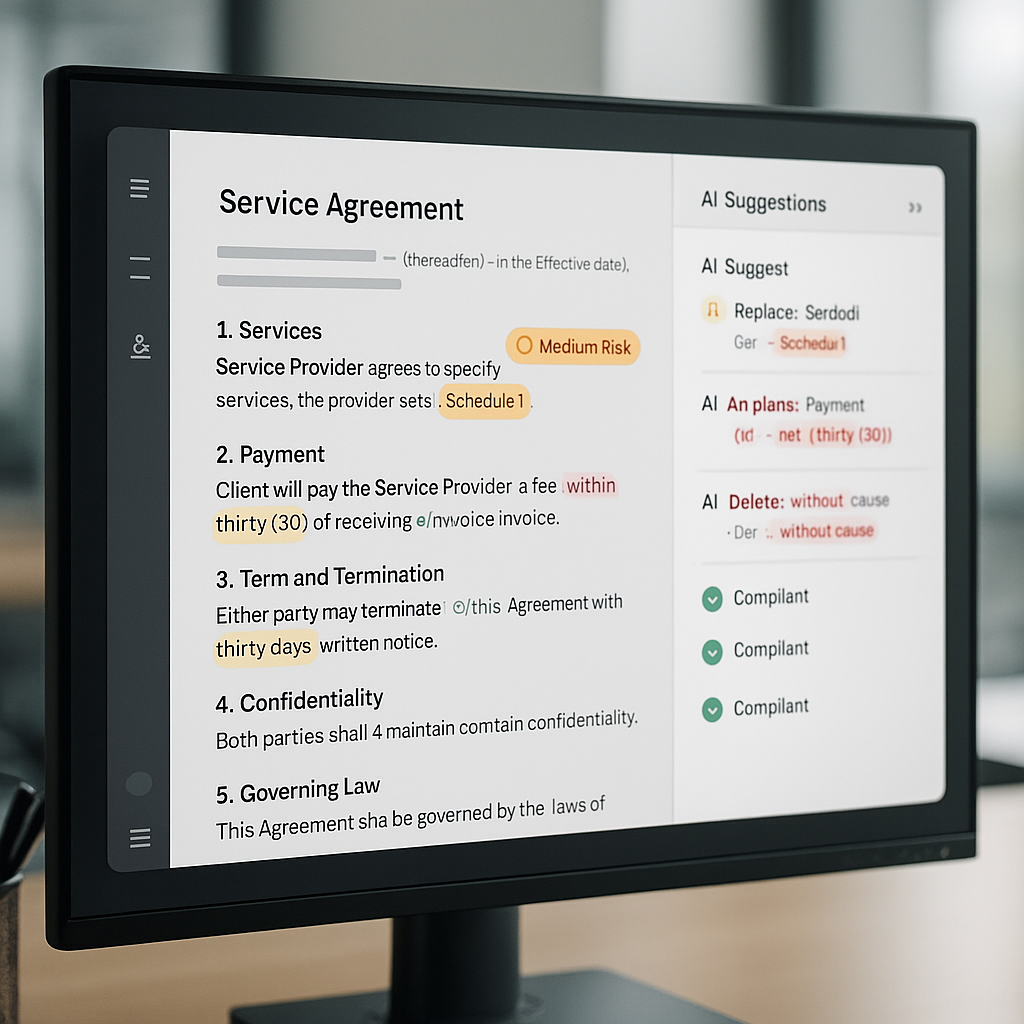
Inside DocuSign’s Intelligent Agreement Management Platform
DocuSign Iris: The AI Engine Behind IAM
At the core of DocuSign’s latest push is DocuSign Iris, an AI engine that powers analysis and automation across the agreement lifecycle. Iris draws on DocuSign’s extensive corpus of contract workflows and two decades of domain expertise to deliver:
- Automated contract review – AI can highlight non‑standard clauses, suggest edits based on playbooks, and answer natural‑language questions about obligations or risks.
- Policy and compliance checks – Contracts can be evaluated against internal standards and industry regulations, flagging deviations before signature.
- Risk flagging – Iris surfaces outlier terms (e.g., indemnity, liability caps, payment terms) and can assign risk levels across large portfolios of agreements.
- Lifecycle analytics – The system tracks how long contracts spend in each stage, where bottlenecks occur, and where terms are consistently negotiated.
DocuSign has framed Iris as “the culmination of [its] unique agreement domain expertise,” built from millions of workflows and an expanding set of AI models tailored to contracts. (investor.docusign.com)
End‑to‑End Coverage: From Draft to Renewal
IAM is designed to cover the entire lifecycle rather than just the moment of signature. DocuSign CLM—its contract lifecycle management solution—is now explicitly described as being “powered by the Intelligent Agreement Management platform,” supporting:
- Document generation using templates, clause libraries, and structured data
- Collaborative negotiation with redlines, versioning, and approvals
- Automated workflows (via tools like Maestro) that route agreements across finance, legal, sales, and procurement
- Execution through integrated e‑signature
- Post‑signature tracking of obligations, renewals, and performance metrics
Analyst firm IDC recently named DocuSign a Leader in its 2025 MarketScape for AI‑enabled buy‑side CLM, citing the vendor’s ability to unify fragmented processes on the IAM platform and its “mature, domain‑specific AI for contract review, clause analysis, and risk management.” (docusign.com)
Platform Extensions, Developers, and Ecosystem
DocuSign is also turning IAM into a broader ecosystem. At its Docusign Discover developer event and related announcements, the company introduced Docusign for Developers and new Agreement APIs that expose IAM capabilities—such as workflow automation via a Maestro API—to external applications. (investor.docusign.com)
On the AI front, DocuSign is integrating IAM directly into ChatGPT using the Model Context Protocol (MCP). This allows users and AI agents to, for example, draft vendor contracts, identify agreements above certain thresholds, and generate renewal letters—all within the ChatGPT interface, backed by DocuSign’s IAM engine. (
PT/default.aspx?utm_source=openai" target="_blank" rel="noopener noreferrer">investor.docusign.com)Strategic shift: By embedding IAM into tools like ChatGPT and opening APIs to developers, DocuSign is positioning itself as infrastructure—not just an app—for agreement workflows.
Strategic Context: From Signatures to Contract Intelligence
A Transformational Year for DocuSign
DocuSign’s pivot toward IAM has been building for several quarters. CEO Allan Thygesen has repeatedly described fiscal 2025 as a “transformative year” centered on the launch and expansion of the IAM platform. (barrons.com)
Key moves in this strategy include:
- Acquisition of Lexion – In 2024, DocuSign acquired AI‑powered agreement management startup Lexion to deepen its AI capabilities in review, search, and workflow automation. The deal brought advanced document understanding technology into IAM to speed contract negotiations and insights. (investor.docusign.com)
- Expanded AI contract agents – DocuSign has introduced purpose‑built AI agents for contracts, designed to accelerate workflows and reduce risk by automating repetitive agreement tasks across departments. (investor.docusign.com)
- New partner program – A refreshed partner program and IAM‑focused training are intended to help system integrators and resellers build services on top of the platform, extending its reach into specialized industries and use cases. (investor.docusign.com)
Notably, the transition has come with short‑term financial turbulence. Earlier in 2025, DocuSign’s stock dropped sharply after it cut billings guidance, citing a faster‑than‑expected impact from foundational changes tied to IAM and AI. However, subsequent quarters have shown that once customers adopt the platform, the AI‑led model can drive higher value and renewed investor confidence. (investopedia.com)
What This Means for the E‑Signature and CLM Industry
From Tools to Platforms
DocuSign’s IAM push reflects a broader industry trend: e‑signatures are now table stakes. Vendors are competing on how deeply they can integrate into business systems, how much intelligence they can extract from agreements, and how well they can orchestrate complex workflows.
Key shifts include:
- Contract data as a first‑class asset – AI engines like Iris treat contracts not as static PDFs but as structured data sources. This enables companies to query obligations, benchmark terms across suppliers, and proactively manage risk.
- AI‑assisted negotiations – Instead of simply routing documents for approval, platforms increasingly suggest redlines, alternative clauses, and fallback positions informed by historical outcomes.
- Embedded experiences – IAM capabilities are being exposed inside CRMs, ERPs, procurement suites, and now conversational interfaces like ChatGPT, reducing context switching for business users.
Competitive Pressure and Ecosystem Opportunities
For competitors in e‑signature and CLM, DocuSign’s IAM strategy raises the bar. Point solutions focused solely on signing or basic repository functions will likely face mounting pressure to either deepen their AI capabilities or specialize in narrow verticals.
At the same time, the rise of IAM platforms opens new opportunities for partners, developers, and complementary vendors—ranging from identity verification providers to analytics platforms—that can plug into these ecosystems and extend their value.
Implications for Businesses Using E‑Signatures Today
From Digital Signatures to Digital Contract Operations
For organizations that already use DocuSign or similar tools purely for e‑signatures, the IAM era invites a more strategic question: What would it look like to treat contracts as a managed, intelligent workflow—rather than a series of ad hoc documents?
Practical implications include:
- Re‑evaluating contract workflows – Mapping how agreements move from request to renewal can uncover where AI‑driven automation and risk checks could reduce cycle times and errors.
- Aligning legal, procurement, and revenue teams – IAM platforms work best when stakeholders agree on playbooks, clause standards, and approval rules that AI can enforce.
- Data governance and security – As contract data becomes more accessible via AI and APIs, organizations will need robust policies around access control, retention, and auditability.
- Change management – AI‑assisted review and negotiation will change how lawyers, sales teams, and finance teams work day‑to‑day. Training, guardrails, and clear escalation paths are essential.
For business leaders: The question is no longer “Should we digitize signatures?” but “Which parts of our contracting process can and should be delegated to AI, and what controls do we need in place?”
Balancing Enterprise Platforms with Agile Solutions
While DocuSign IAM aims squarely at mid‑market and enterprise buyers, many organizations—particularly smaller teams or specific departments—still need lighter‑weight tools for document generation and signature workflows. That’s where agile providers such as QuickSign come in.
QuickSign, for example, focuses on making it simple to generate and send documents for signature with minimal setup and friction, offering a streamlined experience compared to full‑scale enterprise CLM. For teams that are not yet ready for a multi‑year IAM transformation, pairing a core e‑signature and document solution like QuickSign with targeted AI initiatives can be a pragmatic path forward.
Looking Ahead: AI Contracts as a New Operating Layer
DocuSign’s Intelligent Agreement Management strategy—and the Iris AI engine that underpins it—underscores a shift in how businesses think about contracts. Instead of being static records filed away after signing, agreements are becoming a living data layer that informs decisions across procurement, sales, finance, and compliance.
As DocuSign deepens its integrations with platforms like ChatGPT and extends IAM capabilities through APIs and partners, expect AI contracts to feel less like a standalone tool and more like a pervasive capability woven into everyday business applications.
For business professionals, the takeaway is clear: the next competitive advantage will come from how intelligently and proactively your organization manages the agreements that govern everything—from vendor spend to customer revenue and regulatory exposure.
Conclusion & Call to Action
DocuSign’s push beyond e‑signatures with Intelligent Agreement Management marks a decisive moment for the contract technology market. AI‑powered review, compliance checks, identity verification, and risk flagging are rapidly becoming baseline expectations for modern agreement workflows.
Whether you’re ready to explore an enterprise‑grade platform like DocuSign IAM or you’re just beginning to modernize how you generate and sign documents, now is the time to reassess your agreement stack.
For teams looking for a fast, low‑friction starting point, consider trying an agile solution such as QuickSign alongside your broader strategy. It’s an easy way to experiment with streamlined digital document workflows before committing to a full IAM transformation.
Try QuickSign for free - generate 2 documents and send 1 document to unlimited recipients at no cost