Docusign’s December 2025 eSignature Release Bets Big on AI — and EU-Grade Qualified Signatures
Discover how Docusign’s December 2025 eSignature release uses AI and EU-grade qualified signatures to boost security, compliance, and signing speed.

Docusign’s December 2025 eSignature Release Bets Big on AI — and EU-Grade Qualified Signatures
Docusign has pushed its latest eSignature update, version 25.4.00.00, to demo and production environments, rolling out a redesigned sending experience, AI-assisted agreement summaries and Q&A on mobile, and a new “Flexible EU QES” capability that lets signers choose their preferred qualified trust service provider. The December 2025 release also tightens reporting accuracy and refreshes certificate authorities for standards-based signatures in France, underscoring Docusign’s effort to keep pace with Europe’s strict e-signature regulations while maintaining a modern user experience. (community.docusign.com)
Why This Release Matters for Digital-First Businesses
For many organizations, e-signature tools are now mission-critical infrastructure. From sales contracts to HR onboarding, a growing share of high-value agreements are born digital, routed via automated workflows, and stored in the cloud. Docusign’s December 2025 release reflects two converging pressures on this infrastructure:
- Regulatory rigor in the EU, especially around Qualified Electronic Signatures (QES) under eIDAS, which carry the highest legal weight and must integrate with accredited trust service providers.
- Rising expectations for AI and usability, as users increasingly expect smart assistance, simple sending flows, and consistent experiences across desktop and mobile.
Against that backdrop, the update is not just an incremental version bump. It signals how incumbent providers intend to defend market share through AI features and compliance depth—while opening space for newer, more affordable platforms such as QuickSign.it to differentiate on simplicity, pricing, and speed of innovation for small businesses.
Inside Docusign eSignature 25.4.00.00
Flexible EU QES: Giving Signers a Choice of Trust Service Provider
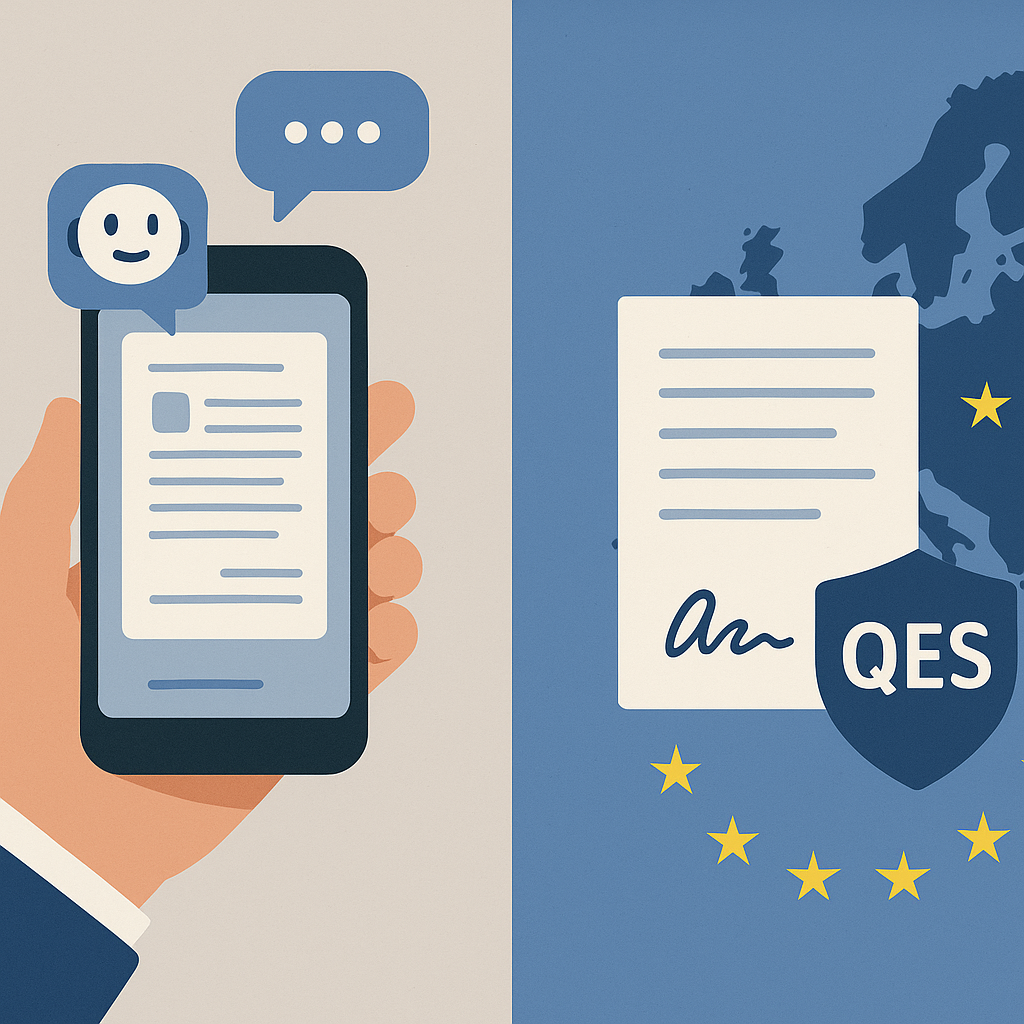
The headline regulatory feature in this release is Flexible EU QES. Docusign describes this as a streamlined process for Qualified Electronic Signatures that allows recipients to select their preferred trust service provider (TSP) when a transaction requires the highest level of electronic signature security in the European Union. (community.docusign.com)
Under the EU’s eIDAS framework, QES carries the same legal effect as a handwritten signature, but only when created using a qualified certificate issued by a qualified trust service provider. In practice, that has often meant rigid configurations where a business, or its vendor, picks a single TSP and locks workflows to that choice. Flexible EU QES upends that model by offering signer-side choice—an important usability and compliance enhancement for cross-border deals where local preferences and trust lists differ.
Key point: By letting signers select their preferred EU-qualified trust service provider, Docusign is reducing friction in high-assurance workflows while still meeting stringent eIDAS QES requirements.
For global enterprises that negotiate across multiple EU jurisdictions—or that work with partners already bound to specific TSPs—this flexibility can remove a common implementation roadblock and may accelerate QES adoption in sectors like finance, public services, and highly regulated industries.
Next-Generation Sending Experience with AI-Recommended Fields
The December release also introduces a “Next Generation eSignature Experience” focused on senders. Docusign is rolling out a modernized user interface for sending and template creation, backed by AI-recommended sender fields designed to accelerate envelope setup and reduce manual steps. (community.docusign.com)
According to the release notes, this overhaul aims to:
- Speed up envelope preparation and template creation
- Surface AI-recommended fields so senders spend less time dragging and dropping
- Drive higher completion and conversion rates through a cleaner, more intuitive flow
This is a direct response to long-standing user feedback that enterprise e-signature interfaces—Docusign included—can feel cluttered and dated. It also shows how incumbents are leaning on AI not just for analysis, but for authoring and configuration support inside the workflow.
Smaller players like QuickSign.it have built their value proposition around a streamlined sending flow from day one—“upload PDF → drag & drop fields → send”—and are now upping the ante with AI document generation and smart variables. For solo entrepreneurs or small teams who don’t need Docusign’s heavy enterprise stack, this kind of focused UX can be a simpler, more affordable alternative.
AI-Assisted Agreement Summary and Q&A Go Global and Mobile
Docusign has been gradually rolling out AI tools that help signers understand what they are about to sign. Earlier 2025 updates expanded AI agreement summaries and Q&A from real estate plans to broader segments and mobile web. (community.docusign.com)
With version 25.4.00.00, those capabilities take another step:
- Global reach for English agreements: AI-assisted agreement summaries and Q&A are expanding to English-language agreements across all global sites, subject to feature flags and eligibility criteria. (community.docusign.com)
- Native mobile apps support: The same AI summaries and Q&A are now coming to Docusign’s mobile apps, meaning signers on phones and tablets can quickly review key points and ask natural-language questions about the document, not just on desktop or mobile web. (community.docusign.com)
Impact for signers: AI that previously lived in back-office tools or desktop signing is now directly embedded in the mobile experience, letting users ask, “What are my termination rights?” or “What is the total cost?” and receive grounded answers before they tap “Sign.”
These moves align with a broader strategy Docusign has articulated around “Intelligent Agreement Management,” where AI helps create, commit, and manage agreements across their lifecycle. Recent corporate announcements, including the rollout of AI contract agents and AI-assisted review features, reinforce that direction. (investor.docusign.com)
Reporting Timezone Fixes and French Certificate Authority Refresh
Beyond AI and UI, the December release includes a handful of less flashy, but operationally critical updates:
- Reporting timezone changes: Organization-level reports will now respect the default timezone configured for each account, eliminating inconsistent or “unpredictable” date and time formatting in cross-account reporting. (community.docusign.com)
- Planned certificate authority update in France: Docusign France is updating the certificate authorities for standards-based signatures (advanced, qualified, and electronic seals) in its production environment, with changes to serial numbers and issuer names scheduled for December 3, 2025. (community.docusign.com)
While invisible to most end users, CA updates are central to maintaining trust in cryptograph
What It Means for the E‑Signature Market
AI Is Becoming Table Stakes
Docusign’s latest features reflect a clear trend: AI assistance is no longer a differentiator but an expectation in the agreement lifecycle. Summaries, Q&A, field recommendations, and intelligent views are steadily becoming standard features among leading platforms.
That raises the bar for all vendors—and creates an opportunity for modern challengers. Platforms like QuickSign.it are pushing AI further up the funnel with AI document generation, allowing users to create contracts from scratch via prompts, not just analyze existing PDFs. Combined with AI-powered variables and auto-fill, this can collapse the time from “idea” to “signable agreement” in ways that traditional e-signature add-ons struggle to match.
Regulatory Depth vs. Usability and Cost
Features like Flexible EU QES and French CA refreshes showcase Docusign’s regulatory depth, particularly for multinational enterprises operating in tightly regulated sectors. For global banks, insurers, and public bodies, this depth is non-negotiable.
But there is an ongoing trade-off:
- Enterprise-grade compliance: Deep integrations with trust service providers, complex standards-based signatures, and extensive reporting.
- Lean usability and cost for small teams: Simple sending flows, transparent pricing, and minimal configuration overhead.
Many SMBs don’t need cross-border QES or advanced seals; they need predictable pricing and straightforward workflows. This is where alternatives like QuickSign.it position themselves as modern, user-friendly options—with a generous free tier (2 AI document generations and 1 send to unlimited recipients) and flat-rate pricing starting at $15/month instead of per-seat licenses and enterprise lock-in.
Implications for Businesses Using E‑Signatures
For Existing Docusign Customers
If your organization already relies on Docusign, the December 2025 release brings several immediate action items:
- Test Flexible EU QES in your demo environment to confirm it aligns with your internal policies, especially if you operate in multiple EU countries or already maintain relationships with specific TSPs.
- Review AI feature controls for summaries and Q&A, ensuring they are enabled or disabled in line with your legal and compliance guidance and that end-user communications match the current capabilities. (community.docusign.com)
- Validate reporting workflows after the timezone update, particularly if you consolidate data across multiple accounts or regions.
- Coordinate with security teams on the French certificate authority changes, updating any pinned certificates, documentation, or internal integration guides as needed.
For Organizations Evaluating E‑Signature Tools
For businesses still choosing a platform—or contemplating a switch—the release highlights a few broader evaluation criteria:
- Regulatory scope: Do you truly need EU QES or advanced standards-based signatures today, or will a robust digital signature with strong audit trails suffice?
- AI coverage: Are you looking for AI primarily to explain documents (summaries, Q&A), to generate them (AI contract drafting), or both?
- Pricing model: Large incumbents often charge per seat with tiered feature access. Newer providers like QuickSign.it emphasize flat-rate plans and a meaningful free tier, which can be more predictable for small teams or agencies.
- UX and deployment speed: Can non-technical staff go from upload to send in minutes? How much admin overhead is needed to configure identity verification, templates, and notifications?
In this landscape, Docusign’s December release underscores its focus on AI and regulatory assurance, especially for multinational enterprises. At the same time, cost-conscious small businesses and solo professionals may find more value in nimble alternatives that package AI document generation, effortless sending, and real-time tracking into a simpler, lower-cost bundle.
Looking for an affordable e-signature solution? Try QuickSign for free - no credit card required.