eSignGlobal and Alibaba Cloud Forge Digital Trust Alliance for the Next Wave of Fintech
eSignGlobal and Alibaba Cloud forge a digital trust alliance, powering secure, scalable fintech innovation worldwide. Discover how eSignGlobal leads the next wa
eSignGlobal and Alibaba Cloud Forge Digital Trust Alliance for the Next Wave of Fintech
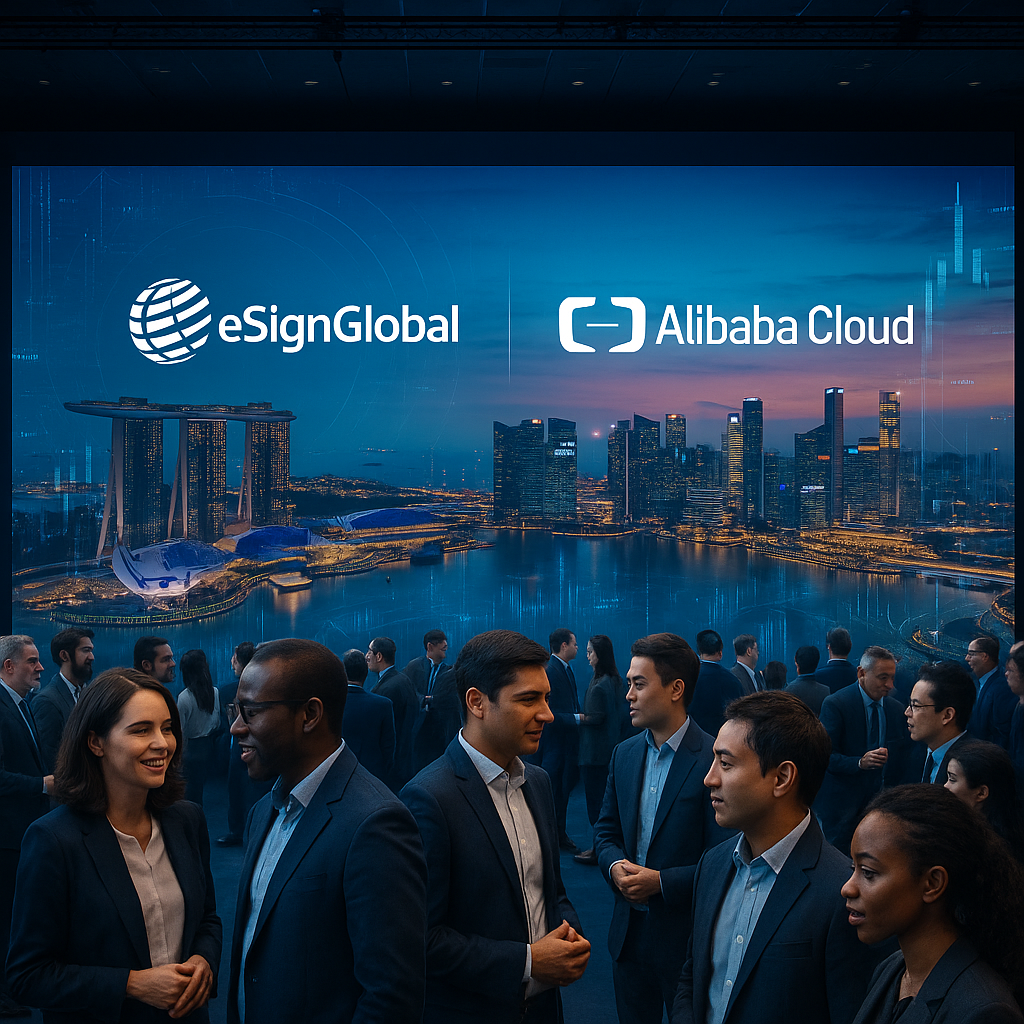
eSignGlobal has announced a new collaboration with Alibaba Cloud to deliver a “cloud-to-application” digital trust stack aimed at fintech firms and financial institutions operating across borders. Building on their joint presence at the Singapore FinTech Festival (SFF) 2025, the partnership focuses on secure, globally scalable e-signature and digital trust services designed to help banks, lenders, insurers, and payment providers tackle cross-border compliance, contract enforceability, governance, and risk-control challenges.
Why This Partnership Matters for Business and Finance Leaders
The timing of the collaboration is significant. Singapore FinTech Festival 2025, which marks the event’s 10th anniversary, is explicitly framed around building the “technology blueprint for the next decade of finance,” emphasizing AI, tokenisation, and trusted digital infrastructure as foundations for future financial systems. (fintechfestival.sg) In this context, a dedicated digital trust stack from eSignGlobal and Alibaba Cloud speaks directly to the industry’s most pressing needs: secure data flows, verifiable identities, and enforceable contracts across multiple jurisdictions.
For business leaders, especially those responsible for risk, legal, and digital transformation, the news underscores a structural shift: e-signatures and trust services are no longer “nice-to-have” add-ons. They are becoming embedded, cloud-native capabilities that underpin everything from digital onboarding to cross-border lending, trade finance, and embedded finance offerings.
Key takeaway: As financial services go increasingly real-time and borderless, the winning institutions will be those that treat digital trust as an end-to-end infrastructure layer—not a point solution bolted on at the signing step.
What Happened: eSignGlobal Meets Alibaba Cloud at SFF 2025
eSignGlobal operates as the international arm of Chinese electronic signature provider e签宝 (Primeton eSign), which has emerged as a leading digital signature vendor in Asia. The company has built out international data centers in Hong Kong, Singapore, and Frankfurt, covering more than 80 countries and regions and aligning with regimes such as the EU’s eIDAS and other local regulations. (esign.cn)
Alibaba Cloud, for its part, has positioned itself as a core cloud infrastructure provider for financial services across Asia-Pacific, with a focus on compliance, data residency, and high-availability architectures that meet regulators’ expectations in markets such as Singapore, Hong Kong, and the EU. Together, the two companies are using SFF 2025 as a launchpad to spotlight their joint “cloud-to-application” digital trust stack tailored to fintech firms.
While full commercial details have not been disclosed, the key pillars of the collaboration can be inferred from both firms’ strategies and from broader SFF themes:
- Cloud-native deployment: eSignGlobal’s signing, sealing, and evidence-preservation engines deployed on Alibaba Cloud’s financial-grade infrastructure, allowing financial institutions to host data in-region while maintaining global reach.
- End-to-end trust services: Services are expected to cover identity assurance, e-signatures, time-stamping, digital certificates, and long-term preservation of evidence, aligned with leading regulations such as eIDAS and local electronic transactions laws.
- Cross-border readiness: Given eSignGlobal’s existing footprint and Alibaba Cloud’s multi-region presence, the stack is clearly aimed at financial institutions operating across Asia, Europe, and emerging markets, where data sovereignty and cross-border enforceability are key pain points. (esign.cn)
Industry context: eSignGlobal already counts more than 600,000 paying customers domestically and serves
tens of millions of daily signature events in China; its international unit has been explicitly tasked with building a “China-tech-centered” global e-signature service system. (esign.cn)

Inside the Digital Trust Stack: Cloud-to-Application for Fintech
A Multi-Layered Model for Trust
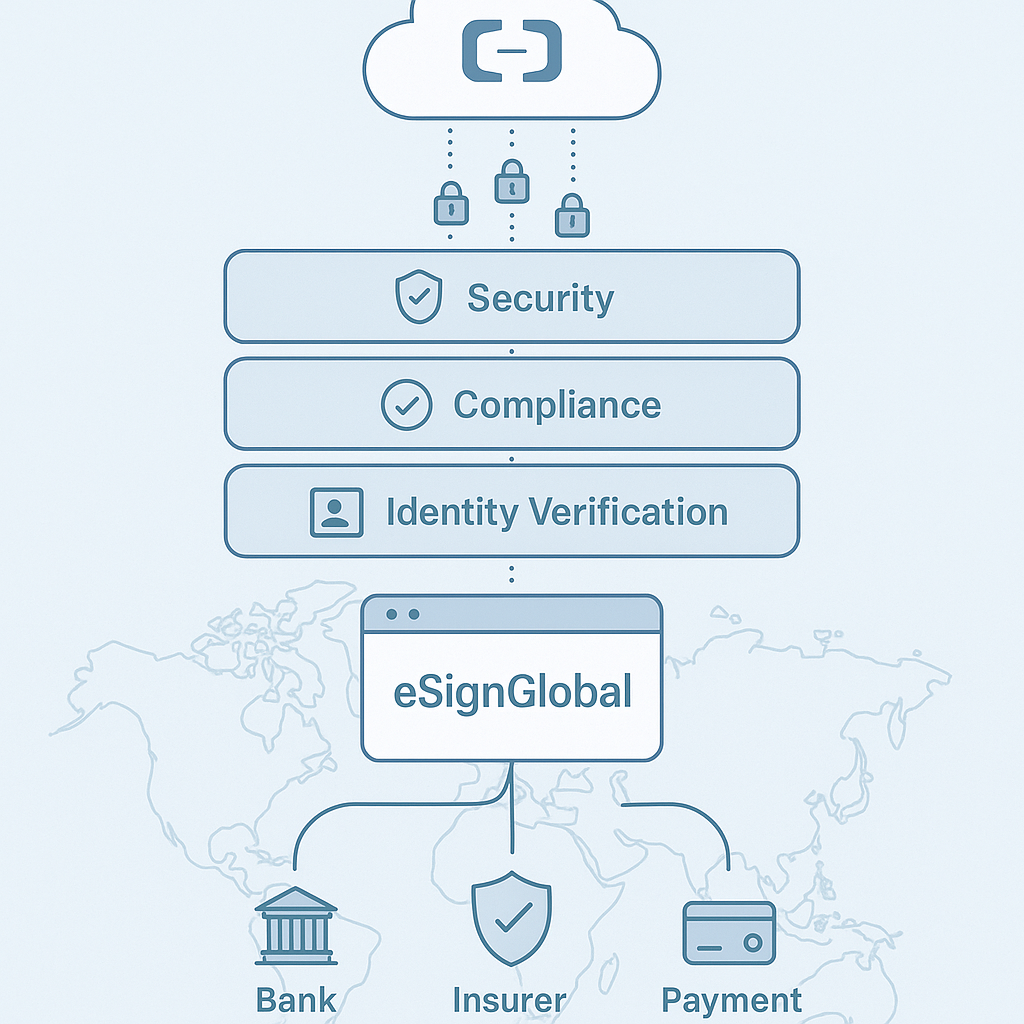
The eSignGlobal–Alibaba Cloud proposition follows a layered architecture that mirrors how modern fintech platforms are built:
- Infrastructure and data layer (Alibaba Cloud): Regional data centers, VPC isolation, encryption at rest and in transit, key management, disaster recovery, and compliance with regimes like MAS TRM in Singapore and other regional guidelines.
- Trust services layer (eSignGlobal): Identity verification, e-signatures (covering multiple assurance levels), digital certificates, seals, time-stamping, and long-term evidence preservation.
- Application and workflow layer (fintech platforms): Digital onboarding, lending and credit agreements, wealth advisory mandates, trade documents, policy issuance, and B2B contracts, where trust services are consumed via APIs and SDKs.
By positioning digital trust as a horizontal layer running from cloud infrastructure up through application workflows, the partners are responding to a core challenge at the heart of the festival’s agenda: how to make AI, tokenisation, and cross-border payments work in a way that regulators, courts, and customers can all trust. (fintechfestival.sg)
Focus on Compliance, Governance, and Evidence
Global financial institutions increasingly face a patchwork of electronic signature and data protection rules. In the EU, the eIDAS Regulation sets out stringent requirements for trust services and cross-border recognition; in Asia, regulators from Singapore to Hong Kong to mainland China maintain their own rules for digital records, data residency, and AML/KYC processes.
eSignGlobal has already emphasized its alignment with eIDAS and other regional standards, including the deployment of European data centers and corresponding legal frameworks. (esign.cn) Coupled with Alibaba Cloud’s existing compliance programs, the new stack is clearly being pitched as a way for fintechs to design once and deploy across many markets without rebuilding their trust infrastructure from scratch each time.
Practical implication: Instead of treating each jurisdiction as a standalone project, fintechs can abstract digital trust into a unified service layer, then toggle policy settings per country while keeping a consistent technical backbone.
What This Means for the E‑Signature and Digital Trust Industry
The alliance between eSignGlobal and Alibaba Cloud highlights several broader trends in the e-signature and digital trust market:
1. Consolidation Around Cloud Platforms
Just as core banking and payments have moved to cloud-native models, trust services are following suit. Leading providers are now tightly aligning with hyperscale and regional cloud platforms to deliver low-latency, compliant services region by region. This matches moves by other industry players that embed e-signature, KYC, and archiving into financial-grade cloud stacks, reducing integration overhead for banks and fintechs.
2. Cross-Border Compliance as a Differentiator
eSignGlobal’s rapid global build-out—covering 80+ countries via data centers in Hong Kong, Singapore, and Frankfurt—speaks to a growing requirement for “compliance mobility,” where institutions need to maintain enforceability and auditability when customers, counterparties, and even data centers span multiple jurisdictions. (esign.cn) Providers that can deliver legally robust signatures, evidence files, and archiving across this landscape are increasingly preferred partners for large financial institutions.
3. Vertical Specialization in Financial Services
Another notable trend is vertical specialization. Providers like eSignGlobal have deep roots in financial services and government workloads in China. Similarly, European platforms such as QuickSign have focused on compliant onboarding and e-signature journeys specifically for banks, lenders, and insurers, offering eIDAS-compliant signatures and long-term legal archiving tailored to financial services. (quicksign.com)
As digital trust matures, general-purpose e-signature tools are giving way to industry-specific platforms that understand regulatory nuances, litigation risks, and operational realities in sectors like finance, healthcare, and public services.
Implications for Businesses Using E‑Signatures Today
From Point Tool to Strategic Infrastructure
For many organizations, e-signature adoption began as a tactical digitization effort—replacing wet signatures in a few workflows. The eSignGlobal–Alibaba Cloud partnership is a reminder that this view is now outdated. In a world of embedded finance, open banking, and cross-border digital trade, e-signature and digital trust capabilities increasingly shape:
- Time-to-market: How quickly new financial products can be launched across multiple markets.
- Risk exposure: Whether contracts hold up under regulatory scrutiny or in court years later.
- Customer experience: The friction (or lack of it) in onboarding, approvals, and servicing.
Enterprises should be evaluating their current trust stack against these emerging standards, asking whether their providers can deliver cross-border compliance, robust evidence files, and regional data residency on par with what alliances like eSignGlobal–Alibaba Cloud are promising.
Benchmarking Against Best‑in‑Class Providers
Business leaders don’t need to wait for new joint offerings to become widely available to act. A practical step is to benchmark existing e-signature capabilities against specialized providers already serving financial services at scale. For example, QuickSign in Europe offers eIDAS-compliant signatures, advanced consent management, audit trails, and long-term legal archiving designed for banks and insurers, underscoring what “industrial-grade” trust infrastructure looks like in practice. (quicksign.com)
Action point for executives: Treat your e-signature and trust provider as a strategic partner, not a commodity vendor. Demand clarity on jurisdictional coverage, evidence and archiving models, and alignment with evolving standards such as eIDAS, MAS TRM, and equivalent frameworks elsewhere.
Looking Ahead: Digital Trust as the Fabric of Global Finance
As SFF 2025 focuses on AI, tokenisation, quantum resilience, and digital assets, the eSignGlobal–Alibaba Cloud collaboration illustrates a key reality: none of these innovations can scale safely without a reliable fabric of digital trust underneath. From programmable money to tokenized securities and multi-country payment corridors, every transaction ultimately depends on binding, verifiable, and enforceable agreements between parties.
For fintech founders, bank executives, and risk leaders, the message is clear. The next decade of growth will be built on:
- End-to-end trust stacks that span from cloud infrastructure through APIs and business applications.
- Cross-border legal robustness that aligns with multiple regulatory regimes simultaneously.
- Verticalized solutions tuned for the specific risk profiles and regulatory expectations of financial services.
Partnerships like eSignGlobal and Alibaba Cloud’s show how cloud providers and trust service specialists are moving to meet that demand. The competitive advantage will go to institutions that proactively modernize their trust infrastructure—before regulations or market pressure force their hand.
Conclusion: Turning Digital Trust into a Competitive Edge
The eSignGlobal–Alibaba Cloud alliance marks another step in the evolution of digital trust from optional add-on to strategic infrastructure. As financial services continue to globalize and digitalize, the ability to prove identity, consent, and contract integrity across borders will increasingly determine who wins in new markets and products.
For organizations reviewing their own digital workflows, this is an opportune moment to reassess whether current e-signature tools are fit for a future defined by cross-border, AI-driven, and tokenized finance. Modern, sector-focused platforms are raising the bar on compliance, user experience, and long-term legal certainty.
If you’re exploring how to upgrade your e-signature stack—especially in a financial services context—consider testing a specialized solution that aligns with these trends. Try QuickSign for free - generate 2 documents and send 1 document to unlimited recipients at no cost. It’s a practical way to benchmark your current setup against an industrial-grade, finance-focused digital trust workflow.