EU Tightens the Technical Rules for Advanced Electronic Signatures Under eIDAS: What Businesses Need to Know by 2026
Discover how eIDAS 2026 changes advanced electronic signatures. Learn what businesses must do now to comply with new EU technical rules.
EU Tightens the Technical Rules for Advanced Electronic Signatures Under eIDAS: What Businesses Need to Know by 2026
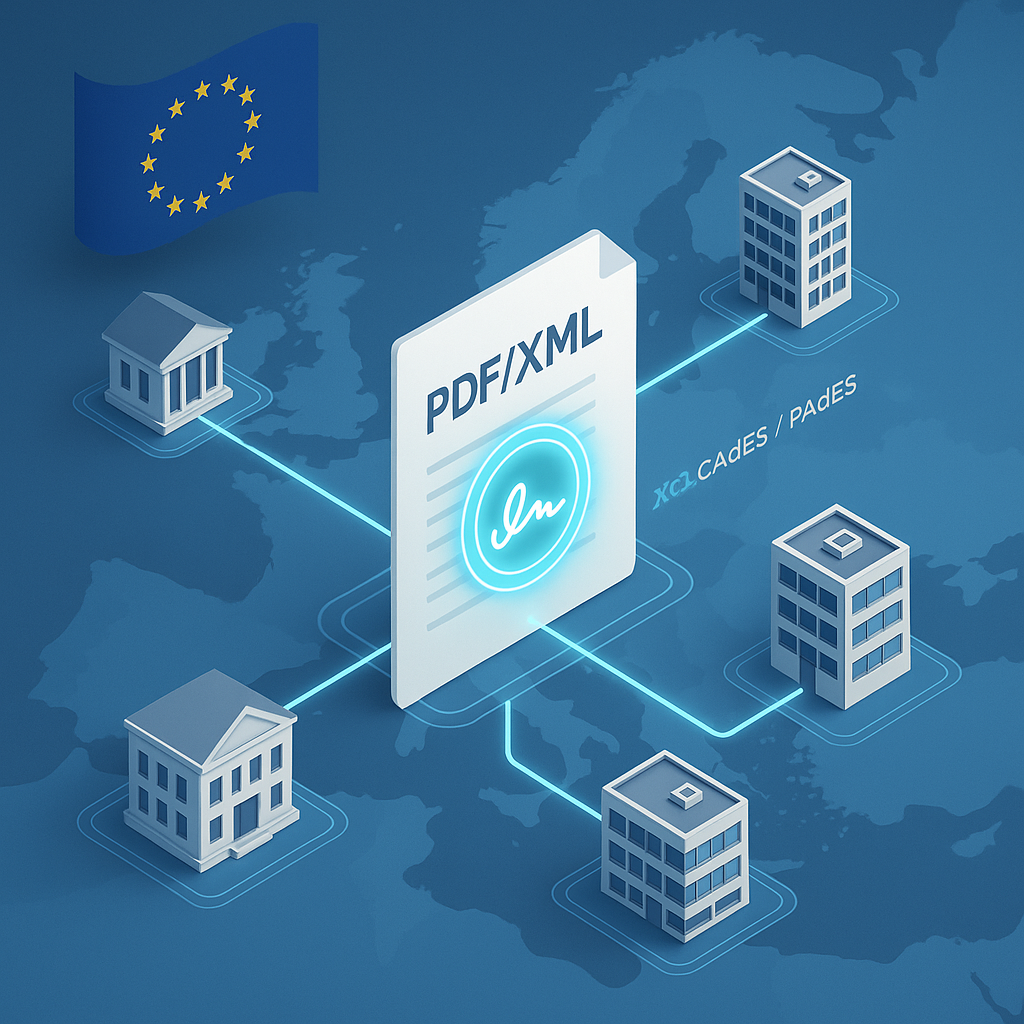
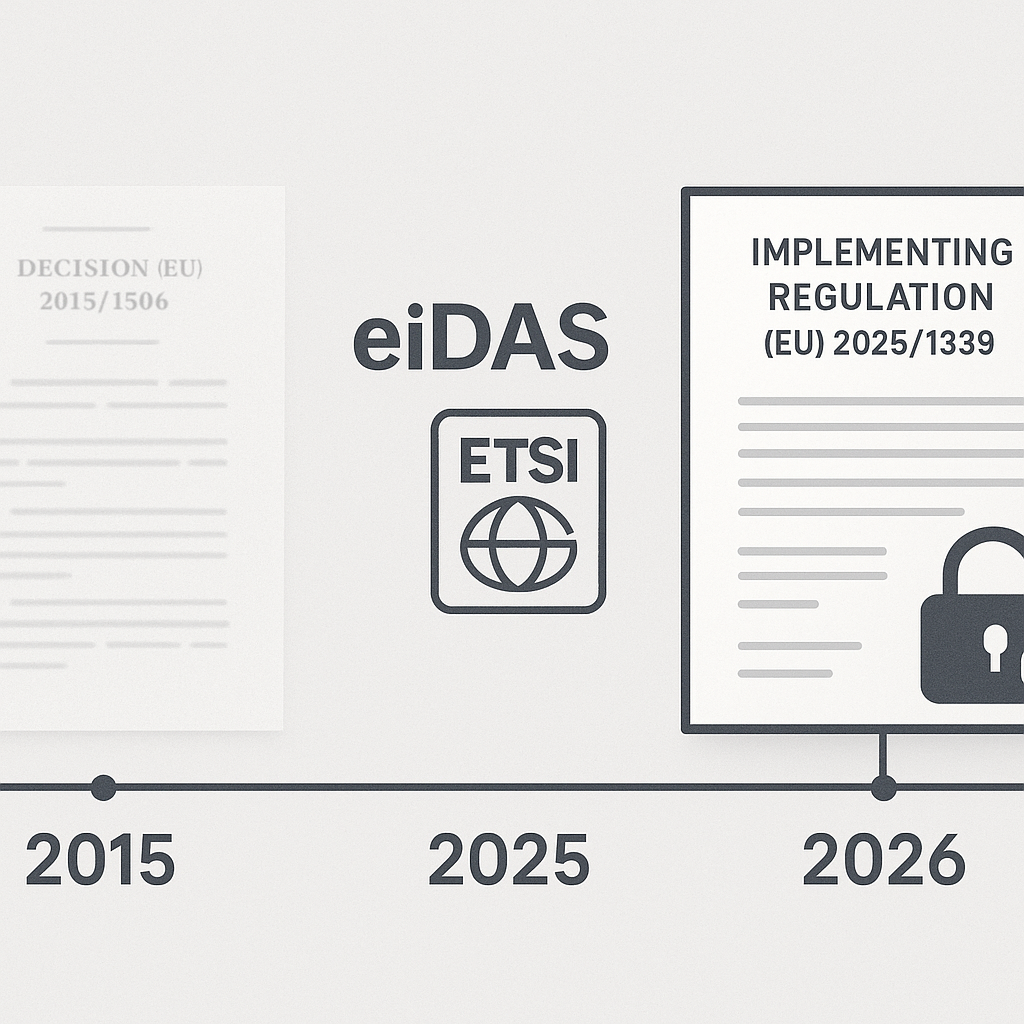
The European Commission has adopted a new implementing regulation that updates the technical specifications EU public-sector bodies must support for advanced electronic signatures and seals under the eIDAS framework. The measure, laid down in Commission Implementing Regulation (EU) 2025/1339 and building on the earlier Decision (EU) 2015/1506, will apply from 10 July 2026 and is designed to ensure that trusted e-signature formats are interoperable across all Member States.
For businesses that regularly sign or file documents with European public administrations — from procurement bids to tax filings and regulatory submissions — this is more than a technical clean-up. It effectively sets the baseline formats and standards that any serious e-signature provider must support to remain compatible with EU public services.
From Decision 2015/1506 to Implementing Regulation 2025/1339
Under the original Commission Implementing Decision (EU) 2015/1506, Member States were required to recognise advanced electronic signatures and seals in specific formats based on ETSI standards: XAdES, CAdES, PAdES and associated containers, at defined conformance levels. The goal was to make sure that when a citizen or company in one Member State signed an XML, CMS, or PDF document, authorities in another Member State could validate it without bespoke integration work. (eur-lex.europa.eu)
The new Implementing Regulation (EU) 2025/1339, adopted on 10 July 2025 and applicable from 10 July 2026, updates those technical references, explicitly linking them to the current generation of ETSI standards and the broader reform of eIDAS (sometimes informally dubbed “eIDAS 2.0”). It replaces the 2015 Decision as the core technical rulebook on formats of advanced electronic signatures and seals to be recognised by public-sector bodies, again acting under Articles 27(5) and 37(5) of Regulation (EU) No 910/2014 (eIDAS). (eur-lex.europa.eu)
Key change: The EU is moving from a Commission “Decision” to a directly applicable “Implementing Regulation”, tightening and updating the technical baseline for which advanced electronic signature and seal formats public-sector bodies must accept across the Union.
Why This Matters for Business Professionals
For many business users, advanced electronic signatures are not abstract legal concepts; they are the mechanism by which contracts close, tenders are submitted, and compliance workflows are executed. The updated rules matter for three main reasons:
- Guaranteed cross-border acceptance: If your signature uses a compliant advanced format, public-sector bodies across the EU must be able to process it.
- Reduced technical friction: IT teams no longer need ad hoc validation tools for each country; interoperable formats become the default.
- Vendor discipline: E-signature providers that target the EU public sector will be compelled to support the latest ETSI profiles consist
ently.
For small and mid-sized companies that rely on external e-signature platforms instead of building their own trust services, this means that vendor choice directly affects whether your documents will be accepted in critical cross-border procedures.
What Exactly Has Changed in the Technical Rules?
The EU’s new implementing regulation is highly technical, but several themes are clear from the published text and related eIDAS materials:
1. Continued reliance on ETSI “baseline” signature standards
The regulation reaffirms ETSI’s XAdES, CAdES and PAdES Baseline Profiles, as well as associated signature containers, as the reference formats for advanced electronic signatures and seals. (eur-lex.europa.eu)
- XAdES (XML Advanced Electronic Signatures) for XML-based processes
- CAdES (CMS Advanced Electronic Signatures) for CMS-based signatures
- PAdES (PDF Advanced Electronic Signatures) for PDF documents, by far the most common in business workflows
These profiles specify how certificates, timestamps, revocation data and other validation information are embedded, ensuring that different systems can interpret and validate signatures consistently.
2. Updated references to newer ETSI versions and long-term validation
When the 2015 Decision was adopted, ETSI’s long-term archival profiles were still evolving, so they were largely excluded. The new regulation reflects the maturity of ETSI’s newer standards and the need for signatures that remain verifiable for many years — critical for sectors such as financial services, healthcare, and public procurement where documents must be kept for a decade or more. (eur-lex.europa.eu)
In practical terms, this means:
- Clearer guidance on how to include revocation and timestamp data
- Improved interoperability for “LT” and “LTA”-style signatures (long-term and archival)
- Better alignment with how trust lists and qualified certificates are managed under eIDAS
3. Harmonised requirements for signatures and seals
Advanced electronic signatures (used by natural persons) and advanced electronic seals (used by legal entities and systems) remain technically very similar. The EU again applies the same technical standards “mutatis mutandis” to both, minimising divergence between how a person and a company “sign” in a digital context. (eur-lex.europa.eu)
4. Validation services for “other” formats
Just as under the 2015 Decision, the new regulation preserves a safety net: if a Member State or trust service provider uses another signature format, they must offer validation tools so that public-sector bodies in other Member States can still verify it, ideally via automated means and at no charge. (eur-lex.europa.eu)
This protects legacy or sector-specific solutions while maintaining the principle that cross-border validation must remain possible without imposing extra costs on the relying public authority.
Industry Impact: E-Signature Providers Under Pressure to Stay in Sync
For the e-signature industry, the updated regulation acts as an enforced product roadmap. Vendors that want to keep serving customers who interact with EU public services will need to:
- Implement or update support for the current ETSI Baseline Profiles
- Ensure their validation logic correctly interprets cross-border certificates and trust lists
- Offer long-term validation capabilities (e.g., via embedded timestamps and revocation data)
Larger, legacy platforms such as DocuSign, Adobe Acrobat Sign and others have historically supported ETSI PAdES profiles for EU customers, but their roadmaps are often driven by enterprise feature demands and regional compliance priorities. As pricing on those platforms has crept upward — especially with per-seat licensing and enterprise contract structures — smaller firms and solo professionals are increasingly looking for affordable alternatives that still align with eIDAS expectations.
This is where modern providers like QuickSign.it are carving out a niche. While traditional players focus on large corporate and government contracts, QuickSign concentrates on delivering:
- A modern, intuitive interface designed for solo entrepreneurs and small businesses
- Flat-rate pricing from $15/month instead of per-seat models that scale poorly for growing teams
- A generous free tier (2 AI document generations and 1 document send to unlimited recipients) so organisations can test workflows without up-front commitment
As EU regulation tightens the technical requirements, the market opportunity lies in combining strict compliance with usability and predictable pricing — especially for organisations that do not maintain in-house eIDAS or PKI expertise.
What This Means for Businesses Using E-Signatures Today
Between now and 10 July 2026, organisations that interact with EU public administrations should treat the new implementing regulation as a transition window. Concretely:
- Audit your signature formats. Verify whether the e-signatures you currently use for dealings with EU public bodies are PAdES, XAdES or CAdES-compliant in line with ETSI Baseline Profiles — not just “PDF with a signature”. Ask your e-signature vendor for documentation that explicitly references ETSI standards and eIDAS.
- Confirm cross-border validation. For multi-country operations (e.g., bidding in tenders across several Member States), test how your signed documents are validated in the target country’s systems. Where possible, run trial submissions or validation checks before critical deadlines.
- Plan for long-term archiving. If your sector requires keeping records for many years, ensure your signatures include the right timestamp and revocation information so they remain verifiable under the updated ETSI profiles.
- Update internal policies. Legal, compliance and IT teams should update their documentation to reflect the new implementing regulation and the 10 July 2026 applicability date, particularly in contract templates and SOPs that reference e-signature requirements.
- Reassess vendor lock-in and cost. As you update for compliance, it may be a good moment to reconsider whether your current e-signature platform is cost-effective and flexible enough for your future EU-facing workflows.
Practical Implementation: From Policy to Daily Workflows
In practice, most business users will not interact with ETSI standard numbers or certificate policies. What they will notice is whether their e-signature solution “just works” when dealing with authorities in different EU countries — or whether they encounter mysterious validation errors and rejections.
Modern platforms need to translate this regulatory complexity into simple workflows. For example, a solution like QuickSign.it focuses on concealing the technical plumbing behind straightforward steps:
- AI Document Generation: Instead of manually drafting NDAs, service agreements or consent forms, users can generate legally structured documents with AI, then apply compliant e-signatures to them.
- Effortless Sending: Upload a PDF, drag and drop signature, date and text fields, and send to recipients — no specialist knowledge of signature containers or ETSI profiles required.
- Real-time Tracking: See when recipients open, sign or complete documents, making it easier to manage tight administrative or tender deadlines with public authorities.
- AI-powered variables: Document variables and smart auto-fill help maintain consistency of names, addresses and identifiers — a subtle but important factor in reducing validation and compliance errors.
Under the hood, vendors must ensure their signing and validation engines align with ETSI and eIDAS requirements. On the surface, users should experience reliable acceptance across borders and a smooth, predictable signing experience.
Learning More: Understanding Advanced vs. Qualified Signatures
While the new implementing regulation is focused on advanced electronic signatures and seals, many organisations are still learning how these differ from “qualified” signatures under eIDAS. Advanced signatures must, among other things, be uniquely linked to the signatory, capable of identifying them, created using data under their sole control, and linked to data so that any change is detectable. Qualified signatures go further, requiring qualified certificates and certified devices, and are legally equivalent to handwritten signatures in all EU Member States. (legislation.gov.uk)
For non-specialists, there are helpful explainer resources, including video content, that walk through when advanced or qualified signatures are needed in real-world scenarios, and how companies can embed them into internal processes and external-facing workflows.
Strategic Takeaways for 2025–2026
By 10 July 2026, any business that signs electronically with EU public administrations should be confident that its workflows, vendors and document formats align with the updated eIDAS technical rulebook.
From a strategic standpoint:
- Regulatory direction is clear: The EU is not stepping back from e-signatures; it is doubling down on interoperable, standards-based formats and long-term validation.
- Vendor differentiation will shift: As compliance becomes table stakes, usability, AI-assisted document creation, integration capabilities and pricing models will determine who wins SME and cross-border business.
- Cost pressure is real: While enterprise-focused platforms may continue to raise prices or bundle e-signatures into broader suites, alternatives like QuickSign.it are positioning themselves with flat-rate pricing from $15/month, no complex contracts, and a free tier that lets teams experiment before committing.
For organisations that want to remain agile, the combination of regulatory compliance, predictable cost, and intuitive workflows will be essential. The new implementing regulation is a timely reminder to revisit your digital signature stack before 2026, not after a rejected filing exposes a hidden gap in your processes.
Looking for an affordable e-signature solution? Try QuickSign for free - no credit card required.