Flat-Fee E‑Signature Platforms Are Coming for Micro‑Business Budgets
Discover how flat-fee e-signature pricing can slash costs for micro-businesses while simplifying contracts, compliance, and client approvals.
Flat-Fee E‑Signature Platforms Are Coming for Micro‑Business Budgets
A New Pricing Model Aimed Squarely at the Smallest Teams
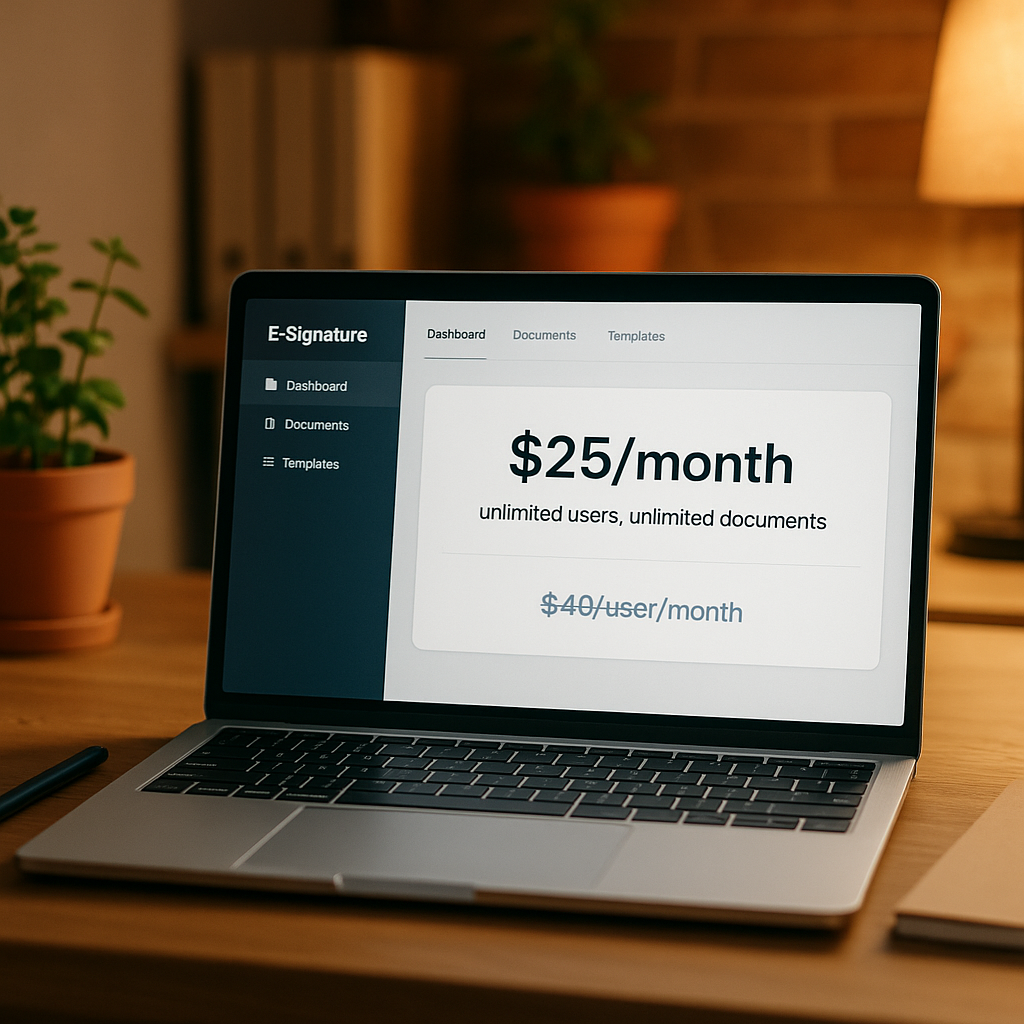
A new class of e‑signature platform is betting that micro‑businesses don’t want “per seat” anything. One new entrant is openly marketing a flat $25/month plan with unlimited users, unlimited documents, and built‑in AI contract generation—a direct challenge to the traditional per‑user pricing that has long dominated the e‑signature market.
For freelancers, agencies, and tiny firms that live project‑to‑project, this shift isn’t just a minor tweak in pricing. It has the potential to cut contract‑related software costs by hundreds of dollars a year, while still offering audit trails and compliance with major e‑signature regulations like ESIGN and eIDAS that businesses increasingly rely on to stay paperless and legally protected.(zipdo.co)
Why E‑Signature Pricing Has Been a Pain Point for Small Businesses
Over the past few years, e‑signatures have become mainstream across industries. Recent industry data suggests that roughly 70% of organizations now use electronic signatures as a primary method for managing contracts, and adoption among small and medium‑sized businesses has surged as remote work and digital onboarding have become the norm.(zipdo.co)
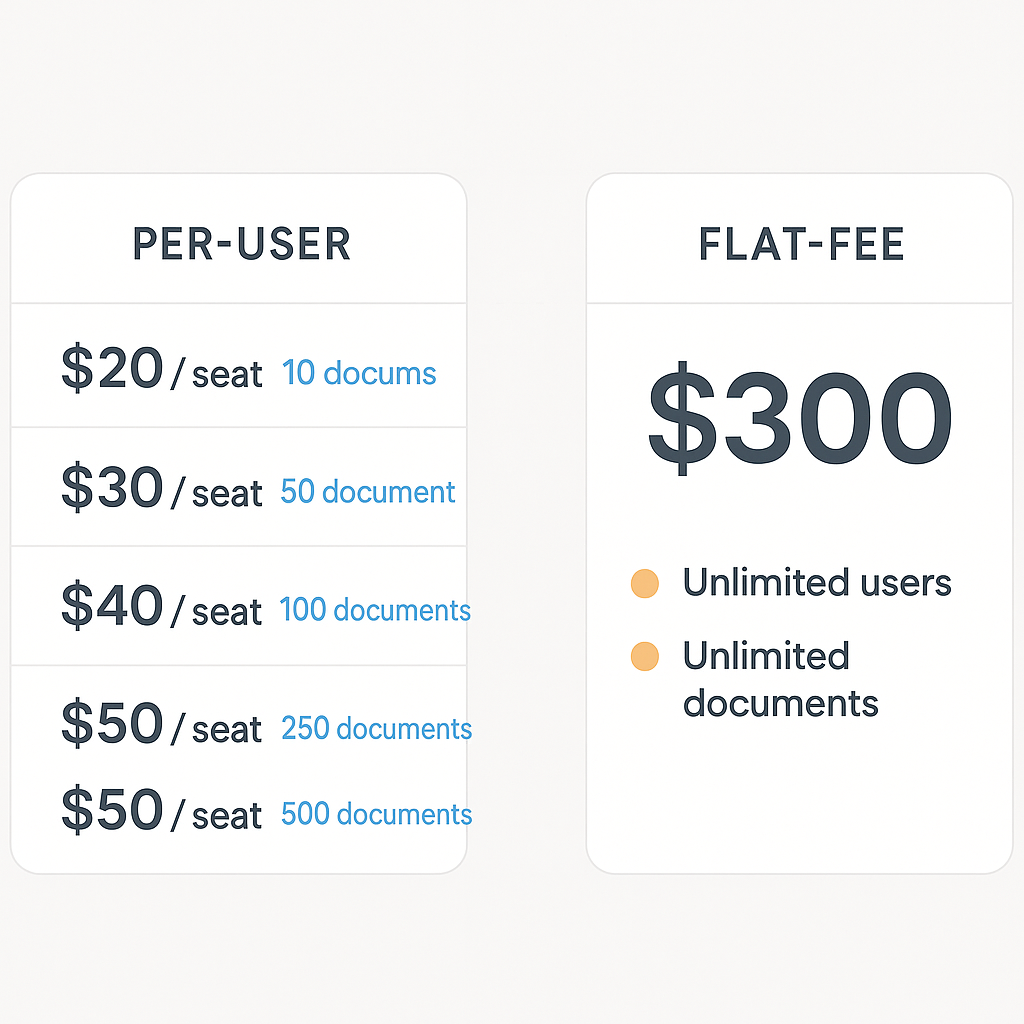
But while usage has gone up, so has frustration with pricing models. Many leading providers still charge on a per‑user basis—often between $20 and $50+ per user per month, with additional limits on the number of envelopes or documents that can be sent.(esignglobal.com)
Per‑user pricing and document caps make the smallest teams pay enterprise‑style rates for tools they use only a few times a week.
Analysis from independent pricing trackers shows that the effective average for small and midsize businesses tends to land around $25 per user per month on annual commitments, especially once envelope limits and occasional overage fees are factored in.(esignglobal.com) For a five‑person agency or boutique law firm, that can translate into $125–$250 monthly, often for a feature set far beyond what they truly need.
On top of subscription fees, there are hidden costs—API access,

The Flat-Fee Pivot: Unlimited Users, Unlimited Docs, Built‑In AI
The new $25/month offering targeting micro‑businesses flips that model on its head. Instead of tying cost to headcount or “envelopes,” the platform promises:
- Unlimited users – add every contractor, assistant, or partner without extra seats
- Unlimited documents – no envelope quotas or overage charges
- AI contract generator – draft basic agreements and NDAs from prompts, without a separate tool
- Core compliance – audit trails, timestamps, and adherence to major e‑signature laws
This is part of a broader trend in SaaS where some tools are abandoning classic seat‑based pricing in favor of usage‑agnostic or flat‑rate models, particularly for agencies and small teams that juggle many collaborators. Similar dynamics are visible in creative and AI platforms experimenting with credit‑ or flat‑based models to reduce friction for teams that ebb and flow.(businessinsider.com)
For micro‑businesses, predictable pricing often matters more than an ever‑expanding feature list. Paying once for “enough of everything” can be more attractive than managing seats and quotas.
In practical terms, this kind of offer is squarely aimed at:
- Solo freelancers sending a handful of contracts and NDAs per month
- Two‑ to five‑person creative or marketing agencies closing projects with simple service agreements
- Local service businesses—from consultants to trades—who need legally reliable signatures but not complex enterprise workflows
What the Numbers Look Like for Micro‑Businesses
To understand the impact, compare a common small‑team scenario under traditional pricing versus flat‑fee models.
- A five‑person agency on a typical small‑business plan at around $25–$45 per user per month is likely paying between $125 and $225 monthly, with limits on envelopes or advanced features locked behind higher tiers.(esignglobal.com)
- That same agency on a $25/month flat plan with unlimited users and documents sees immediate savings of roughly $100–$200 per month, or $1,200–$2,400 per year, without changing their day‑to‑day workflow.
For solopreneurs and individual consultants, the contrast can be just as stark. While many can get by on low‑tier plans around $10–$15/month from established players, they often face strict document caps—something that can be surprisingly limiting during busy seasons or growth spurts.(esignglobal.com)
AI Contract Generation Becomes Table Stakes
Alongside pricing, AI is quietly becoming a must‑have feature in e‑signature platforms. Newer entrants are promoting built‑in AI contract generation that can turn a short natural‑language brief (“Social media management for a local restaurant at $2,500/month, 6‑month term”) into a ready‑to‑review contract in seconds.(flowsign.com)
AI‑generated templates won’t replace legal advice, but they can dramatically reduce the time it takes to get from “handshake” to “signed document.”
For very small teams without in‑house legal support, these tools are typically used to:
- Draft standard client service agreements and statements of work
- Generate non‑disclosure agreements (NDAs) for collaborators and vendors
- Produce repeatable templates for retainers, renewals, and change orders
The key is that the AI is embedded directly within the e‑signature workflow, eliminating the need to bounce between a contract editor and a separate signing platform.
Where QuickSign Fits: Flat‑Rate, AI-First, Built for Small Teams
For readers evaluating their options in light of this pricing shift, QuickSign has taken a similarly small‑business‑first approach—at an even lower price point.
Unlike enterprise‑focused solutions that still rely on per‑seat pricing, QuickSign offers a flat-rate $15/month plan for the whole team, specifically designed for freelancers, agencies, and micro‑businesses that just need fast, reliable signatures and simple automation.
Key ways QuickSign.it aligns with the emerging flat‑fee trend:
- AI Document Generation – Generate core legal documents—like contracts and NDAs—directly inside QuickSign using AI, then send them for signature in a few clicks.
- Effortless Sending – The workflow is intentionally minimal: upload PDF → drag & drop fields → send. No need to learn a sprawling enterprise dashboard.
- Real‑Time Tracking – See who has opened, viewed, and signed your documents in real time, so you can follow up only when it matters.
- Flat-Rate, Team‑Friendly Pricing – At $15/month flat, QuickSign undercuts not only traditional per‑user models but also newer $25 flat‑fee offers aimed at micro‑businesses.
- Generous Free Tier – Test the waters with 2 AI document generations and 1 document send to unlimited recipients without entering a credit card.
Unlike enterprise-focused solutions, QuickSign offers flat-rate pricing at $15/month, giving small teams predictable costs and modern features without the enterprise overhead.
Practical Takeaways for Small Business Document Workflows
For small business owners and independent professionals reviewing their tech stack, the rise of flat‑fee e‑signature platforms and built‑in AI suggests a few concrete steps:
- Audit your current usage. How many people actually need to send documents? How many contracts do you send per month? If you’re paying per seat but only a handful of documents go out each week, you may be over‑subscribed.
- Calculate your true monthly cost. Include per‑user fees, envelope overages, and any add‑ons (API, storage, advanced verification). Compare this to a flat‑fee plan like the $25 unlimited model—or QuickSign’s $15/month flat—to see potential savings.
- Consider AI’s role. If you’re routinely copying and pasting from old Word templates, AI contract generation inside your e‑signature tool can shave hours off each new engagement, especially for standard agreements.
- Prioritize compliance and audit trails. Any replacement should still provide time‑stamped logs, clear signer identities, and adherence to major e‑signature laws in your jurisdiction.
- Test with a live deal. Use a free tier (such as QuickSign’s 2 AI generations and 1 send to unlimited recipients) to run a real client contract through the system. This is often the quickest way to see if a new platform fits your existing workflow.
What This Means for the Future of Small Business Contracts
As e‑signature adoption continues to climb, small businesses are no longer willing to accept enterprise‑style pricing and complexity as the default. Flat‑fee, AI‑enhanced platforms signal a maturing market where micro‑businesses are treated as first‑class customers rather than edge cases.
For many, the decision in 2026 and beyond won’t be whether to digitize contracts—that ship has sailed—but how to do it without overspending. In that context, models that combine predictable flat pricing, AI document generation, and streamlined workflows are likely to become increasingly attractive.
QuickSign sits squarely in that sweet spot: a modern, affordable e‑signature solution built from the ground up for freelancers, agencies, and small teams that want powerful features without enterprise bloat.
Looking for an affordable e-signature solution? Try QuickSign for free - no credit card required.