Global Electronic Signature Software Market Forecast to Hit $35.7 Billion by 2030 as Digital Agreement Adoption Surges
Discover how the electronic signature software market is set to reach $35.7B by 2030, driven by rapid digital agreement adoption worldwide.
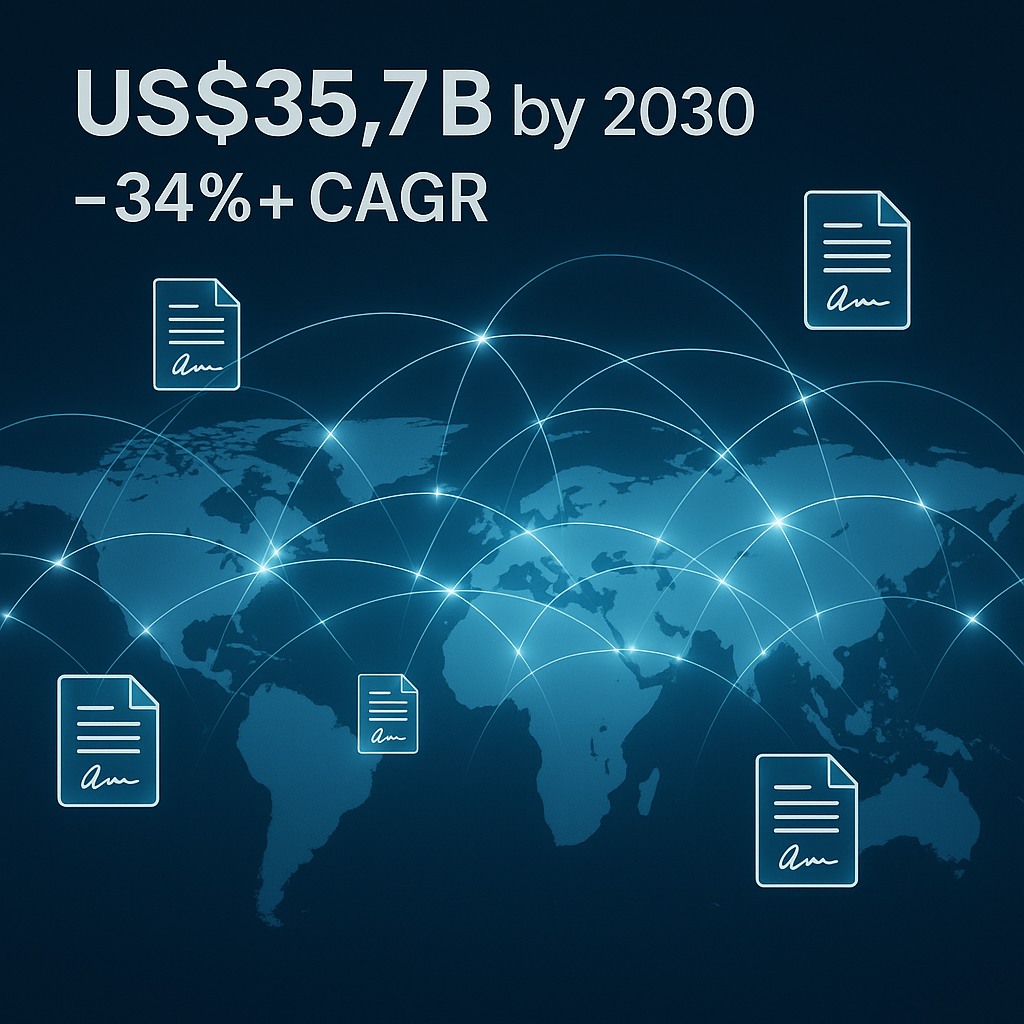
Global Electronic Signature Software Market Forecast to Hit $35.7 Billion by 2030 as Digital Agreement Adoption Surges
The global electronic signature software market is on track for explosive growth, with a new report from research firm The Insight Partners projecting the sector to reach approximately US$35.7 billion by 2030, expanding at a compound annual growth rate (CAGR) of around 34%+ through the end of the decade. This rapid rise is being fueled by escalating digital fraud, booming e-commerce, and increasingly mature e-signature legal frameworks worldwide—all factors that are helping enterprises justify sustained investment in digital agreement technologies.
Why This Forecast Matters for Business Leaders
For business executives, CIOs, legal teams, and operations leaders, the latest forecast underscores that electronic signatures are no longer a niche productivity tool. They are a core component of broader digital transformation and risk management strategies.
Electronic signature platforms now sit at the intersection of three powerful forces:
- Security and compliance in an era of rising cyber and identity fraud
- Customer experience in digital-first commerce and services
- Operational efficiency in distributed and remote work environments
In other words, e-signature is evolving from a “nice-to-have” workflow optimization into a critical infrastructure layer for how organizations create, approve, and execute agreements. For solution providers, including agile platforms such as QuickSign, the new market projections signal a long runway for innovation and competitive differentiation.

Inside The Insight Partners’ Market Forecast
The Insight Partners’ latest study on the electronic signature software market, published in March 2025, forecasts that the market will grow from about US$3.3 billion in 2022 to roughly US$35.7 billion by 2030, reflecting a CAGR of 34.2% over the 2022–2030 period.(globenewswire.com)
The report highlights that “the electronic signature software market is observing healthy growth owing to the increasing use of electronic signatures in the e-commerce industry,” and notes that adoption is accelerating across public and private enterprises, from banks and government agencies to small and mid-sized businesses.(globenewswire.com)
Although the user brief references a 2031 horizon, The Insight Partners’ current public data pegs the market at US$35.7 billion by 2030 rather than 2031. The trajectory, however, is directionally consistent with a high-30s CAGR that could logically extend into the early 2030s if macro conditions remain supportive.
Key Growth Drivers Identified
The Insight Partners and other analysts point to several core factors driving this outsized growth:
- Rising digital and identity fraud: Across financial services, government, and consumer services, organizations are grappling with more sophisticated fraud schemes. The same firm’s research on the digital signature market—a closely related category—explicitly cites rising digital fraud incidences as a key growth driver, alongside the establishment of e-signature laws and the adoption of mobile signatures.(globenewswire.com)
- Flourishing e-commerce and digital services: The shift to online buying, remote onboarding, and fully digital service models is expanding the volume of agreements that need to be executed electronically, from account openings and loan applications to subscription contracts and vendor onboarding.(globenewswire.com)
- Maturing legal and regulatory frameworks: Over the past decade, more countries have enacted or updated e-signature and digital identity laws, giving enterprises greater legal certainty when retiring wet-ink signatures. The Insight Partners’ coverage of the broader digital signature market emphasizes the role of e-signature legislation in unlocking demand globally.(globenewswire.com)
- Remote and hybrid work: Post-pandemic work patterns continue to normalize around hybrid and remote models, increasing pressure on organizations to digitize end-to-end document workflows and remove paper-based bottlenecks.
- Cloud adoption and API-
first architectures: The broader technology landscape is moving toward API-driven SaaS, enabling e-signature tools to plug directly into CRM, ERP, HR, and vertical line-of-business systems, embedding agreements in the systems where work already happens.
Who’s Shaping the Market?
The Insight Partners’ e-signature report notes that the market is “dominated by tech giants – Adobe, DocuSign, Esign Genie and HID Global,” alongside a broad ecosystem of specialized and regional vendors.(globenewswire.com)
That ecosystem now includes:
- Enterprise suites integrated into broader document, collaboration, and identity platforms
- Vertical-specific players targeting financial services, real estate, healthcare, and government
- Agile SaaS providers such as QuickSign, which focus on streamlined document generation and signature workflows with simple, transparent pricing that appeals to SMBs and digital-native teams
Competition is also intensifying at the intersection of digital signatures and identity, as shown by The Insight Partners’ separate forecast for the global digital signature market to climb from US$5.45 billion in 2024 to US$53.6 billion by 2031, at a 38.7% CAGR.(globenewswire.com) This adjacent growth underscores how identity assurance, trust services, and cryptographic signing are increasingly bundled into e-signature offerings.
Industry Analysis: E-Signature as a Pillar of Digital Transformation
From a strategic standpoint, the forecasted US$35.7 billion market size is less about the dollar figure itself and more about what it signals: electronic signatures are becoming baseline infrastructure for digital business.
E-Signatures in the Broader Trust & Compliance Stack
Electronic signature tools are converging with other compliance and trust technologies, including:
- RegTech platforms that automate regulatory compliance in finance and other heavily regulated industries. The Insight Partners expects the RegTech market to grow from US$7.55B in 2023 to US$42.73B by 2031.(prnewswire.com)
- Remote access and endpoint security solutions, which themselves are scaling rapidly as organizations support hybrid work and defend against endpoint attacks.(globenewswire.com)
- Digital identity and authentication frameworks, where multi-factor authentication, certificate-based identity, and mobile signatures are tightly coupled with signing workflows.(globenewswire.com)
In this context, e-signature becomes a visible, user-facing element of a much larger digital trust architecture. Vendors that can combine usability with strong identity and security guarantees stand to win enterprise budgets.
From Point Solution to Embedded Capability
Another critical shift is the move from standalone signing portals to embedded signatures inside business applications. The Insight Partners’ analysis notes that e-signature solutions increasingly integrate with tools such as Microsoft 365, Google Docs, and Dropbox, allowing organizations to weave signature events directly into existing workflows.(globenewswire.com)
This embedding trend is blurring the lines between “document,” “workflow,” and “signature,” pushing buyers to evaluate platforms based on how smoothly they connect to customer journeys, employee processes, and partner ecosystems—not just on the act of signing itself.
Implications for Businesses Using (or Considering) E-Signatures
For organizations still on the fence or early in their e-signature journey, the latest market projections carry several concrete implications.
1. Budget Justification Gets Easier
A market growing at more than 30% annually—backed by clear regulatory and risk drivers—gives IT, legal, and operations leaders a stronger narrative for continued or expanded budget allocation. E-signature projects can be framed not only as cost-saving tools but also as:
- Fraud mitigation measures (via stronger identity verification and audit trails)
- Regulatory compliance enablers (aligning with eIDAS in the EU, ESIGN/UETA in the US, and equivalent regimes elsewhere)
- Revenue accelerators (shortening contract and onboarding cycles in sales, lending, and subscriptions)
2. Expect More Sophisticated Buying Criteria
As e-signature becomes mainstream, buyers are moving beyond basic “Can we sign PDFs?” questions. Evaluation criteria increasingly include:
- Depth of integrations with CRM, ERP, HRIS, and custom apps
- Support for advanced and qualified signatures where legally required
- Granular security and auditability, including evidence logs, certificate management, and data residency options
- Ease of use for non-technical staff and external signers
- Pricing transparency and scalability for growing teams
Lean, modern platforms such as QuickSign are positioning themselves around simplicity and predictable pricing, which can be particularly attractive for small and mid-sized businesses that don’t have dedicated IT or legal engineering resources.
3. SMEs Will Play a Major Role in Market Expansion
The Insight Partners explicitly highlights the “high implementation of electronic signatures across SMEs,” noting that automated, integrated signing can reduce errors, save staff time, and improve customer experience for smaller organizations.(globenewswire.com)
Given the sheer number of small and mid-sized enterprises globally, their incremental adoption is likely to be one of the largest underlying contributors to the forecast US$35.7B market size. Vendors that can demystify compliance and offer intuitive onboarding for non-experts stand to capture a disproportionate share of this growth.
4. Legal and Compliance Teams Must Stay Ahead of Evolving Standards
With e-signature laws and standards continuing to evolve—especially in areas such as cross-border recognition, qualified trust services, and sector-specific regulations—legal and compliance teams need to treat e-signature not as a one-off deployment but as an ongoing governance program.
That means:
- Regularly reviewing signature types and assurance levels used for different transactions
- Collaborating with IT to ensure identity, access, and signing policies remain aligned with changing regulations
- Maintaining clear internal policies and training so employees understand when and how to use electronic signatures appropriately
Strategic Takeaways for 2025–2030
As the electronic signature software market marches toward an expected US$35.7B by 2030, the strategic message for businesses is clear: digitizing agreements is no longer optional. The organizations that win in this environment will be those that:
- Embed e-signature capabilities into end-to-end digital workflows, rather than bolting them on as an afterthought.
- Take a risk- and compliance-aware approach to signature policies, identity verification, and record-keeping.
- Choose platforms that can scale with their growth—from simple contracts to complex, multi-party, regulated transactions.
- Continuously track evolving legal frameworks in their operating regions and update processes accordingly.
Electronic signatures are quickly becoming the transactional fabric of the digital economy. As volumes rise and regulations tighten, the winners will be those who treat e-signatures not just as a tool, but as a strategic capability woven into how they create, manage, and secure agreements.
Conclusion: From Pilot Projects to Core Infrastructure
The Insight Partners’ latest forecast cements electronic signature software as one of the fastest-growing categories in business technology through 2030. With drivers ranging from digital fraud and e-commerce adoption to maturing legal frameworks and hybrid work, the momentum behind digital agreements shows little sign of slowing.
For business professionals, the call to action is twofold:
- Evaluate where paper- or email-based agreements still slow down revenue, introduce risk, or frustrate customers and employees.
- Map out a roadmap to standardize on a secure, integrated e-signature platform that aligns with your compliance and customer experience goals.
If you’re exploring options or looking to pilot a more modern, streamlined approach to signing, you can start small without long-term commitment. Try QuickSign for free - generate 2 documents and send 1 document to unlimited recipients at no cost. Learn more and get started at https://quicksign.it.