New All‑in‑One Agreement and Payment Platform Targets Freelancers and Small Service Businesses
Protect your work with solid freelancer contracts. Discover a new all‑in‑one agreement and payment platform built to simplify getting paid and staying secure.

New All‑in‑One Agreement and Payment Platform Targets Freelancers and Small Service Businesses
A new wave of all‑in‑one agreement platforms is emerging that combines e‑signatures with integrated payments, promising to help freelancers and small service businesses get contracts signed and paid in a single workflow. By tying client approvals directly to checkout, these tools aim to reduce late invoices, smooth cash flow, and eliminate the need to juggle separate apps for proposals, contracts, invoicing, and payment links.
Why Contract‑to‑Cash Is Becoming Mission‑Critical for Small Businesses
Late payments have quietly become one of the defining risks for solo professionals and small firms. Recent research shows that late invoices are now the norm rather than the exception in B2B relationships:
- More than half of all B2B invoiced sales in the U.S. are overdue, with the average business waiting 43 days to be paid.(kaplancollectionagency.com)
- U.S. small businesses with outstanding invoices are owed over $17,000 on average.(quickbooks.intuit.com)
- 64% of small businesses have invoices more than 90 days overdue, and for many, overdue payments account for over 10% of annual revenue.(kaplancollectionagency.com)
- SMBs spend roughly 14 hours a week chasing late invoices.(invopilot.com)
For freelancers and small service businesses—consultants, designers, agencies, coaches, tradespeople—this isn’t just an accounting issue. It’s a survival issue. Industry data suggests that financial struggles tied to cash flow and late payments are a major contributor to early business failure.(invopilot.com)
In 2025, getting paid on time is no longer just about sending an invoice. It’s about designing a seamless contract‑to‑cash experience where approval and payment happen in the same motion.
That is the core promise of the new all‑in‑one agreement and payment platforms: turn a signed agreement into an instant, enforceable payment obligation—without extra steps, tools, or manual follow‑ups.
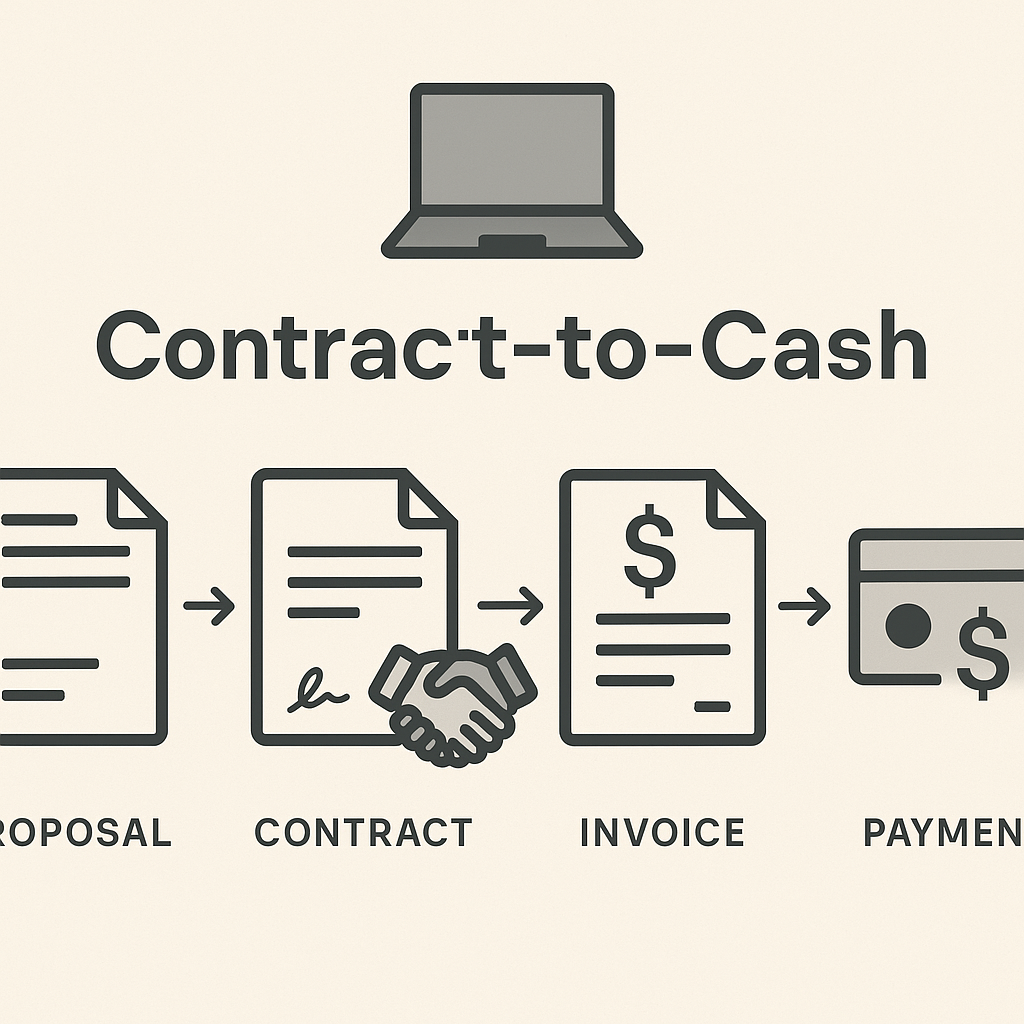
What’s New: Agreements That Get Signed and Paid in One Flow
The latest generation of agreement platforms aimed at freelancers and micro‑businesses is built on a simple premise: the moment a client agrees to terms should also be the moment they commit to paying—either immediately, via deposit, or on a clear schedule. Technically, this means weaving together three capabilities that used to live in separate products:
- Contract creation – turning scope, pricing, and terms into a professional client agreement.
- E‑signature – capturing a legally binding signature in a browser or on mobile.
- Integrated payment – collecting a card, ACH, or wallet payment as part of the signing process, or automatically triggering invoices and payment reminders once signed.
Instead of sending a proposal via email, then a contract via an e‑signature tool, then an invoice via accounting software, and finally a payment link via a payment processor, freelancers can present a single, cohesive flow: review terms → sign → pay.
This trend dovetails with a broader shift among small businesses toward integrated financial and workflow tools. Surveys in 2024 and 2025 show that most SMBs still l
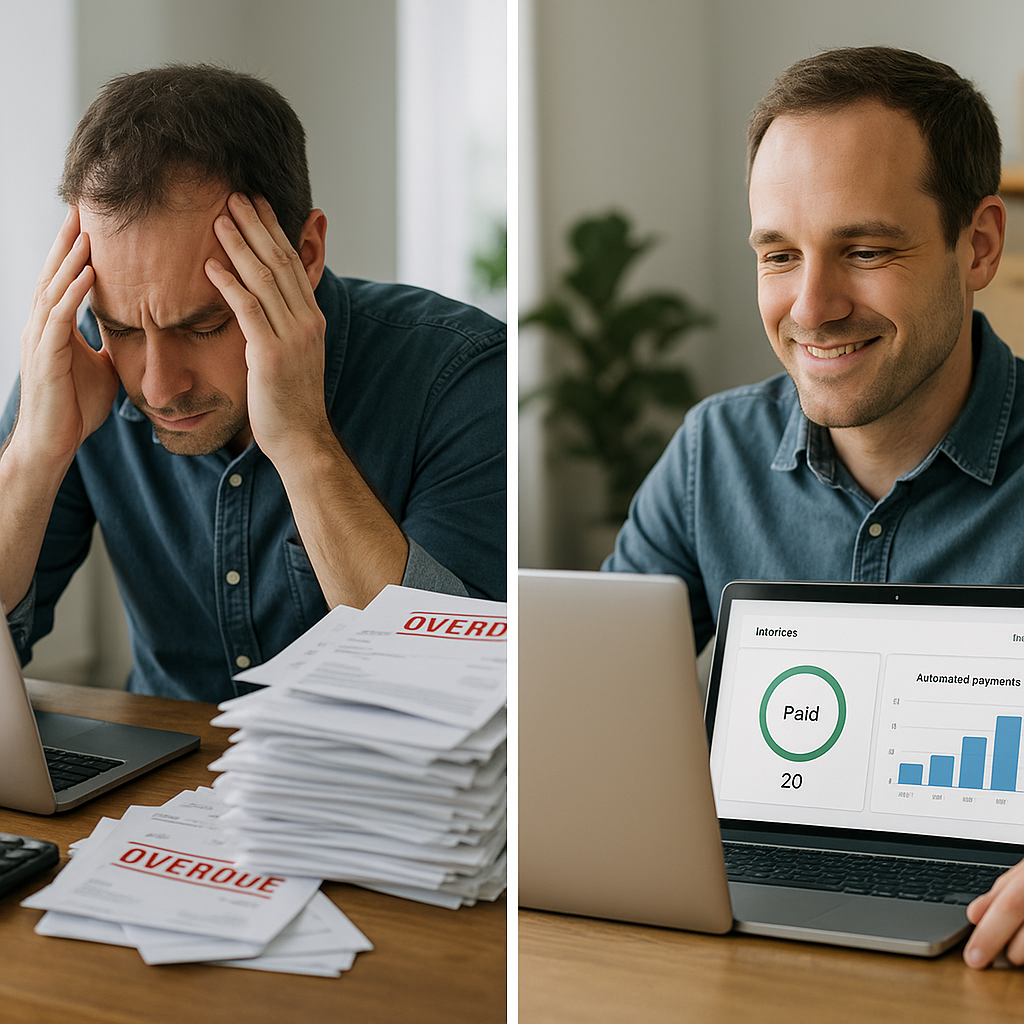
How Integrated Agreement–Payment Platforms Change the Freelancer Workflow
From “Sign, Then Maybe Pay” to “Sign and Pay Now”
Traditionally, a freelancer’s process might look like this:
- Draft contract from a template.
- Upload to an e‑signature tool and send.
- Wait for signature; follow up if needed.
- After signature, create and send an invoice.
- Share a payment link or bank details separately.
- Chase payment when it becomes overdue.
Each step is a potential drop‑off point where clients can delay, ignore, or forget. In a climate where 55% of B2B invoices are already paid late, those gaps matter.(kaplancollectionagency.com)
With an all‑in‑one agreement and payment platform, the workflow compresses:
- Create a contract (often from a guided template).
- Send a single link where the client reviews, signs, and submits payment details.
- Deposit or first installment is collected automatically on signature, or scheduled payments are pre‑authorized.
- The system triggers receipts, reminders, and status updates without manual chasing.
By merging contract acceptance and payment authorization, freelancers effectively turn a “yes” into cash—reducing the risk that good work ends up subsidizing slow‑paying clients.
Reducing Late and Unpaid Invoices
The aim isn’t just convenience; it’s risk mitigation. When payment is structurally tied to agreement signing, several chronic problems are addressed:
- Fewer forgotten invoices – the invoice is auto‑generated and linked to the signed contract.
- Clearer expectations – payment terms (deposits, milestones, late fees) are unambiguous at the moment of acceptance.
- Less manual chasing – automated reminders and card‑on‑file reduce the hours spent pursuing overdue payments, which currently average nearly two full working days per week for many SMEs.(invopilot.com)
- Lower bad‑debt risk – capturing deposits and pre‑authorizations makes it harder for projects to end in total non‑payment.
QuickSign Perspective: A Modern, Affordable Option for Solo and Small Teams
While some integrated platforms in this space are branching out of enterprise or mid‑market stacks, that’s not where most freelancers live. They need something lightweight, affordable, and fast to set up.
QuickSign sits squarely in that niche as a modern, user‑friendly alternative to legacy tools. Unlike enterprise‑focused solutions that often charge per seat and add complexity, QuickSign is built with freelancers, agencies, and small teams in mind.
Key capabilities relevant to this new agreement‑plus‑payments trend include:
- AI Document Generation – Instead of drafting contracts from scratch, users can generate tailored freelancer contracts, NDAs, and service agreements with AI, then refine them for each client engagement.
- Effortless Sending – The workflow is intentionally simple: upload a PDF, drag and drop signature and form fields, and send in a few clicks—ideal for small businesses that don’t have in‑house legal or ops teams.
- Real‑Time Tracking – Status indicators show when a document is sent, opened, signed, or stalled, helping owners identify where a deal is stuck and follow up at the right moment.
- Predictable Pricing – Instead of per‑seat fees, QuickSign offers flat‑rate pricing at $15/month for an entire team, along with a free tier that includes two AI document generations and one document send to unlimited recipients.
Combined with integrated payment platforms—whether embedded directly or via links in the contract process—these features help solo professionals move closer to a true contract‑to‑cash workflow without paying enterprise prices or hiring a back‑office team.
Practical Takeaways for Freelancers and Small Service Businesses
1. Treat Your Contract as the Start of the Payment Workflow
For many service providers, the contract is still seen purely as a legal protection. In a late‑payment environment, it should also be a payment engine. That means:
- Embedding payment terms, milestones, and late‑fee language clearly in the agreement.
- Using tools that can trigger invoices and payment requests automatically once the contract is signed.
- Requesting a deposit or first milestone payment at the moment of signature, not weeks later.
2. Standardize Your Client Agreements With AI
Consistency is key: every deviation from your standard contract is a chance for ambiguity, scope creep, or disputes. AI‑powered document generation—as offered by QuickSign—lets freelancers standardize their agreements around best practices, then adapt details (scope, timeline, pricing) per client in minutes.
This is particularly relevant to the types of service businesses highlighted in popular educational content—such as digital marketing agencies, consulting firms, and local service providers featured in YouTube tutorials about scaling service businesses and starting agencies. Their revenue model depends heavily on repeatable processes and predictable cash flow; standardized, automation‑friendly agreements are a critical building block.
3. Make It Frictionless for Clients to Say “Yes”
The more tools and links a client has to navigate, the more likely they are to delay. All‑in‑one agreement and payment platforms, paired with simple e‑signature tools like QuickSign, reduce friction by creating a single, coherent experience.
- One link to review, sign, and pay.
- No downloads, printing, or scanning.
- Clear, mobile‑friendly layouts for busy decision‑makers.
When clients can approve and pay in under two minutes, “I’ll get to this later” turns into “Let’s get started.”
4. Use Tracking Data to Follow Up Strategically
Real‑time document tracking helps freelancers understand where deals stall:
- If a contract is sent but unopened, a quick check‑in may be all that’s needed.
- If it’s opened multiple times with no signature, the client may have internal questions—an opportunity to jump on a call.
- If it’s signed but payment is pending, automated reminders or updated terms (for example, partial upfront payment) may help close the gap.
Instead of guessing, freelancers can act on data from their e‑signature platform to protect revenue and relationships.
5. Choose Tools That Match Small‑Business Economics
Many freelancers hesitate to adopt new software because of cost and complexity. Flat‑rate, usage‑friendly tools like QuickSign reduce that barrier:
- Free starter tier for occasional or new users (two AI document generations and one send to unlimited recipients).
- $15/month flat rate that covers the whole team as they grow.
- Simple workflows that don’t require consulting, integrations, or dedicated admins.
Paired with an all‑in‑one agreement and payment platform—or used as the e‑signature and contract engine that sits atop your invoicing and payment stack—this allows small operators to benefit from big‑company workflows without big‑company overhead.
What This Trend Signals for the Future of Small‑Business Workflows
The rise of agreement‑plus‑payment platforms signals a broader shift: small businesses no longer want a dozen disconnected apps. They want unified, outcome‑driven workflows—“get signed and paid” rather than “manage documents” and “send invoices” in isolation.
For freelancers and small service businesses, that convergence offers a practical path out of the late‑payment spiral. By redesigning client onboarding so that signature and payment happen together, they can reclaim time, stabilize cash flow, and focus on delivering the work they’re actually being hired for.
As these platforms mature, we’re likely to see deeper integrations across CRM, project management, and accounting, making the handoff from “signed agreement” to “completed project” even more seamless. For now, adopting a modern, affordable e‑signature solution like QuickSign—and pairing it with integrated payments—may be one of the highest‑leverage upgrades a freelancer or small firm can make to their business infrastructure.
Looking for an affordable e-signature solution? Try QuickSign for free - no credit card required.