New Tech-First Law Firm Puts Startup Legal Services on Subscription
Discover how a new tech-first law firm makes startup legal services simple, affordable, and on subscription to power your growth from launch to exit.

New Tech-First Law Firm Puts Startup Legal Services on Subscription
A new wave of “tech-first” law firms is emerging with a simple promise to founders: instead of scrambling between DIY templates, ad hoc legal advice, and expensive hourly rates, early-stage startups can now get core legal work on a predictable monthly subscription. The latest entrant in this space has just closed a pre-seed round to build a highly automated, workflow-driven subscription law firm focused on incorporations, compliance, and contract drafting for young companies.
Backed by growing investor appetite for legaltech and AI-powered workflows, this model aims to sit between generic online templates and traditional law firms—offering vetted legal support at startup-friendly prices, delivered through standardized processes and automation rather than purely billable hours. (reuters.com)
Why Subscription Legal Services Matter for Early-Stage Startups
For founders, legal work is both essential and inconveniently timed. Incorporation, cap table setup, NDAs, contractor agreements, early customer contracts, IP assignments, compliance polices—these show up before there’s real revenue, and often before there’s any formal legal budget.
Historically, many early-stage teams have taken one of two paths:
- DIY templates and generic AI answers, which are cheap but risky when it comes to enforceability, investor expectations, and regulatory nuances.
- Traditional firms billing by the hour, where corporate rates in the U.S. have climbed past $400 per hour on average, putting routine startup work quickly into the four-figure range. (datadab.com)
This mismatch has opened a large gap in the market. At the same time, investors have poured hundreds of millions of dollars into legaltech startups building AI-powered tools for contract review, document drafting, and legal workflows—evidence that both law firms and in-house teams are eager to automate repeatable work. (reuters.com)
The newly launched subscription law firm is explicitly targeting that gap: giving pre-seed and seed-stage companies a way to “rent” an experienced legal team on a subscription that looks more like a SaaS bill than a law firm invoice.

Inside the New Tech-First Law Firm Model
While details vary by provider, this new entrant follows a pattern increasingly visible across legaltech and alternative legal service providers:
- Flat monthly tiers that bundle common startup needs—formation, basic employment and contractor agreements, NDAs, early-stage customer contracts, compliance checklists, and periodic “office hours.”
- Heavy workflow automation for intake, data collection, document assembly, and status tracking, reducing the time lawyers spend on repetitive tasks.
- Standardized playbooks for recurring startup scenarios (e.g., Delaware C‑corp incorporation, seed SAFE rounds, standard SaaS terms) so founders aren’t reinventing the wheel or negotiating from untested templates. (ycombinator.com)
- Usage of AI in the background—for clause suggestions, drafting assistance, and contract comparison—combined with human review to keep quality and compliance high. (reuters.com)
According to recent legaltech funding data, investors increasingly favor hybrid models where AI and automation do the heavy lifting, but licensed attorneys remain responsible for judgment calls and final outputs—exactly the balance these subscription firms are trying to strike. (reuters.com)
“Founders don’t want another generic chatbot—they want fast, predictable answers from someone who actually understands startup law, priced in a way that doesn’t punish them for asking questions.”
In practice, that means early-stage founders can pay a recurring fee instead of a large up-front formation package or unpredictable hourly invoices, and get a mix of:
- Initial incorporation and po
st-incorporation setup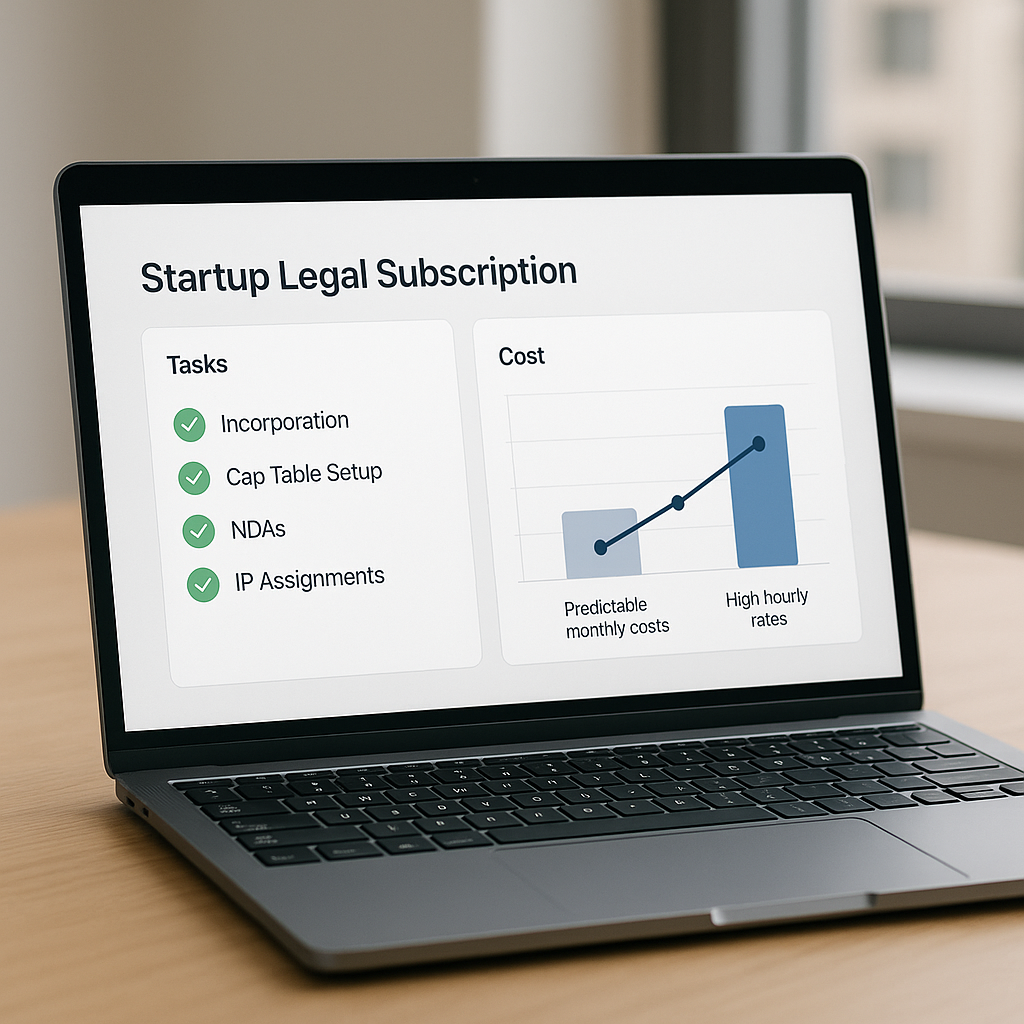
- Core contracts (NDAs, contractor agreements, basic SaaS or consulting terms)
- Light-touch compliance support (policies, checklists, reminders)
- Document review quotas and limited negotiation support per month
What This Means for Small Businesses, Freelancers, and Indie Founders
Although the headline focus is “startups,” the same dynamics affect small businesses and independent professionals. Many solo founders and service businesses still rely on free online templates or recycled documents because paying hundreds of dollars per hour for bespoke advice simply isn’t feasible.
At the same time, legal complexity is creeping downward: privacy and data protection expectations, remote hiring across states and countries, platform terms for app stores and marketplaces, and growing investor or lender diligence—even for very small entities.
Subscription models and automated workflows can shift that equation in several ways:
- Lower, predictable costs: Turning scary one-off legal bills into manageable operating expenses.
- Faster turnaround: Standardized workflows and reusable clause libraries mean contracts and policies can be produced in hours or days instead of weeks.
- Better documentation culture: When legal help is on-demand and predictable, founders are more likely to formalize relationships and document decisions, reducing future risk.
- Closer alignment with digital workflows: These firms are more likely to integrate with cloud tools, CRMs, and e-signature platforms, keeping everything in one digital trail. (en.wikipedia.org)
The Critical Role of Contract Workflows and E‑Signatures
Even the best subscription legal advice is only as effective as the workflows that turn drafts into signed, enforceable agreements. In modern startup operations, that means tight integration between:
- Document generation (often automated or AI-assisted)
- Internal review and approval workflows
- Signature collection and tracking
- Secure storage and audit trails
Contract lifecycle management tools have been standard in large enterprises for years, but they’re often overkill or too expensive for small teams. More recently, a crop of SMB-focused platforms has emerged to provide fast drafting, e‑signing, and workflow automation without enterprise complexity. (ycombinator.com)
This is where e‑signature solutions like QuickSign fit naturally into the new law-firm-as-a-service stack.
QuickSign Perspective: Making Subscription Legal Support Actually Usable
For a founder on a subscription legal plan, the real value isn’t just “having a lawyer”—it’s getting contracts out the door quickly, signed, and tracked. Any friction between the law firm’s output and the startup’s day-to-day tools undermines the promise of speed and predictability.
QuickSign is designed precisely for that gap, pairing well with tech-first legal providers and small firms that work with startups:
- AI Document Generation: Generate foundational contracts (like NDAs, simple service agreements, or basic contractor agreements) using AI, then have your subscription law firm review and customize. This avoids starting from a blank page while still ending with vetted language.
- Effortless Sending: Once your lawyer finalizes a PDF, you can simply upload, drag & drop signature and date fields, and send for signing—no complex setup, no per-seat management.
- Real-Time Tracking: Founders and legal advisors can see when documents are opened, viewed, or signed, keeping everyone aligned on closing investors, customers, or hires.
- Flat-Rate Pricing: Unlike many enterprise-focused tools that charge per user, QuickSign offers flat-rate $15/month pricing for your whole team—aligned with the predictable-cost philosophy behind subscription law firms.
For small law firms experimenting with subscription models themselves, a tool like QuickSign can also become part of the service bundle: simple for clients to use, inexpensive enough to absorb or pass through, and flexible enough to handle everything from one-off NDAs to recurring vendor agreements.
Lessons from Startup Success and Funding Playbooks
Recent discussions on startup success—from classic analyses of timing and product-market fit to modern guidance on fundraising strategy—underscore a familiar theme: operational friction kills momentum. Legal bottlenecks and contract chaos are common offenders. (arxiv.org)
Founders who treat legal infrastructure as part of their “go-to-market stack” rather than a reactive cost center tend to move faster:
- Standardized contract templates that sales and partnerships can use repeatedly
- Pre-negotiated fallbacks and playbooks for key clauses (limitations of liability, SLAs, IP ownership)
- Clear processes for who can sign what, and where those agreements are stored
The new subscription law firm model formalizes that mindset: instead of a sporadic relationship with legal counsel, early-stage companies get continuous, lightweight support plus a consistent playbook—something investors increasingly appreciate when evaluating operational maturity.
Practical Takeaways for Small Business Document Workflows
Whether you’re a venture-backed startup, a small agency, or an independent software consultant, the underlying trends behind this new law firm model carry some clear implications:
- Move away from one-off legal events. Treat legal work as an ongoing process with recurring check-ins, not just something that happens during incorporation or a financing round.
- Standardize, then customize. Start with solid, vetted templates and workflows; use lawyers and AI to refine for edge cases rather than reinventing from scratch every time.
- Integrate legal into your digital stack. Connect your legal workflows with e‑signature, CRM, and document storage tools so you have a single source of truth on deals, hires, and vendor relationships.
- Prioritize predictability. Subscription pricing from legal providers and flat-rate tools like QuickSign make it easier to budget and avoid “fee shock” that causes founders to delay important legal work.
- Leverage AI responsibly. Generic AI answers are not a substitute for licensed advice, but AI-assisted drafting and review—combined with human lawyers—can dramatically speed up routine tasks while controlling costs. (arxiv.org)
How Founders Can Get Ready for Tech-First Legal Partnerships
If you’re considering working with a subscription law firm—or if your existing firm begins adopting similar models—there are a few steps you can take now to make the most of it:
- Inventory your documents: List the contracts and policies you already use (even if they’re DIY) and those you know you’ll need in the next 6–12 months.
- Define approval workflows: Decide who needs to sign off on what (e.g., founder for key customer contracts, operations lead for vendor agreements) and build that into your e‑signature and document tools.
- Centralize storage: Ensure signed contracts live in an organized, searchable location that both your internal team and outside counsel can access.
- Pick tools that scale with you: Choose affordable, intuitive solutions—like QuickSign—that can handle today’s few contracts and tomorrow’s larger volume without forcing a switch to heavyweight enterprise platforms.
The combination of subscription legal services and lightweight, AI-enhanced e‑signature tools gives early-stage teams something they’ve rarely had before: real legal infrastructure that fits both their budget and their pace.
As legaltech investment continues to climb and more firms adopt automation and standardized workflows, small businesses and freelancers stand to benefit from a level of legal sophistication that was once reserved for large enterprises. The challenge—and opportunity—will be stitching together the right mix of expert counsel, smart automation, and frictionless contract workflows.
Looking for an affordable e-signature solution? Try QuickSign for free - no credit card required.