Research Shows Multi‑Agent AI Can Slash Contract Review Time for Small Teams
Discover how multi-agent AI transforms contract review, slashing time for small teams while boosting accuracy, compliance, and deal speed.

Research Shows Multi‑Agent AI Can Slash Contract Review Time for Small Teams
New research in “multi‑agent” artificial intelligence—where several specialized AI agents collaborate on a single task—is starting to show concrete results for one of the most painful jobs in business: reading long, dense contracts. Recent academic work on multi‑agent frameworks for legal agreements suggests that coordinated AI agents can answer questions and review lengthy contracts more accurately than single, general‑purpose models alone, pointing toward a new generation of affordable tools for freelancers, small firms, and non‑lawyer business owners. (aclanthology.org)
From One Big Model to a Team of AI “Specialists”
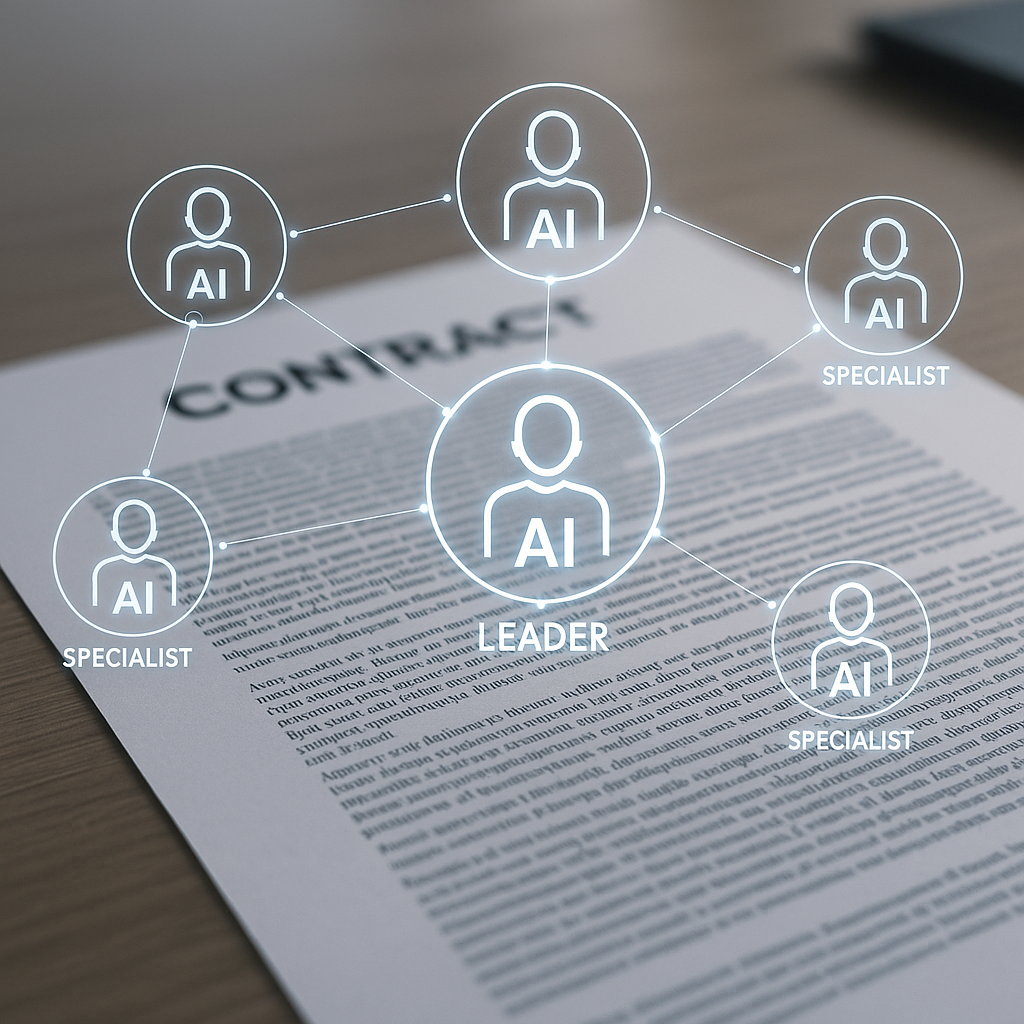
Traditional large language models (LLMs) are powerful, but they struggle with very long documents and detailed reasoning over dozens of pages. A new line of research tackles this by organizing multiple AI agents into a coordinated “team,” where each agent has a specific role—such as reading a subset of pages, checking references, or synthesizing a final answer.
In 2024, researchers introduced LongAgent, a multi‑agent system that breaks long documents (up to 128k tokens—roughly hundreds of pages) into manageable chunks. A leader agent delegates segments to worker agents, then orchestrates a discussion to form a final answer. On long‑document question answering benchmarks, a relatively small open‑source model guided by LongAgent outperformed even frontier models like GPT‑4 on certain tasks, with reported gains of over 16 percentage points in single‑hop questions. (aclanthology.org)
In late 2025, a dedicated legal framework called PAKTON pushed this idea directly into contract review. PAKTON is a fully open‑source, end‑to‑end, multi‑agent framework designed for long legal agreements. It uses specialized agents plus a retrieval‑augmented generation (RAG) component to collaboratively analyze contracts. In evaluations, PAKTON outperformed both general‑purpose and domain‑specific legal models not just in accuracy, but also in explainability, completeness, and grounded justifications—crucial factors when business decisions rest on what’s “actually” in the contract. (arxiv.org)
Key finding: Multi‑agent legal AI systems like PAKTON can deliver more accurate, better‑explained answers to contract questions than single general‑purpose models—especially on long, complex agreements.
Why This Matters for Small Businesses and Freelancers
For many small organizations, the bottleneck in contract work isn’t signing—it’s understanding what you’re about to sign.
- Freelancers struggle with one‑sided client contracts that hide non‑compete clauses, aggressive IP assignments, or unfavorable payment terms.
- Small agencies, consultancies, and SaaS startups juggle NDAs, MSAs, and SOWs, often negotiating against larger enterprises with in‑house legal teams.
- Local service businesses sign leases, vendor agreements, franchising documents, and financing contracts that can run to dozens of pages.
Historically, the options have been limited:
- Pay a lawyer several hundred dollars per hour for each contract review.
- Use generic AI tools that summarize text but may miss legal nuance or hallucinate details.
- Skim and hope for the best—accepting real legal and financial risk.
Multi‑agent legal AI frameworks are designed to address exactly this gap. PAKTON’s authors note that contract review is complex, time‑intensive, and heavily reliant on scarce legal expertise, making it inaccessible to non‑experts. Their framework specifically targets long legal agreements while respecting confidentiality constraints by relying on open‑source components that can be run in more controlled environments. (aclanthology.org)
For small teams, the implications are clear: instead of a single AI “generalist” reading a contract once, you can have a coordinated set of AI specialists:
- One agent focuses on parties, dates, and amounts.
- Another tracks termination, renewal, and auto‑renew clauses.
- Another scans for liability caps, indemnit
y, and IP ownership.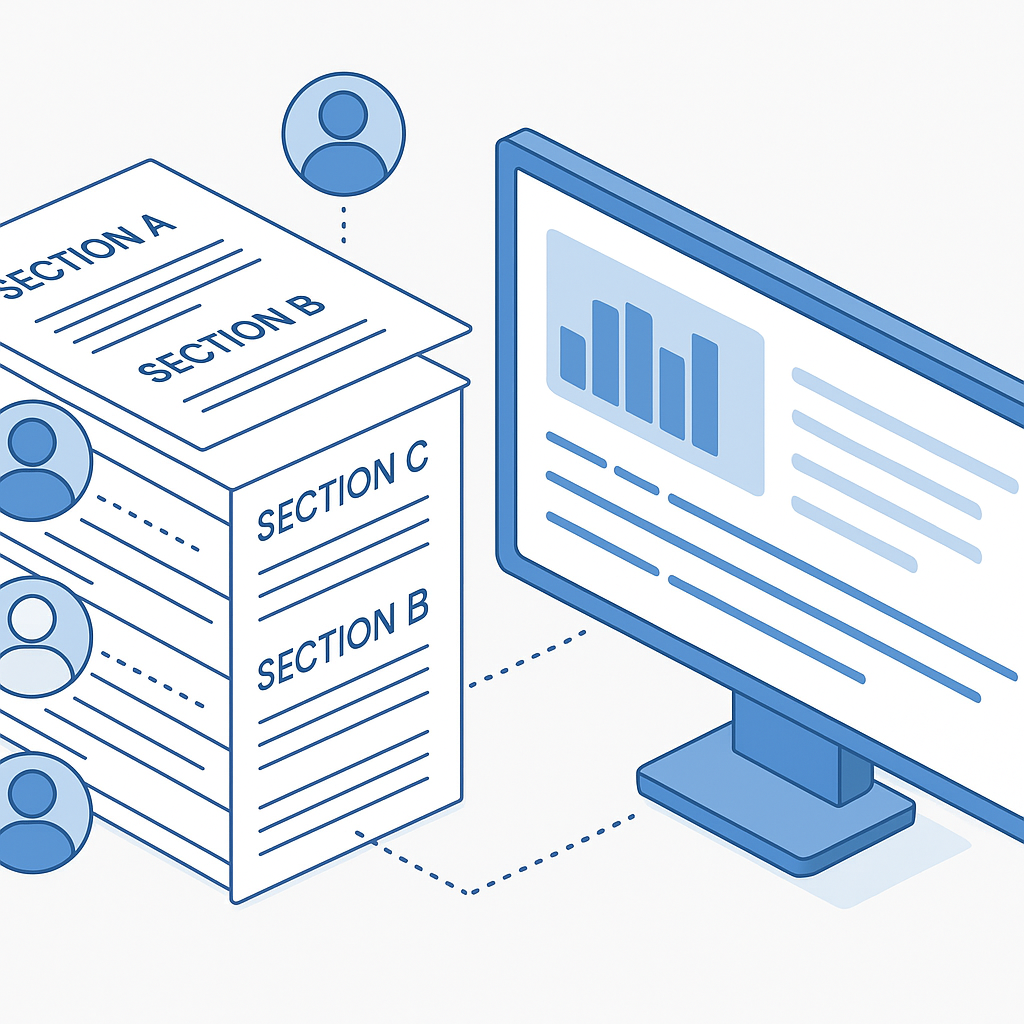
- A final “reviewer” agent checks consistency and synthesizes the core risks into plain language.
This mirrors how a human legal team might divide labor—but in software, at a fraction of the cost and time.
What Recent Research Actually Shows
Across several strands of recent work, a consistent picture is emerging:
- Better performance on long documents: LongAgent’s collaborative strategy yields significant improvements vs. single models on question answering over long texts, proving that structured multi‑agent coordination can tame very large inputs. (aclanthology.org)
- Higher accuracy and explainability in legal tasks: PAKTON’s evaluations show gains in predictive accuracy, retrieval performance, completeness, and grounded justifications compared with both general LLMs and specialized legal models. (aclanthology.org)
- Improved faithfulness and coverage in document QA: Other multi‑agent frameworks, such as CIR3 for collaborative question‑answer generation, demonstrate increased comprehensiveness and faithfulness (+23 and +17 points respectively in one study), highlighting how multiple agents cross‑check each other’s work. (sciencedirect.com)
- Domain‑specific contract management benefits: Multi‑agent methods applied to contract management scenarios show better accuracy and relevance when combining structured and unstructured sources, such as PDFs plus contract databases. (scisimple.com)
In practical terms, this means an AI system can now:
- Ingest a long contract (or a stack of related documents).
- Break it into sections for different agents to analyze.
- Run a coordinated review where agents debate, cross‑check, and refine answers.
- Produce a concise, referenced explanation of key points, with links to exact clauses.
For a small business owner, that translates directly into reduced time spent reading and re‑reading legalese—and fewer surprises after the contract is signed.
Understanding Multi‑Agent and Agentic AI (In Plain English)
If you’re new to the concept of AI “agents,” there’s a growing ecosystem of explainer content. Popular tutorials on agentic AI describe how agents differ from static chatbots: instead of just answering a prompt, an agent can plan, call tools, and act in sequences toward a goal. Multi‑agent systems extend this idea by letting multiple agents collaborate—debating, critiquing, and refining each other’s work to reach better answers.
While most of these videos speak broadly about software development and data workflows, the same patterns map neatly onto contract review: one agent ingests the PDF, others extract data, another flags risks, and a coordinator agent assembles a final, human‑readable brief.
How This Connects to E‑Signatures and QuickSign
Multi‑agent contract review doesn’t replace e‑signature tools—it makes them more powerful and less risky for small teams.
A common workflow today looks like this:
- Receive a contract as a PDF.
- Skim or send to a lawyer for review (often under time pressure).
- Upload to an e‑signature platform, place signature fields, send.
As multi‑agent AI frameworks mature, that workflow can be upgraded:
- Upload the draft to an AI‑aware platform.
- Run a multi‑agent review that extracts key terms, flags risky clauses, and answers your questions in plain English.
- Make edits or negotiate based on specific, AI‑highlighted issues.
- Once finalized, send via e‑signature—confident you understand what you’re signing.
This is where modern tools like QuickSign come in. Unlike legacy e‑signature systems that focus solely on collecting signatures, QuickSign is built for small teams that want to generate, understand, and execute documents in a single, streamlined flow.
QuickSign’s Role in a Multi‑Agent Future
QuickSign already leans into AI‑assisted legal workflows with:
- AI Document Generation: Generate contracts, NDAs, and other legal templates with AI, giving small businesses a fast starting point instead of wrestling with templates from scratch.
- Effortless Sending: Upload a PDF, drag and drop signature and form fields, and send in a few clicks—no training required.
- Real‑Time Tracking: See who has opened, viewed, and signed your documents, and nudge signers as needed.
- Affordable Pricing: A flat‑rate plan at $15/month for the whole team, instead of per‑seat enterprise pricing that punishes growth.
- Generous Free Tier: Test the workflow with 2 AI document generations and 1 document send to unlimited recipients, ideal for freelancers validating a new tool.
As multi‑agent contract review frameworks move from labs into production, platforms like QuickSign are well‑positioned to integrate them into everyday workflows—so that generating a contract, reviewing it with AI, and collecting signatures all happens in one place, at a price point small businesses can actually afford.
Practical Takeaways for Small Teams
The research is promising, but how should a small firm or independent professional act on it today?
1. Treat AI as a First‑Pass Reviewer, Not a Lawyer
Multi‑agent systems can quickly surface key clauses, deadlines, and red flags, but they’re not a substitute for professional legal advice. Use them to:
- Get a fast, structured overview of the contract.
- Compile a list of specific questions for your attorney.
- Compare multiple versions of an agreement and spot changes.
This alone can dramatically reduce the hours you’re billed for, because your lawyer spends more time answering targeted questions and less time on routine extraction.
2. Prioritize Tools That Explain Themselves
One of PAKTON’s notable contributions is its focus on grounded justifications—tying answers back to specific clauses. (aclanthology.org) For small businesses, that’s critical. When evaluating tools (or workflows you build with general AI), look for features like:
- Inline citations to contract sections.
- Side‑by‑side clause excerpts with plain‑language explanations.
- Summaries broken down by risk category (payment, liability, IP, termination).
This makes it easier for a non‑lawyer to verify AI output and for a lawyer to review it efficiently.
3. Start with High‑Leverage Document Types
Not all contracts are equal in impact. Apply AI review where it moves the needle most:
- Client MSAs and SOWs that define revenue and scope.
- Office or equipment leases with long‑term commitments.
- Vendor agreements that can lock in pricing and obligations for years.
- Employment and contractor agreements that define IP ownership and non‑competes.
For each, pair AI review with a clean e‑signature flow. Generate or upload the agreement, review it with AI, send via QuickSign, and track completion—all in one pass.
4. Watch the Multi‑Agent Space—But Don’t Wait to Digitize
Multi‑agent frameworks like LongAgent, PAKTON, and CIR3 are still evolving, and many are currently research prototypes. (aclanthology.org) But small teams don’t need to wait for “perfect” multi‑agent products to benefit. The biggest gains often come from simply:
- Moving away from email and paper for contracts.
- Using AI to generate initial drafts and summaries.
- Standardizing on one e‑signature + document workflow platform.
Once your workflow is digital and centralized—using a tool like QuickSign—you can layer in more advanced AI review features as they become available.
The Bottom Line
The evidence from recent academic work is clear: carefully orchestrated multi‑agent AI systems can understand and question long documents more effectively than single general‑purpose models, and early legal‑specific frameworks like PAKTON show that this approach maps well to real‑world contract review. For small businesses, freelancers, and independent professionals, that opens the door to faster, cheaper, and more accessible understanding of the agreements that govern their revenue, risk, and relationships.
Looking for an affordable e-signature solution? Try QuickSign for free - no credit card required.