Rising AI Adoption Creates New Opportunities and Risks for SMB Contract Work
Discover how rising AI adoption reshapes SMB contract work. Explore generative AI opportunities, hidden risks, and strategies to stay competitive.

Rising AI Adoption Creates New Opportunities and Risks for SMB Contract Work
Generative AI is moving rapidly from hype to everyday tool in the world of contracts—and small businesses are on the front line of that shift. Recent surveys show AI use among lawyers and small firms has surged in the past year, especially for drafting and reviewing contracts and other routine documents. (msba.org) For small businesses and independent professionals who rely on contracts, NDAs, and service agreements, that can mean faster and more affordable legal support—but it also raises fresh questions about quality control, confidentiality, and how to embed AI safely into e-signature workflows.
AI Goes Mainstream in Smaller Firms
Across the economy, small businesses are embracing generative AI at a brisk pace. A recent Gusto analysis finds that around half of U.S. small businesses are now incorporating generative AI into their operations, using it to automate tasks like content creation, data entry, and report drafting. (gusto.com) Another national review by the U.S. Census Bureau notes that very small firms have shown “relatively high AI use rates” through 2023 and 2024, particularly as AI tools get embedded into everyday software. (census.gov)
The legal sector—long seen as conservative in its tech adoption—is catching up quickly, including at the smaller end of the market. The American Bar Association’s 2024 Legal Technology Survey data, summarized by state bar groups, shows generative AI use in law firms jumping from around 11% in 2023 to 30% in 2024, with solo and small firm practitioners posting some of the sharpest percentage increases in AI use. (msba.org) A 2025 legal industry report similarly finds that roughly one in five firms report firm-level use of generative AI and nearly a third of individual legal professionals are using it at work, often outside formal firm programs. (fedbar.org)
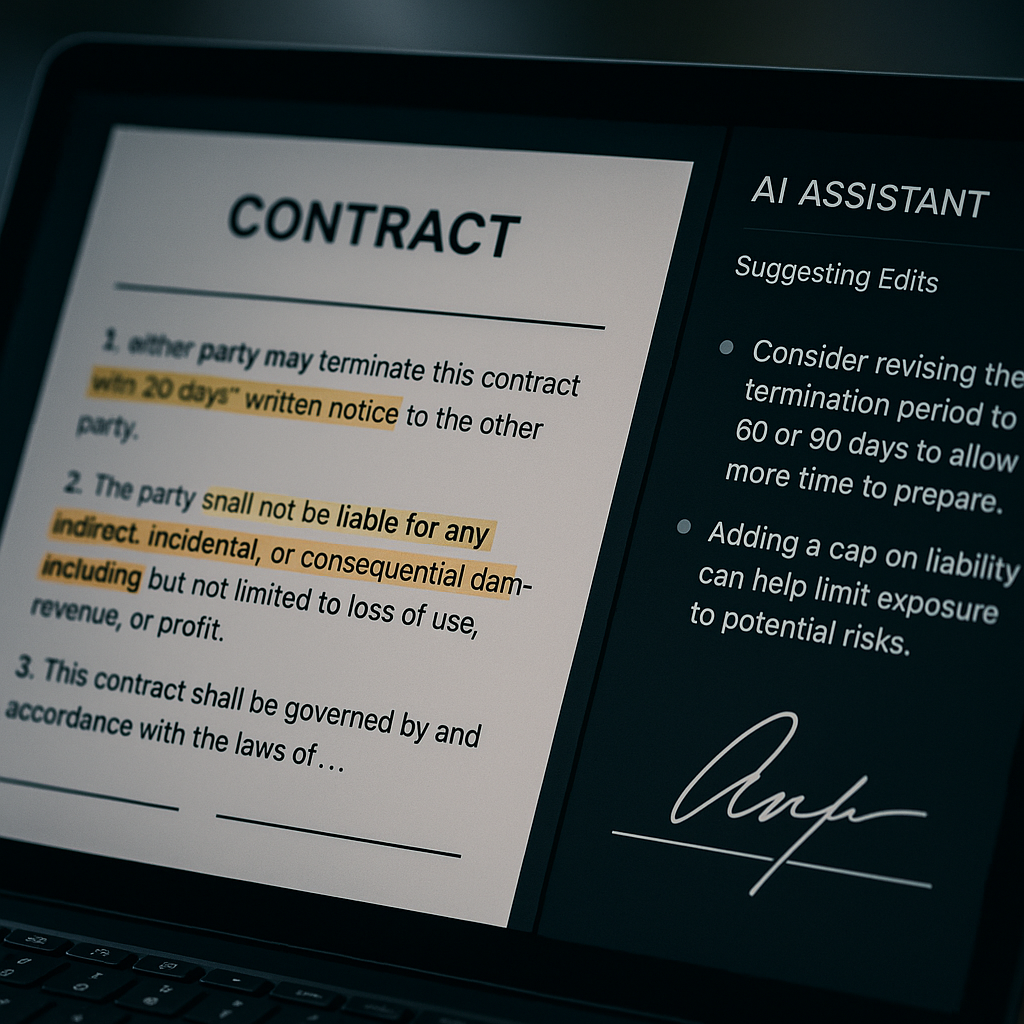
Contract work is one of the first targets. Drafting and reviewing standardized agreements—client service contracts, NDAs, employment offers, and vendor terms—is time-consuming but often follows recognizable patterns. That makes it an ideal fit for generative AI, which can quickly produce first drafts, summarize complex clauses, and suggest alternative wording.
Key shift: In many small practices, generative AI is now the “junior associate” for contract work—producing drafts in minutes that lawyers then refine, rather than starting from a blank page.
Why This Matters for Small Businesses and Freelancers
For small businesses and independent professionals, AI-assisted contract work can bring three immediate benefits:
- Faster turnaround: Routine agreements can move from request to signature in hours instead of days when lawyers and in-house staff use AI to generate and revise drafts.
- Lower costs: When attorneys spend less time on repetitive drafting, they can offer flat fees or lower hourly bills for standard contracts.
- More experimentation: Small businesses can more affordably test new contract templates—for partnerships, retainers, or subscription services—because generating variants is faster and cheaper.
Surveys of small businesses using AI echo this productivity story: AI adopters report time savings, cost reductions, and more capacity to grow or hire. (gusto.com) Many small-business respondents say AI helps them compete more effectively with larger firms, both in how quickly they can respond to opportunities and

But speed and savings only matter if the resulting contracts are enforceable, accurate, and aligned with the business’s risk tolerance. That’s where the emerging downsides—and responsibilities—begin.
New Legal Risks: Hallucinations, Confidentiality, and Compliance
1. The “hallucination” problem in contracts
Generative AI tools are powerful pattern matchers, not legal databases. High-profile cases in recent years have shown lawyers sanctioned for submitting AI-generated briefs packed with fictitious citations and mischaracterized case law, prompting judges and bar associations to issue warnings and guidance. (theverge.com)
While contract drafting is somewhat different from litigation briefs, the core risks carry over:
- Invented clauses or standards that sound plausibly “legal” but don’t match any governing law or industry practice.
- Inconsistent language across sections that can create ambiguity or unintended obligations.
- Hidden jurisdictional issues, where AI reuses language optimized for a different state or country.
Bar association guidance now stresses that lawyers must verify AI-generated content and remain fully responsible for its accuracy—AI cannot be treated as an authoritative source. (forbes.com) For small-business clients, this means AI can make legal work faster, but it does not remove the need for qualified human review.
2. Confidentiality and data privacy
Confidentiality may be the most acute AI risk in contract work for SMBs. Many popular AI tools—especially public, consumer-facing chatbots—log prompts and may use them to train models, unless a business is on a specific enterprise or private plan. Legal-ethics experts warn that entering client names, deal specifics, or proprietary information into such systems can expose sensitive data and risk attorney–client privilege. (forbes.com)
The Illinois State Bar Association, among others, now advises lawyers to avoid entering personally identifiable information or trade secrets into public AI tools and to review each platform’s terms of service before use. (isba.org) Academic researchers are also exploring privacy-preserving frameworks that mask or anonymize client details when lawyers work with large language models. (arxiv.org)
For SMBs, the key question is no longer “Is my lawyer using AI?” but “How is my lawyer protecting my confidential information when they use AI?”
3. Evolving ethical and regulatory expectations
Bar associations and courts are rapidly issuing opinions and rules on AI use in legal practice, touching on competence, supervision, disclosure, and data handling. Recent American Bar Association guidance emphasizes that lawyers should consciously decide whether and how to use generative AI in each matter—and be ready to justify that decision—while maintaining traditional duties of competence and confidentiality. (forbes.com)
This environment is still in flux, but for small-business clients, it introduces new questions to raise with counsel about AI-related policies and safeguards.
What SMBs Should Ask Their Lawyers About AI and Contracts
Given the rapid changes, small businesses and freelancers don’t need to micromanage how their counsel works—but they should be informed customers. Practical questions to consider:
- Do you use generative AI in drafting or reviewing our contracts? If so, in which parts of the workflow (e.g., first drafts, clause suggestions, checklists)?
- What tools do you use, and are they configured for legal use? Are they public consumer tools, or privacy-focused/legal-specific platforms?
- How do you protect our confidential information? Do you avoid entering identifiable client or deal details into public AI models? Do you anonymize or mask data?
- What quality controls are in place? Who reviews AI-generated drafts? Do lawyers compare language against up-to-date law and firm-approved templates?
- Can AI use lower our costs or speed up turnaround? How is that reflected in your pricing model (flat-fee contracts, subscription arrangements, etc.)?
Clear answers signal that a firm is treating AI as a professional tool—not a shortcut that shifts risk onto the client.
Embedding AI into SMB Contract & E-Sign Workflows
As AI becomes more “agentic”—capable not just of writing text but orchestrating tasks across systems—its value will increasingly be measured at the workflow level: moving from intake, to drafting, to review, to e-signature and storage with minimal friction. That vision is already visible in new generations of AI “copilots” that can monitor inboxes, suggest responses, and trigger document workflows.
For small businesses, the sweet spot is using generative AI in tightly scoped, high-impact parts of the contract lifecycle:
- Template creation: Generate first drafts of standard agreements (service contracts, NDAs, SOWs) that a lawyer or experienced operator can refine once, then reuse.
- Clause comparison: Summarize differences between a counterparty’s contract and your standard template to speed up review sessions with counsel.
- Risk flagging: Highlight unusual termination, indemnity, or IP clauses that warrant closer legal attention.
- Summaries for stakeholders: Create plain-language summaries of key contract terms for non-legal decision-makers.
When connected directly to an e-signature and document-management platform, these AI-enhanced steps can cut days from the time between “let’s do a deal” and “fully signed contract on file.”
QuickSign Perspective: AI-Ready Workflows for Small Businesses
This is the gap platforms like QuickSign aim to fill for small businesses, freelancers, and lean teams that don’t have in-house legal departments.
Rather than bolting AI onto legacy enterprise systems, QuickSign is built around a streamlined contract workflow:
- AI Document Generation: Generate contract templates and NDAs directly inside the platform, so AI drafting is tied from the start to a structured, sign-ready document.
- Effortless sending: Upload a PDF, drag-and-drop signature and form fields, and send for signature in a few clicks—no complex admin console required.
- Real-time tracking: See when documents are opened, viewed, and signed, closing the loop between AI-assisted drafting and final execution.
- SMB-friendly pricing: Instead of per-seat enterprise pricing, QuickSign offers a flat-rate $15/month plan for the whole team, plus a free tier with 2 AI document generations and 1 document send to unlimited recipients—designed for small firms and solo professionals experimenting with AI-driven workflows.
For small businesses wary of both cost and complexity, this model allows them to test AI-generated contracts and digital signatures incrementally, without committing to heavy software suites or large legal-tech budgets. Unlike many enterprise-focused solutions, QuickSign’s flat-rate pricing and free tier are built around the realities of small teams that need flexibility as they grow.
Practical Takeaways for SMB Leaders
Business owners and independent professionals don’t need to become AI engineers—or lawyers—to benefit from these changes. But they do need a clear view of their role in managing risk.
- Assume AI is already in the loop. Your lawyer or consultant may already be using generative AI for research or drafting. Ask about it directly and clarify expectations around confidentiality and review.
- Use AI where standardization helps, not where nuance dominates. Routine agreements with well-understood patterns are prime candidates; complex, high-stakes deals still demand bespoke legal attention.
- Keep sensitive details out of unvetted tools. If your team experiments with public AI chatbots, train staff not to paste contracts containing PII, trade secrets, or confidential deal terms.
- Connect AI to your e-sign workflow. Generating a draft is only half the job; integrating AI-assisted drafting with your e-signature platform reduces errors from copy-paste and version sprawl.
- Pilot, then standardize. Start with one contract type—say, your standard services agreement—and work with counsel to approve an AI-assisted template. Once stable, deploy it widely through a platform like QuickSign for consistent, trackable use.
AI will not replace lawyers for small businesses anytime soon—but lawyers and SMBs who learn to use AI responsibly will increasingly outpace those who don’t.
As generative AI adoption among small firms and legal professionals continues to rise, the opportunity for small businesses is clear: faster, more flexible contract processes at a fraction of yesterday’s cost. The challenge is to pair that efficiency with disciplined safeguards around quality, confidentiality, and compliance—ideally embedded directly into the tools that handle drafting, signing, and tracking.
Looking for an affordable e-signature solution? Try QuickSign for free - no credit card required.