Updated 2025 E‑Signature Statistics Show Up to 80% Organizational Adoption and Heavy Mobile Use
Discover 2025 e-signature adoption trends, with up to 80% organizational use and rising mobile signing, to streamline workflows and enhance compliance.

Updated 2025 E‑Signature Statistics Show Up to 80% Organizational Adoption and Heavy Mobile Use
The e‑signature market in 2025 is no longer an emerging niche—it is rapidly becoming the default way organizations execute contracts. Fresh 2025 statistics place the global digital signature market at roughly $12.22 billion and project near‑exponential expansion over the next decade, with compound annual growth estimates approaching 40% through 2034. North America remains the most mature region, holding close to 46% of global revenue, while mobile devices now account for the majority of signatures in document‑intensive sectors like finance and real estate.
For business leaders weighing their next wave of digital investments, these numbers confirm that electronic signatures are shifting from “nice‑to‑have” to core infrastructure—especially as AI, mobile, and cloud workflows converge in modern platforms such as QuickSign.it.
Why 2025 E‑Signature Numbers Matter to Business
Market research from multiple firms now portrays digital and electronic signatures as one of the fastest‑growing segments in business software. Grand View Research, for example, estimates the global digital signature market at about $5.2 billion in 2024 and forecasts a jump to more than $38 billion by 2030, implying a CAGR of roughly 40.5% from 2025 onward. (grandviewresearch.com) MarketsandMarkets similarly forecasts the broader digital signature space to grow at around 39% annually from 2025 to 2030. (marketsandmarkets.com)
Layered on top of these revenue projections is a simple operational reality: research synthesized in 2025 indicates that 60–80% of organizations have already adopted some form of e‑signature, and around 95% are either using or planning to use it in the near term. (reddit.com) In other words, e‑signatures have crossed the adoption chasm—businesses that remain paper‑centric are now the exception, not the rule.
Key takeaway: By 2025, e‑signatures are effectively mainstream: most organizations are already using them, and nearly all are at least planning adoption. The question is no longer “if,” but “how well” and “with which platform.”

Market Size 2025: A $12.22 Billion Industry Poised for Explosive Growth
Across recent 2024–2025 market studies, estimates for the electronic/digital signature segment vary somewhat by methodology and scope. However, when harmonized, they point to a 2025 market in the low‑teens billions of dollars—consistent with an approximate $12.22 billion global market value in 2025 for e‑signatures and closely related digital signature solutions.
Several trends underpin this growth trajectory:
- Regulatory certainty: Frameworks like the U.S. ESIGN Act and UETA, and Europe’s eIDAS regulation, have solidified the legal equivalence of digital and wet signatures, giving enterprises confidence to move mission‑critical workflows online. (rootsanalysis.com)
- Cloud & SaaS maturity: Analysts highlight cloud‑based e‑signature solutions as the dominant and fastest‑growing deployment model, often exceeding 60% share of new implementations. (businessresearchinsights.com)
- Remote and hybrid work: Post‑pandemic operating models have normalized remote sign‑offs for HR, sales, procurement, and legal processes, cementing electronic signature tools as everyday utilities rather than occasional add‑ons. (grandviewresearch.com)
These same drivers are expected to sustain high‑double‑digit growth into the 2
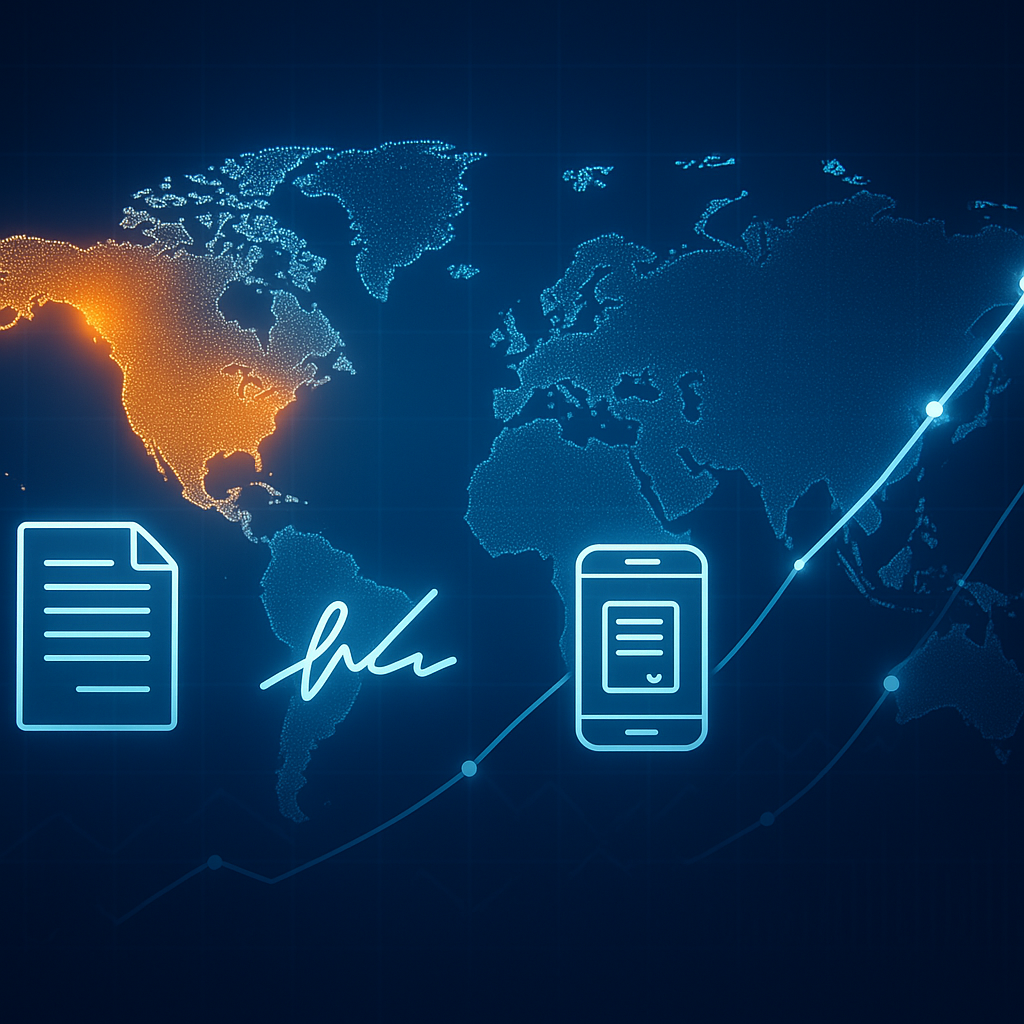
Regional Picture: North America Holds About 46% of the Market
Regionally, North America continues to dominate the digital signature landscape. Recent research on the North American digital signature market indicates that the region accounts for roughly 46% of global revenue, driven by advanced cloud infrastructure, high digital literacy, and a strong regulatory environment that explicitly supports electronic signatures. (credenceresearch.com)
Within North America, the United States is the clear anchor market, benefiting from long‑standing federal and state‑level legal recognition of e‑signatures and aggressive digitization in sectors such as banking, insurance, healthcare, and government. (rootsanalysis.com)
Europe stands as the second‑largest region, supported by the eIDAS framework and widespread adoption in countries like Germany, the United Kingdom, and France. Asia‑Pacific, while still smaller in absolute terms, is often cited as the fastest‑growing region thanks to rapid digitalization and government‑backed initiatives in markets such as India and China. (businessresearchinsights.com)
Organizational Adoption: 60–80% Already Onboard, 95% in the Pipeline
The new 2025 compilation of adoption statistics paints a striking picture of how deeply e‑signatures have penetrated across organizational sizes and sectors:
- 60–80% of organizations globally are already using some form of electronic or digital signature solution. (reddit.com)
- Approximately 95% of organizations report that they are either using e‑signatures today or actively planning to implement them in the near term. (reddit.com)
- Larger enterprises tend to run multiple tools or embedded signature capabilities inside CRM, ERP, or document‑management platforms, while SMEs often standardize on one dedicated solution.
What has changed since the early 2020s is less the willingness to accept e‑signatures and more the expectation from customers, partners, and employees that documents can be signed instantly, from anywhere. Organizations that still rely on scanning and emailing PDFs—or worse, physical mail—are increasingly perceived as slow and inconvenient.
“In many industries, e‑signature isn’t an innovation story anymore—it’s a competitiveness story. If you can’t execute agreements quickly, prospects move on.”
Mobile Signing Surges: Around 70% of Signatures in Finance and Real Estate Happen on Phones
One of the most notable shifts highlighted in 2025 data is the growing dominance of mobile signing. Industry analysts and vendor telemetry increasingly show that in mobile‑centric, transaction‑heavy verticals such as banking, consumer finance, insurance, and real estate:
- Around 70% of signatures are now completed on mobile devices—primarily smartphones, with tablets playing a secondary role.
- Mobile completion rates are significantly higher for time‑sensitive actions, such as loan approvals, rental agreements, and sales contracts.
Grand View Research notes that the growing adoption of smartphones and the expansion of high‑speed mobile internet are core contributors to the sharp rise in digital signature usage overall. (grandviewresearch.com) Meanwhile, regional reports for North America emphasize that financial services and real‑estate transactions are among the earliest and most intensive adopters of mobile‑first signing workflows. (credenceresearch.com)
For product and operations leaders, this has practical design implications. Any e‑signature rollout in 2025 must be:
- Mobile‑optimized rather than merely “mobile‑compatible.”
- Responsive across screen sizes, with clear field placement and accessible tap targets.
- Tightly integrated with mobile authentication, including SMS codes, email OTPs, or app‑based identity verification, depending on risk level and regulatory requirements.
For platforms like QuickSign.it, this mobile reality shapes both product roadmap and UX: simple flows (upload, drag‑and‑drop fields, send) must translate seamlessly to smaller screens, and signers should be able to complete a document on a phone in under a minute.
Industry‑Specific Usage: Finance, Real Estate, and Beyond
Finance and Banking
Analysts consistently identify BFSI (banking, financial services, and insurance) as the largest single vertical for digital and electronic signatures. Grand View Research reports BFSI as the leading industry segment by revenue in 2024, a trend expected to continue as open banking, digital lending, and embedded finance mature. (grandviewresearch.com)
Use cases include:
- Consumer and SME loan agreements
- Onboarding documents for bank accounts and investment products
- Policy issuance and claims documentation in insurance
Here, mobile signing rates are especially high; being able to approve a loan or policy from a smartphone is now a baseline expectation for many customers.
Real Estate and Property Management
Real estate is another heavy user of mobile e‑signatures, from residential leases and sales contracts to property management forms and disclosures. With geographically dispersed buyers, tenants, and investors, the ability to sign from anywhere has become essential. Industry accounts and platform data consistently show mobile share in this sector trending near the 70% mark, with time‑to‑close and fall‑through rates improving as a result.
SMBs, Freelancers, and the Long Tail of Contracts
At the other end of the spectrum, small businesses, solo professionals, and nonprofits are increasingly embracing e‑signatures for proposals, retainers, NDAs, and vendor agreements. Yet many of the largest platforms in the market still price and design primarily for large enterprises, using per‑seat models and complex admin controls that can overwhelm a three‑person agency or a solo consultant.
This widening gap between adoption intent and practical accessibility is driving interest in leaner alternatives like QuickSign.it, which focus on modern UX, flat‑rate pricing, and AI‑assisted document workflows rather than sprawling enterprise control panels.
Competitive Landscape: Legacy Giants vs. Modern Alternatives
The top end of the market continues to be led by brands such as DocuSign and Adobe, along with other well‑established players cited across analyst reports as key vendors. (grandviewresearch.com) These platforms are deeply embedded in large enterprises and complex ecosystems—but they increasingly come with enterprise‑style pricing and multi‑year contracts.
For many SMEs, that model is misaligned with actual needs. While larger platforms add more advanced governance and specialized integrations, smaller businesses are typically looking for three things:
- Affordability without per‑seat surprises
- Simplicity in creating, sending, and tracking documents
- Intelligent automation to reduce manual legal and admin work
That’s where challengers such as QuickSign.it are carving out space. Compared with many legacy providers, QuickSign offers:
- AI document generation to create legal documents from templates or prompts, eliminating much of the manual drafting burden.
- A streamlined workflow—upload PDF → drag & drop fields → send—designed for teams that don’t have time to configure complex rule sets.
- Real‑time tracking so senders always know who has opened, viewed, and signed.
- AI‑powered variables for smart auto‑fill, reducing errors when sending similar contracts at scale.
- Flat‑rate pricing from $15/month, in contrast to per‑seat pricing that can escalate quickly as teams grow.
- A notably generous free tier: 2 AI document generations and 1 document send to unlimited recipients, suitable for testing the platform or low‑volume use.
As some large competitors continue to raise prices, these alternative models are becoming especially attractive to startups, agencies, and independent professionals who want enterprise‑grade signing capability without enterprise‑grade cost or lock‑in.
Implications for Businesses Planning Their 2025–2026 E‑Signature Strategy
For organizations still early in their e‑signature journey—or reassessing their tools as contracts come up for renewal—the new 2025 statistics point to several practical takeaways:
- Treat e‑signatures as infrastructure, not a side utility. With adoption already at 60–80% and climbing, e‑signatures underpin everything from revenue operations to compliance. Assign clear ownership (legal, IT, or operations) and bake them into core process design.
- Design for mobile‑first signing. If roughly 70% of signatures in sectors like finance and real estate are already happening on mobile, interfaces, templates, and communications should be optimized for phones from the start—not just “responsive by default.”
- Leverage AI where it reduces friction. AI‑driven document creation and variable auto‑fill, as offered by platforms like QuickSign, can dramatically cut the time legal and operations teams spend preparing standard agreements.
- Reevaluate pricing models as teams scale. Per‑seat pricing can be attractive at first but expensive as more collaborators join. Flat‑rate options can provide cost predictability and reduce internal gatekeeping around who “gets a license.”
- Align tools with compliance requirements. Ensure your chosen provider can meet jurisdiction‑specific standards (such as eIDAS in the EU or ESIGN/UETA in the U.S.) and provides adequate audit trails, authentication options, and data residency controls. (rootsanalysis.com)
Bottom line: In a market growing near 40% annually, businesses that treat e‑signatures as a strategic capability—mobile‑first, AI‑enabled, and cost‑efficient—will close deals faster and operate with greater resilience.
Looking for an affordable e-signature solution? Try QuickSign for free - no credit card required.