What a 40.1% CAGR Really Means – And How to Harness Growth with Modern E‑Signatures
Unlock what a 40.1% CAGR really means and how modern e‑signatures can fuel explosive, sustainable growth. Learn to harness CAGR 40.1% in your business.
What a 40.1% CAGR Really Means – And How to Harness Growth with Modern E‑Signatures
If you work in a growing business, you’ve probably seen numbers like “CAGR 40.1%” in market reports, pitch decks, or internal plans. A 40.1% compound annual growth rate sounds impressive—but what does it actually mean for your revenue, operations, and the way you manage documents and signatures?
In fast-expanding markets like digital signatures and e‑signatures, high CAGRs are common. Asia-Pacific’s digital signature sector alone is projected to grow at around a 40.1% CAGR between 2025 and 2030, driven by government digitalization, e‑commerce, and cloud adoption. (esignglobal.com) That kind of growth reshapes how organizations handle contracts, approvals, and compliance—and it’s exactly the environment where a modern platform like QuickSign can transform your document workflows.
This article breaks down what “CAGR 40.1%” means in plain language, why such high growth rates matter for document signing, and how to use QuickSign.it to stay ahead while the market explodes around you.
Understanding CAGR 40.1% in Simple Terms
What is CAGR?
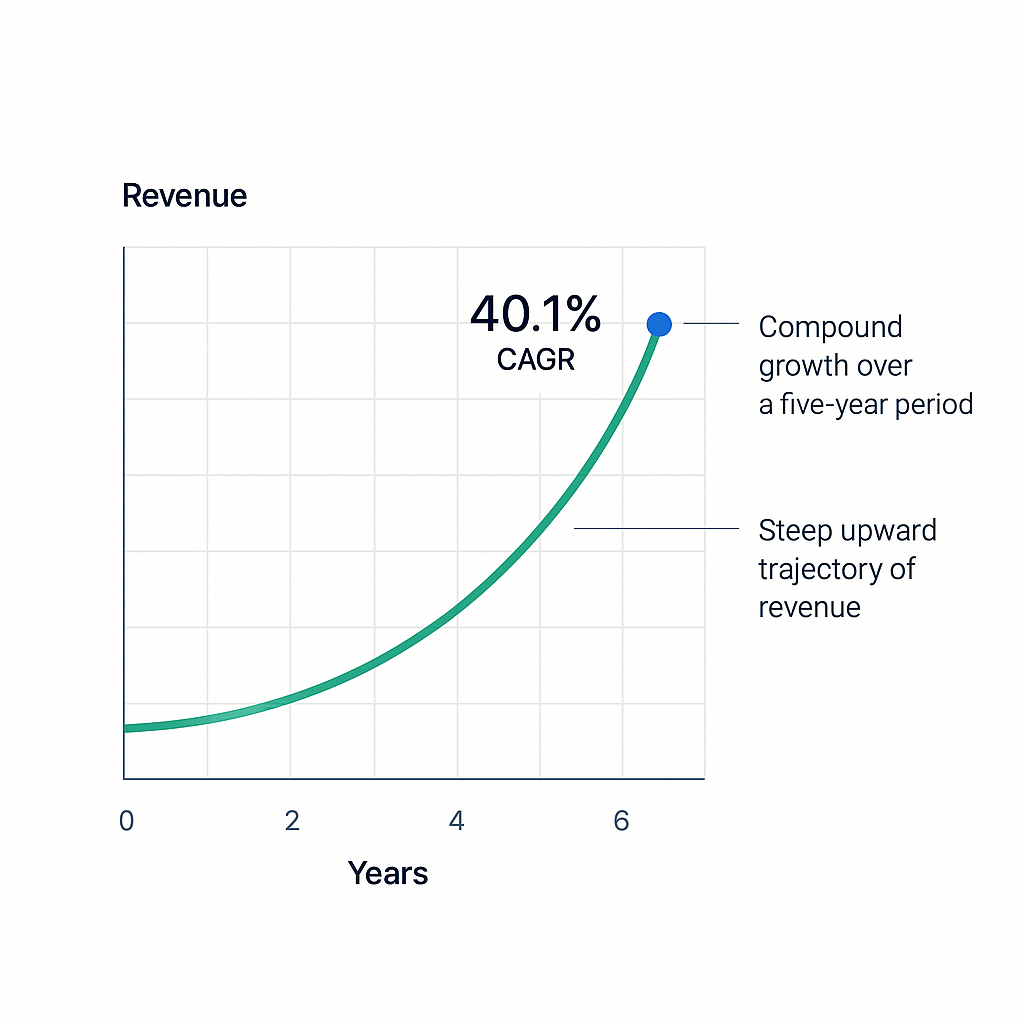
CAGR (Compound Annual Growth Rate) is the rate at which something—like revenue, users, or a market—would have grown each year if it increased at a steady, compounded rate from a starting value to an ending value.
The basic formula is:
CAGR = (Ending Value / Beginning Value)1 / n − 1
Where n is the number of years.
So when you see “CAGR 40.1%,” it means:
- If growth were perfectly smooth, the value would increase by 40.1% every year, compounded.
Key takeaway: A 40.1% CAGR means you’re dealing with exponential, not linear, growth. Systems that work at 1x scale will often fail at 3x or 5x scale unless you modernize them—especially around contracts and approvals.
What Does 40.1% CAGR Look Like in Practice?
Let’s say your document volume today is 1,000 signed contracts per year. With a 40.1% CAGR over five years:
- Year 1: 1,401 documents
- Year 2: ~1,963 documents
- Year 3: ~2,751 documents
- Year 4: ~3,856 documents
- Year 5: ~5,405 documents
In just five years, your annual volume has grown by more than fivefold. Human-centered, manual workflows—emailing PDFs back and forth, tracking signatures in spreadsheets—simply don’t scale to that level. That’s where QuickSign comes in as a modern, AI-powered e‑signature solution built for compounding growth.

Why High-CAGR Markets Matter for Document Signing
The Digital Signature Market Is Compounding Quickly
Analysts consistently project robust double-digit growth for digital signatures:
- One recent report estimates the global digital signature market growing at a ~32–38% CAGR through 2030. (prnewswire.com)
- Another analysis projects North America as the dominant region, with Asia-Pacific the fastest growing, often posting CAGRs above 35–40%. (industryresearch.biz)
In Asia-Pacific specifically, some forecasts cite a 40.1% CAGR between 2025 and 2030, with the regional market expanding from roughly USD 3 billion to over USD 16 billion in five years. (esignglobal.com)
For businesses, that level of growth means:
- More customers to onboard, more contracts to sign.
- More compliance obligations and audit trails.
- More pressure to operate digitally and remotely.
Using a legacy or manual signature process while your transaction volume grows at 40.1% per year is like trying to scale an online business while still handwriting receipts.
How CAGR 40.1% Translates to Business Pressures
If your market, customer base, or transaction count is growing at or near 40.1% per year, you’ll feel specific kinds of pressure:
- Speed pressure: Sales teams need contracts out in minutes, not days.
- Accuracy pressure: As documents proliferate, version control and legal precision matter more.
- Visibility pressure: Leadership needs clear metrics on how quickly deals move through the pipeline.
- Cost pressure: Traditional per-seat platforms can become very expensive as
headcount and usage scale.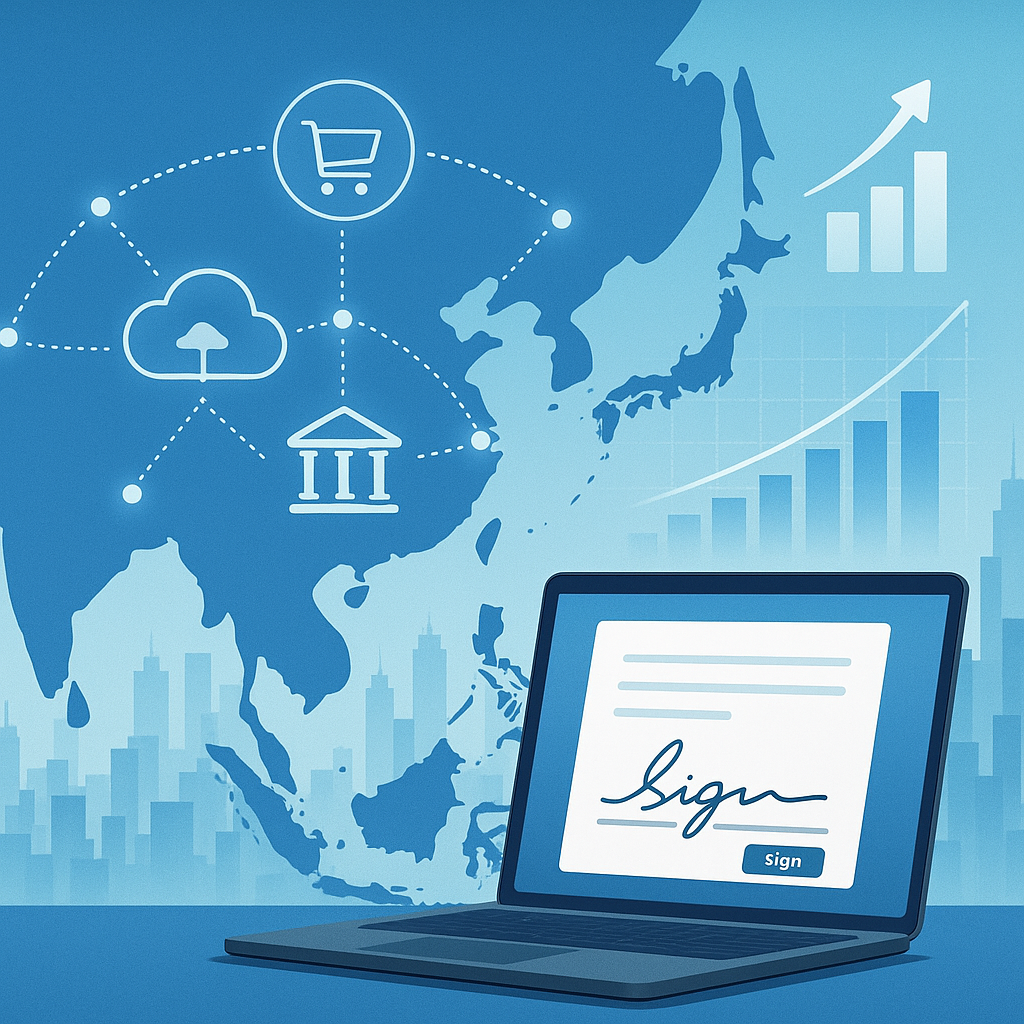
QuickSign.it is built exactly for these conditions, with AI document generation, drag-and-drop fields, seamless sending, real-time tracking, and flat-rate pricing that doesn’t penalize growth.
Using QuickSign to Turn High-CAGR Chaos into Structured Growth
1. Generate Contracts in Seconds with AI
At 40.1% CAGR, the number of contracts, NDAs, and agreements your team drafts will explode. Manually authoring every document in Word or Google Docs becomes a bottleneck.
With QuickSign:
- AI Document Generation lets you describe what you need (“Mutual NDA for two US companies, 2-year term, includes non-solicitation clause”) and automatically generate a professionally structured document.
- You can fine-tune sections, clauses, and language without starting from a blank page.
- Standardize templates across the company, so Sales, HR, and Operations all work from consistent, approved language.
Pro tip: In high-growth environments, templatize your top 5–10 documents in QuickSign (e.g., NDA, MSA, SOW, sales order, employment contract). Use AI to generate variations instead of reinventing each one from scratch.
2. Scale Document Volume with Drag-and-Drop Field Placement
As volume grows, errors in signature placement, missing initials, or overlooked date fields multiply your rework. A 40.1% CAGR in contracts can quickly create a 200–300% CAGR in administrative headaches if your process is brittle.
QuickSign’s drag-and-drop field placement eliminates that risk:
- Upload any PDF or AI-generated document.
- Drag signature, initials, text, and date fields exactly where they’re needed.
- Assign each field to the correct signer so nothing is missed.
This is especially valuable when your business expands into new regions or business units with customized contract layouts. You can adapt in minutes instead of redesigning workflows.
3. Keep Up with Growing Teams via Seamless Sending
When your user base, customers, or partners are growing at near-40% CAGR, the number of signers per document and the complexity of your signature workflows also increase.
QuickSign’s seamless sending capabilities are designed for this:
- Add one or many recipients with just an email address.
- Define signing order when approvals must follow a sequence (e.g., manager → legal → client).
- Send documents for signature in under 60 seconds from upload to send.
This makes it realistic to maintain or even accelerate your sales and onboarding cycles while the underlying transaction base is compounding.
4. Use Real-Time Tracking to Manage a Growing Pipeline
With a 40.1% CAGR in deals or agreements, you can’t manage your pipeline by asking, “Did the client sign yet?” on Slack. You need data.
QuickSign provides real-time tracking so you always know:
- When a recipient has opened, viewed, or signed a document.
- Where documents are stuck (e.g., waiting on procurement, legal, or a specific stakeholder).
- How long each stage typically takes—vital input for forecasting in high-growth environments.
That visibility is essential for business professionals who need to forecast revenue, manage renewals, and report progress to leadership in fast-scaling companies.
Why Flat-Rate Pricing Matters in 40.1% CAGR Scenarios
Traditional Per-Seat vs. QuickSign’s Flat-Rate Model
As your team and document volume grow, per-seat pricing models can get painful. A 40.1% CAGR in headcount—or even in “occasional signers” like contractors, partners, or regional managers—means your annual software spend can balloon unexpectedly.
Unlike traditional per-seat solutions, QuickSign offers affordable flat-rate pricing starting at $15/month for the entire team, with:
- No per-seat fees.
- Simple budgeting as your organization scales.
- Ability to invite more team members without doing cost gymnastics.
When you’re planning multi-year growth at or near 40.1% CAGR, predictable SaaS costs become a strategic advantage.
Leverage the Generous Free Tier During High-Growth Experiments
If you’re piloting new business units, markets, or product lines, you may not yet know how many documents you’ll need to send. QuickSign’s free tier is designed for this experimentation:
- 2 AI document generations at no cost.
- 1 document send to unlimited recipients.
- No credit card required to get started.
This lets you test e‑signature-driven processes in a high-CAGR environment before committing budget—perfect for innovation teams, new regions, or early-stage startups experiencing explosive growth.
Practical QuickSign Workflows for High-Growth Teams
Example 1: Sales Team in a 40.1% CAGR SaaS Company
Imagine a SaaS company whose revenue and customer base are growing at 40.1% per year. The sales operations leader wants to eliminate contract friction across regions.
- Standardize templates with AI: Use QuickSign’s AI Document Generation to create master templates for NDAs, subscription agreements, and SOWs.
- Localize quickly: For new geographies, have AI adapt terms (jurisdiction, currency, data-processing clauses) instead of drafting by hand.
- Configure fields visually: Upload your PDF or AI draft and drag-and-drop signature and initial fields for customer, signer, and internal approver.
- Send in under a minute: Add the prospect, legal approver, and finance approver as recipients and send directly from QuickSign.it.
- Monitor time-to-sign: Use real-time tracking to measure how long agreements sit at each stage, and optimize internal SLAs as volume grows.
Instead of adding legal and ops headcount at the same rate as deal volume, the company leverages QuickSign to absorb the load.
Example 2: HR Team Onboarding in a Rapidly Scaling Organization
Now consider an HR department in a company hiring aggressively. A 40.1% CAGR in employees means a similar growth rate in offer letters, onboarding docs, and policy acknowledgments.
With QuickSign, HR can:
- Generate offer letter templates with AI, tailored to role types and seniority.
- Bundle NDAs, IP agreements, and policy documents in a single signing packet.
- Drag-and-drop checkboxes and initials for policy acknowledgment.
- Send to candidates in seconds and track open/sign timestamps for compliance.
This keeps HR agile even as headcount scales exponentially.
When “40.1%” is a KPI, Not Just a Market Statistic
Setting and Managing Internal CAGR Targets
Many leadership teams use CAGR-style targets for:
- Annual recurring revenue (ARR).
- Customer count or active users.
- Number of signed partnerships or vendor agreements.
If your leadership sets a 40.1% CAGR goal for revenue or customers, expect a similar or higher CAGR in documents requiring signatures—contracts, renewals, channel agreements, data-processing addenda, and more.
QuickSign helps you support those KPIs by:
- Removing friction from the “sign” step in any process.
- Providing real-time visibility into contract pipeline bottlenecks.
- Keeping costs predictable so your signature tooling doesn’t become a growth tax.
Using Data from QuickSign to Track Operational Scale
Over time, QuickSign can effectively become an operational barometer for your growth:
- Track monthly or quarterly document send and sign volumes.
- Compare your own “document CAGR” to your revenue or customer CAGR.
- Identify when manual teams (legal, finance, HR) are nearing capacity before issues surface.
If you see your document volume compounding at 40.1% while approval times are lengthening, that’s your cue to streamline templates, adjust routing, or empower more users with signing authority—all of which QuickSign can support.
Learning Growth Strategy from Unlikely Sources (MK11 & Beyond)
What a 40.1% Combo in a Game Teaches You About Business Scaling
One of the YouTube videos you referenced—“MK11 KANO COMBO 40.1% (2 BARRAS)”—is about pulling off a 40.1% damage combo in Mortal Kombat 11. While that’s worlds apart from B2B contracts, there’s an interesting parallel:
A complex combo in a game is a sequence of precise inputs executed quickly. High-CAGR growth in business is a sequence of precise processes executed repeatedly at scale.
In gaming tutorials (like the MK11 Kano guides), players learn how to chain actions optimally. Similarly, QuickSign lets you chain business actions:
- AI generation → field placement → sending → tracking → archiving.
- With minimal manual work between each step.
Think of QuickSign as the “combo system” that turns scattered, manual document tasks into a smooth, repeatable, high-impact sequence that can handle 40.1% growth and beyond.
Applying Analyst Thinking to Document Workflows
The “Sports Analyst – What Career paths to choose?” video emphasizes using data and structured thinking to make informed decisions. That same mindset is critical when your operations are scaling quickly:
- Measure how many documents you send and sign per month.
- Identify where delays occur (internal legal, external client, partner approvals).
- Use QuickSign’s real-time tracking data as your “film room” to analyze and improve your process.
Action Steps: How to Prepare Your Document Stack for 40.1% CAGR
1. Audit Your Current Document Workflows
List the processes that will be most impacted by growth:
- New customer contracts.
- Renewals and upsell amendments.
- Vendor agreements and procurement approvals.
- HR onboarding and policy acknowledgments.
Estimate how the volume of each will look in 3–5 years with a 40.1% CAGR. Even rough numbers will show you where cracks will appear first.
2. Identify Prime Candidates for QuickSign Automation
For each process, ask:
- Can the document be standardized into a template?
- Can AI drafting remove 70–80% of manual writing?
- Is there a clear signing order that can be automated?
Start with one high-volume, low-complexity process (e.g., NDAs), implement it in QuickSign, and then expand.
3. Pilot, Measure, Then Roll Out
Use QuickSign’s free tier to:
- Generate 2 real documents via AI.
- Send 1 document to unlimited recipients.
- Measure how much faster and smoother the process is compared to your status quo.
Once you have data—time saved per document, fewer errors, faster deal closure—it’s easier to justify rolling QuickSign across teams before growth overwhelms your existing processes.
Ready to simplify your document signing? Try QuickSign for free - generate 2 documents and send 1 document to unlimited recipients at no cost. No credit card required.