Consulting Agreement Template Free: Protect Your Projects and Get Paid
consulting agreement template free: download to clearly define scope, payments, IP, and milestones; protect your work and get paid faster.

Here is your free consulting agreement template, designed to protect your projects and get you paid on time. This isn't just a document; it's a tool for setting clear expectations, outlining the scope of work, and formalizing your payment terms. It turns casual handshake deals into professional, legally sound partnerships.
Why a Solid Agreement Is Your Best Business Partner
Let's be real for a moment: handshake deals are a recipe for disaster. They might feel casual and easy at the start, but they leave you completely exposed when things go sideways.
Ever had a client ask for "just one more tweak" that balloons into weeks of unpaid overtime? That’s scope creep, and it’s a classic symptom of a project without boundaries. Or maybe you've spent months chasing down an invoice, throwing your cash flow into chaos and souring a good relationship. These aren't just worst-case scenarios; they're the painful reality for countless consultants working without a contract.
A professional consulting agreement is more than a legal formality—it’s your most powerful communication tool. It takes an ambiguous arrangement and turns it into a secure, predictable partnership. By defining everything upfront, you pave the way for a successful, conflict-free engagement from day one.
Establishing Professionalism and Preventing Disputes
Handing a new client a clear, well-structured agreement instantly signals that you're a serious professional. This foundational document does more than just list deliverables; it builds immediate trust and respect. It shows your client you value clarity, transparency, and accountability for both sides.
That clarity is your best defense against misunderstandings down the road. The consulting world is growing fast—the U.S. market alone is expanding at an 8%+ CAGR. But with that growth comes risk. Industry data shows that disputes over scope, payments, and intellectual property derail up to 30% of engagements that lack proper agreements. You can dive deeper into these consulting industry statistics to see how templates help you sidestep common traps.
Think of your consulting agreement as the project's constitution. It's the single source of truth that you and your client can always refer back to, making sure everyone stays aligned on expectations, responsibilities, and outcomes.
A solid contract provides a clear roadmap for:
- Defining the Scope: Pinpointing exactly what work will be done, which prevents extra tasks from being tacked on without compensation.
- Setting Payment Terms: Detailing when and how you'll be paid, including deposits, milestone payments, and any late fees.
- Clarifying Ownership: Deciding who owns the intellectual property created during the project.
- Outlining Termination: Establishing the conditions under which either party can end the engagement fairly.
Skipping this step introduces risks that are easy to avoid but expensive to fix. Many consultants learn this the hard way.
Key Risks of Operating Without a Consulting Agreement
This table breaks down the most common and costly risks consultants face when they skip a formal agreement, helping you quickly grasp the value of using a solid template.
| Risk Area | Potential Consequence | How an Agreement Protects You |
|---|---|---|
| Scope Creep | Performing weeks of unpaid work on "small" additions the client requests. | The Scope of Services clause clearly defines project boundaries and deliverables. |
| Payment Disputes | Chasing late payments, arguing over invoice amounts, or not getting paid at all. | The Compensation clause locks in rates, payment schedules, and late fee policies. |
| IP Ownership Ambiguity | The client assumes they own all your work, processes, and background IP. | An Intellectual Property clause specifies who owns what, protecting your valuable assets. |
| Liability Claims | Being held personally liable for project outcomes that were outside your control. | A Limitation of Liability clause caps your financial exposure to an agreed-upon amount. |
| Sudden Termination | A client ends the project abruptly, leaving you with no notice or final payment. | The Termination clause requires a notice period and outlines kill fees or final payments. |
Ultimately, using a consulting agreement template free of ambiguity isn't about planning for failure. It's about setting up the project for success. It creates the conditions for a smooth, profitable engagement where both you and your client feel secure and respected from start to finish.
What Goes Into a Bulletproof Consulting Contract?
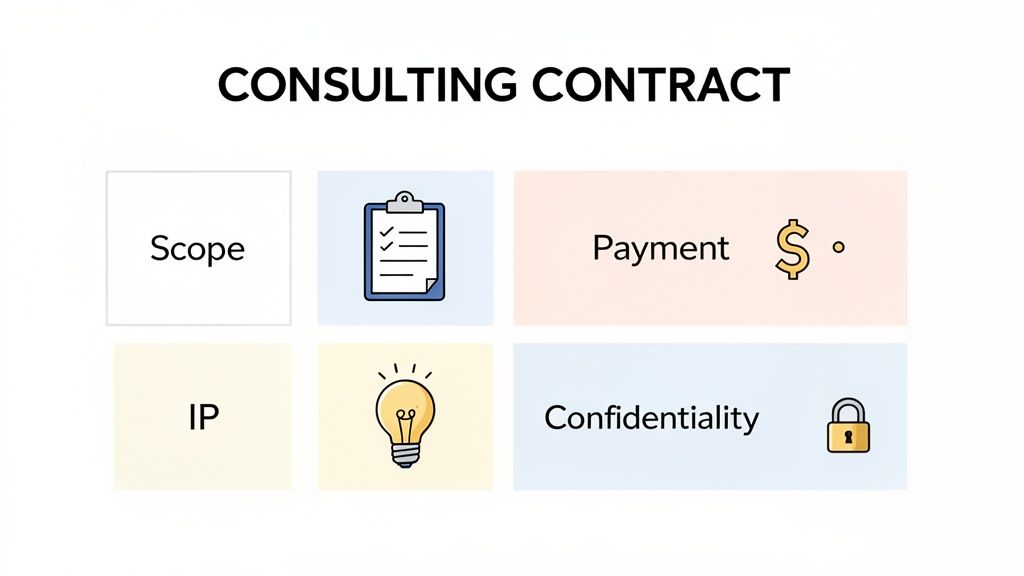
Think of any free template as your foundation, not the finished building. To truly protect your business, you need to understand what each clause actually does in the real world. Let’s walk through the critical parts of our consulting agreement template, breaking down the pieces that turn a simple document into a shield for your hard work.
At its heart, a consulting agreement is a specific type of contract for services. It’s built to manage expectations, define boundaries, and give both you and your client a clear roadmap. Here’s what matters most.
Defining a Rock-Solid Scope of Services
This is, without a doubt, the most important section of your entire contract. I’ve seen it time and time again: a vague scope is a direct invitation for scope creep. It’s those “can you just…” requests that pile up, blow up your timeline, and eat away at your profits. Your goal here needs to be absolute, undeniable clarity.
Don’t just write, "Consultant will provide social media marketing services." That’s a recipe for disaster. Get granular.
A strong scope looks more like this:
- Deliverable 1: A comprehensive social media audit of the Client’s Instagram and LinkedIn profiles, delivered as a 10-page PDF report by [Date].
- Deliverable 2: A 30-day content calendar for Instagram, including 20 static post mockups and 8 Reels concepts, delivered in a shared Google Sheet by [Date].
- Exclusions: This engagement specifically excludes community management, responding to direct messages, and the creation or management of paid ad campaigns.
This level of detail leaves zero room for misinterpretation. It clearly defines what you will do and, just as importantly, what you won't. Setting those boundaries from day one is a professional power move.
Structuring Airtight Payment Terms
Nothing tanks a client relationship faster than a misunderstanding about money. This clause removes all the awkwardness and ambiguity around getting paid, turning it into a simple contractual obligation.
A solid payment section goes way beyond just listing your rate. It must clearly outline:
- Fee Structure: Is it a fixed project fee (e.g., $5,000), an hourly rate (e.g., $150/hour), or a monthly retainer (e.g., $2,500/month)?
- Payment Schedule: When is the money due? A common and effective structure is a 50% deposit upon signing and the remaining 50% upon final project delivery.
- Late Fee Policy: This is non-negotiable. A late fee clause is a powerful motivator for on-time payment. Something as simple as, “Invoices are due within 15 days. A late fee of 5% per month will be applied to overdue balances,” works wonders.
- Payment Methods: Make it easy for them to pay you. Specify your accepted methods, like ACH transfer, credit card (via Stripe or another processor), or check.
By defining your payment structure this clearly, you shift from hoping to get paid on time to having a legally enforceable expectation. It’s a game-changer for protecting your cash flow.
Clarifying Intellectual Property Ownership
This is a big one: who actually owns the brilliant work you create? If you don't define this upfront, it can become a messy, expensive legal headache down the road. This IP clause clarifies ownership for both the final product and the tools you used to make it. For a deeper look, our guide on the core elements of a contract breaks down these foundational concepts.
There are two key parts to think about:
- Client-Owned Deliverables: This is the finished product the client is paying for—the completed website, the final report, the new logo. Generally, they own this.
- Consultant-Owned Background IP: This is your secret sauce. It protects your pre-existing tools, code libraries, templates, and proprietary processes. The clause should make it clear that while the client owns the final result, you keep the rights to your underlying methods.
For instance, a web developer delivers a finished website to the client (they own it), but the developer retains ownership of the custom code framework they built to create it. This ensures you can use your own tools for future projects.
Protecting Information with a Confidentiality Clause
You’ll almost certainly be exposed to sensitive client information—internal financials, customer lists, or future business plans. A confidentiality clause (sometimes called an NDA) is your formal promise to keep their secrets safe.
This is a huge trust-builder. It shows the client you’re a professional who takes their privacy seriously, which encourages them to share the information you need to do a great job. Be sure this section defines what counts as "confidential information" and how long the obligation lasts, which is often a few years after the project ends.
Planning a Clean Exit with Termination Terms
Nobody starts a project planning for it to fail, but the smartest consultants plan for every contingency. The termination clause is your exit strategy. It lays out a fair and orderly process for ending the engagement if things go south, whether it's their fault or yours.
This section absolutely needs to cover:
- Notice Period: How much warning is required to end the contract? A 30-day written notice is a common standard that prevents anyone from abruptly pulling the plug.
- Termination for Cause: What happens if someone breaks the rules (e.g., the client stops paying, or you fail to deliver)?
- Payment Upon Termination: This is critical. The clause must state that if the contract ends early, the client is responsible for paying for all work completed up to the termination date.
While it's tempting to grab the first free template you find, be warned. Research shows that generic online templates often lack crucial termination or IP clauses, leading to serious conflicts in 25-40% of projects. This is why taking a quality template and customizing it isn't just a good idea—it's essential.
Making the Template Your Own: A Guide to Customization
A good template is just the beginning. The real art of protecting your consulting business lies in knowing how to adapt that starting point for each unique client and project. Your work isn't one-size-fits-all, so your contracts shouldn't be either. This is where you move from just having a document to having a strategic asset.
Think of your free consulting agreement template like a great suit off the rack—it has a solid structure, but it needs a tailor's touch to fit perfectly. Making those adjustments shows professionalism and foresight, ensuring the contract not only looks good but provides the right protection and flexibility for the work ahead.
One-Off Projects vs. Ongoing Retainers
The first big decision is matching the contract structure to the engagement. Is this a quick, one-and-done project or the start of a long-term relationship? The answer dictates your approach.
For a straightforward, short-term job with a clear finish line, a simple standalone consulting agreement gets the job done.
- For example: A client hires you for a single, six-week project to overhaul their website's SEO. You have a fixed scope, a clear timeline, and a final report as the key deliverable. Once that report is handed over, your work is done. A single, self-contained contract is perfect for this.
But what about clients you’ll be working with for months or even years? Constantly writing new contracts from scratch is a massive time-sink. This is where the Master Services Agreement (MSA) and Statement of Work (SOW) model is a game-changer.
- The Master Services Agreement (MSA): This is your foundational "umbrella" contract. It lays out all the core legal terms that will govern your entire relationship—confidentiality, IP rights, liability, payment terms, etc. You sign this once when you first start working together.
- The Statement of Work (SOW): For each new project, you just issue a simple SOW. This document references the MSA you both already signed and outlines only the project-specific details: the scope, deliverables, timeline, and fees.
The MSA/SOW combo is a huge efficiency booster. It stops you from renegotiating the same legal boilerplate over and over. Kicking off a new project with an existing client becomes as easy as sending over a one-page SOW, which gets you to work faster.
Tweaking Clauses for Your Specific Niche
Beyond the overall structure, the devil is in the details of the clauses themselves. The risks and requirements for a marketing consultant are vastly different from those of a software developer. To get started, a readily available US-specific consulting agreement template can be an excellent foundation.
Here are a few common scenarios to think through as you customize:
If you're a tech or software consultant... your Intellectual Property clause is everything. You must state clearly that you own all your pre-existing code, frameworks, and tools (your "background IP"). The client is paying for and owns the final deliverable, not the proprietary systems you used to create it.
If you're a marketing consultant... you need to be explicit about deliverables and performance. The contract should specify who owns the final ad copy, social media accounts, and any content created. It's also wise to include a disclaimer that you can't guarantee specific results, like a 20% increase in sales, since market forces are beyond your control.
If you handle sensitive client data... your Confidentiality clause needs to be airtight. Don't just use a generic NDA. Specify the exact types of data you'll be accessing (e.g., customer lists, financial records), the security measures you'll implement, and how you’ll return or destroy that data once the project is over.
Getting these niche-specific details right is critical. The back-and-forth over contract terms can often feel like a bottleneck, but it doesn't have to be. We've got a whole guide on how freelancers can get contracts signed fast that dives into streamlining this process. Each thoughtful tweak transforms your template from a generic document into a sharp, bespoke tool that protects you in the real-world situations you face every day.
Bringing Your Agreement to Life with E-Signatures
You've done the hard work of customizing your consulting agreement, but let's be honest—it’s just a document until it’s signed. This is the moment of truth, the final, crucial step where your draft becomes a legally binding contract. Forget the old-school hassle of printing, scanning, and chasing down emails. Modern e-signature platforms make this last mile a smooth, secure, and professional experience for everyone involved.
The whole journey, from finding a consulting agreement template free of charge to getting it executed, really boils down to three simple stages: start with a solid template, tailor the key clauses to your project, and then finalize it with a signature.
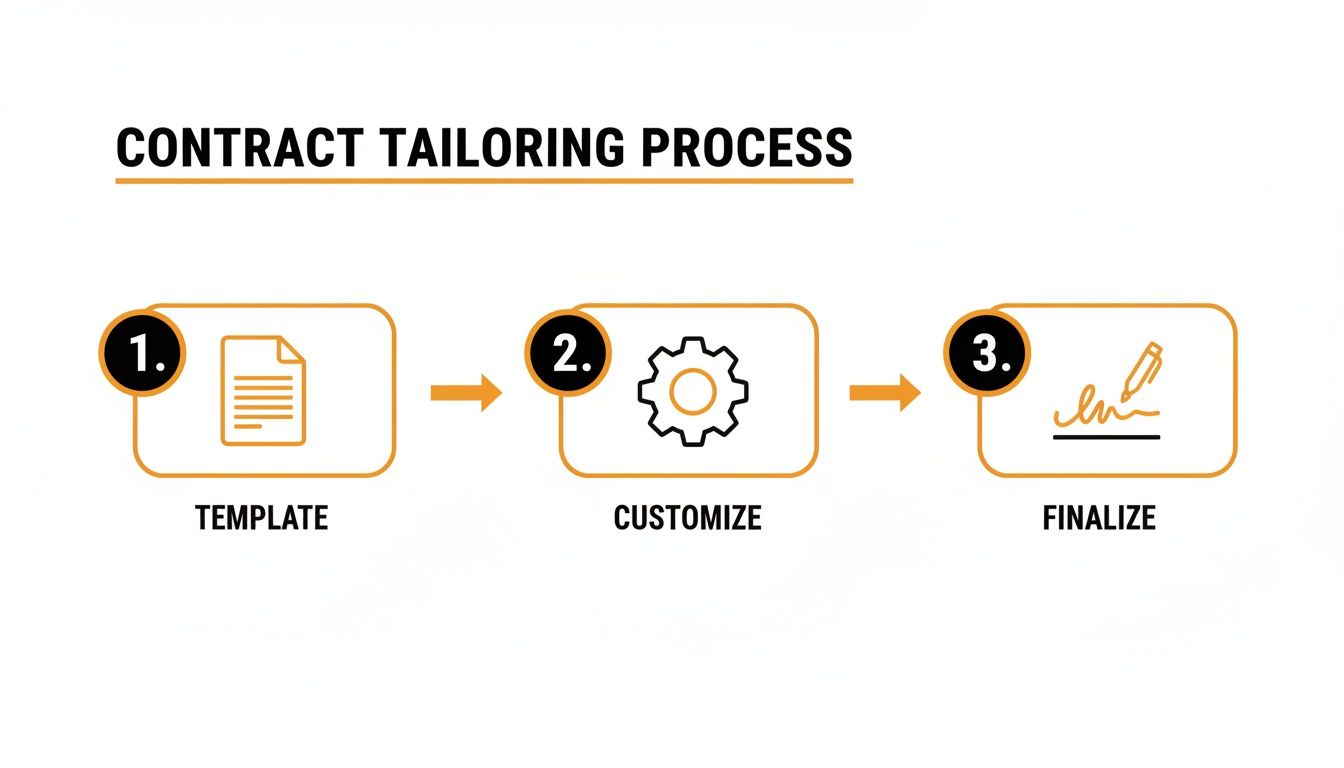
Think of it as building a house—you need a blueprint (the template), you customize the rooms (the clauses), and then you get the final inspection and keys (the signature). That finalization stage is where tools like QuickSign really shine.
Uploading and Preparing Your Document for Signing
First things first. Once you've saved your masterpiece of a contract as a PDF or Word doc, you just upload it directly into your e-signature platform. The system will process the file and open it in a digital editor where you can work your magic.
This is where your static document becomes interactive. You’ll drag and drop specific fields onto the page, telling your client exactly where to sign and what information to provide. It completely eliminates the risk of them missing a spot or you having to email them back for more details.
Some of the must-have fields include:
- Signature Fields: The designated spots for you and your client to apply a legal signature.
- Initial Boxes: I like to place these at the bottom of each page. It's a great way to get confirmation that the client has actually reviewed everything.
- Text Fields: Perfect for capturing their full legal name, company name, and address.
- Date Fields: These auto-populate the moment someone signs, creating an indisputable timestamp.
The placement of a signature page for a contract is so important for enforceability, and digital tools make it foolproof. You can position these fields with pixel-perfect precision, ensuring the final document looks clean and professional.
Sending the Agreement and Automating Follow-Ups
With your fields set, you're ready to send it off. Just pop in your client’s name and email, write a quick personal message, and hit send. The platform takes over, instantly notifying your client that their agreement is ready for review.
Here's where you start to see the real efficiency. Gone are the days of manually tracking who has signed what and sending those slightly awkward "Just checking in..." emails.
One of my favorite features is setting up automated reminders. If a client hasn't opened the document in a couple of days, the system sends a polite, pre-written nudge for you. It keeps things moving forward without you having to play project manager for your own contract.
You also get total transparency. You can see precisely when the client opens the document, how long they view it, and the second they sign. This real-time tracking gets rid of all the guesswork and anxiety that comes with waiting for a reply.
Securing Your Deposit at the Moment of Signing
For most of us consultants, getting that initial deposit is essential for kicking off a project with good cash flow. Having to chase an invoice right after the contract is signed is not a great start to a new relationship. The best e-signature tools solve this by integrating payment collection right into the signing process.
While you're setting up your document, you can add a payment request. This prompts the client to pay their deposit with a credit card or bank transfer immediately after they sign.
This is brilliant for two reasons:
- It connects the signature to the payment. The project doesn't officially start until you have both a signed contract and a paid deposit.
- It's completely frictionless. Your client is already in the "let's do this" mindset, making it the perfect, most natural time to handle the first payment.
This simple function turns your contract from a legal necessity into a powerful tool for locking in your project's financial foundation.
Honestly, the switch to digital signing has been a game-changer. Studies show that modern e-signatures can slash contract cycle times by an incredible 70-80%. Platforms like QuickSign also provide a full audit trail and downloadable certificates, ensuring your agreements are fully compliant and enforceable in both the EU and the U.S. This means you can close deals faster and get to the actual work sooner.
Common Contract Mistakes That Can Cost You
Grabbing a consulting agreement template free online can feel like a smart shortcut. You get a professional-looking document, and you're ready to dive into the work. But I've seen it time and again: using a template without truly understanding it is just as risky as having no contract at all. A poorly customized agreement gives you a false sense of security that can completely fall apart when you need it most.
The real trouble isn't in the big, obvious clauses. It's in the small details consultants often gloss over—the ticking time bombs that lead to scope creep, payment nightmares, and even legal headaches. Getting these right is what separates a contract that actually protects you from one that just looks official.
The Peril of Vague Language
If there’s one mistake that costs consultants more money than any other, it’s being fuzzy in the Scope of Work. Clients aren't usually trying to be malicious, but if a contract term is open to interpretation, you can bet they'll interpret it in a way that benefits them. Ambiguous descriptions are an open invitation for "just one more thing" requests and a mountain of unpaid work.
For instance, what does "social media optimization" actually mean? I've seen contracts with language that vague.
- Does it mean you’re creating the content, or just advising on it?
- Are you expected to manage their paid ad campaigns?
- Is responding to DMs and customer comments part of the deal?
I know a consultant who got burned by this exact phrase. The client had a PR crisis erupt over a weekend and expected the consultant to lead a 24/7 crisis response team because, to them, that fell under "optimization." It resulted in dozens of hours of high-stress, unpaid work that was never part of the original plan.
Your Scope of Work should leave zero room for guesswork. It needs to spell out what you will deliver, the format, the number of revisions, and—just as importantly—what is explicitly out of scope.
Ignoring Jurisdictional Differences
Another detail that feels small but has massive consequences is the "Governing Law" or "Jurisdiction" clause. This is the part that determines which state's or country's laws will apply if there's ever a dispute. It might seem like boring legalese, but trust me, you'll care about it if things go south.
Imagine you're a consultant based in Texas, but your client is in California. If your agreement doesn't specify which law governs it and you end up in a legal fight, you could be forced to hire a California lawyer and travel there for court. It’s an expensive, logistical nightmare. Simply adding a line like, "This Agreement shall be governed by the laws of the State of Texas," keeps any potential legal issues on your home turf.
Mishandling Project Changes
Projects evolve. It's a fact of life. A client’s priorities might shift, new ideas pop up, or you hit an unexpected roadblock. A free template might give you a good starting point, but many of them fail to include a formal process for handling these changes. Without one, you’re basically letting scope creep run the show.
The fix is a "Change Order" or "Addendum" clause. This clause should clearly state that:
- Any changes to the original Scope of Work have to be requested in writing.
- You will provide a written quote for the new work, outlining its impact on the timeline and cost.
- You won't start on the new request until both parties have signed the official Change Order.
This little process turns a casual, "Hey, while you're at it, can you also...?" into a documented, billable task. It protects your time and ensures you get paid for every ounce of value you deliver. Nailing down details like these is central to good contract management. For a more thorough look, check out our guide on the best practices for contract management to keep your projects profitable and on track.
Your Questions Answered
Even with a great template, you're bound to have questions. It’s smart to get total clarity before you hit send on a new agreement. Let’s walk through a few of the most common questions consultants ask about using our free template so you can feel confident moving forward.
This is your final check-in, a chance to make sure you've got a handle on the practical and legal side of the document that protects your business.
Is a Free Consulting Agreement Template Legally Binding?
Yes, absolutely. An agreement built from a free template can be just as legally binding as one drafted from scratch by a lawyer. A contract's power doesn't come from its price tag; it comes from having the right ingredients: an offer, acceptance, consideration (the payment), and a clear intention from both sides to be legally bound.
Once you and your client sign it, you've got a contract. Using a secure e-signature platform adds another layer of legal muscle, creating a digital audit trail that proves exactly when and how the agreement was finalized. For a deeper dive, check out our guide on whether electronic signatures are legally binding.
A quick word of advice, though: a solid template is a phenomenal start, but it’s always a good idea to have a legal professional give it a once-over. They can spot any issues specific to your local laws or unique industry risks.
What Is the Difference Between an Agreement and a Statement of Work?
This is a fantastic question and gets right to the heart of managing client work efficiently, especially if you plan on having a long-term relationship. These two documents work together, but they do very different jobs.
- The Consulting Agreement: Think of this as the master document or the "rulebook" for your entire relationship. It covers the big-picture terms that won't change from project to project: confidentiality, payment terms, liability, and intellectual property. You sign this once at the beginning.
- The Statement of Work (SOW): This is a project-specific document that falls under the main agreement. It drills down into the nitty-gritty of a single project: the exact scope, deliverables, timelines, and fees.
I like to think of the agreement as the constitution for your client relationship, while each SOW is a specific bill passed under that constitution. This system is a lifesaver with ongoing clients. Instead of drafting a whole new contract for every project, you just issue a simple one-page SOW. It's clean, fast, and professional.
How Do I Handle Scope Changes After the Contract Is Signed?
It’s not a matter of if project requirements will change, but when. The trick is to have a formal process for handling these changes so you don't end up doing free work or creating confusion. Just letting "small" changes slide is how scope creep slowly eats away at your profits.
The professional way to manage this is with a "Change Order" or an "Addendum."
This is a simple, formal document you create anytime the scope of work shifts. It needs to clearly spell out:
- The New Tasks: A specific description of what new work is being added.
- The Timeline Impact: How this change will affect the project's final deadline.
- The Additional Cost: The exact fee for the new work.
The most important part? Both you and your client must sign the Change Order before you start the new work. This simple step turns a casual "hey, can you also..." request into a documented, billable task. It keeps the project organized and ensures you’re paid for every ounce of your expertise.
Ready to get your customized template signed? With QuickSign, you can upload your document, add signature fields, and collect legally binding e-signatures and payments in just a few minutes. Create your free QuickSign account today and streamline your agreement workflow.