The Essential Elements of a Contract Explained
Unlock the essential elements of a contract. Our guide breaks down offer, acceptance, and consideration to help you create legally sound agreements.
For a simple promise to become a legally enforceable agreement, it needs a few key ingredients. These elements of a contract—most critically, the offer, acceptance, and consideration—are what turn a casual chat into a binding commitment that a court will actually recognize.
Understanding What Makes an Agreement Enforceable
I like to think of a contract as the recipe for a business relationship. If you miss a core ingredient or mess up the measurements, the whole thing can fall flat. You wouldn't try to bake a cake without flour, and you shouldn't jump into a business deal without making sure all the essential elements of a contract are in place.
Getting a handle on these foundational pillars is your first line of defense against misunderstandings and expensive disputes down the road. A handshake deal might feel fine in the moment, but it rarely holds up when memories get fuzzy and disagreements pop up. Let's walk through each component so you can see how they work together to create a solid, enforceable agreement.
The Pillars of a Binding Contract
At its heart, a valid contract is built on a few core principles that create a fair and clear deal for everyone. While the nitty-gritty can change depending on where you are, these three elements are almost universally required:
- Offer: One person has to propose a clear, specific deal to another.
- Acceptance: The other person must agree to the exact terms of that offer.
- Consideration: This is the big one—both sides have to give up something of value. It's the "skin in the game" that makes it a two-way street.
This diagram shows how these pieces fit together.
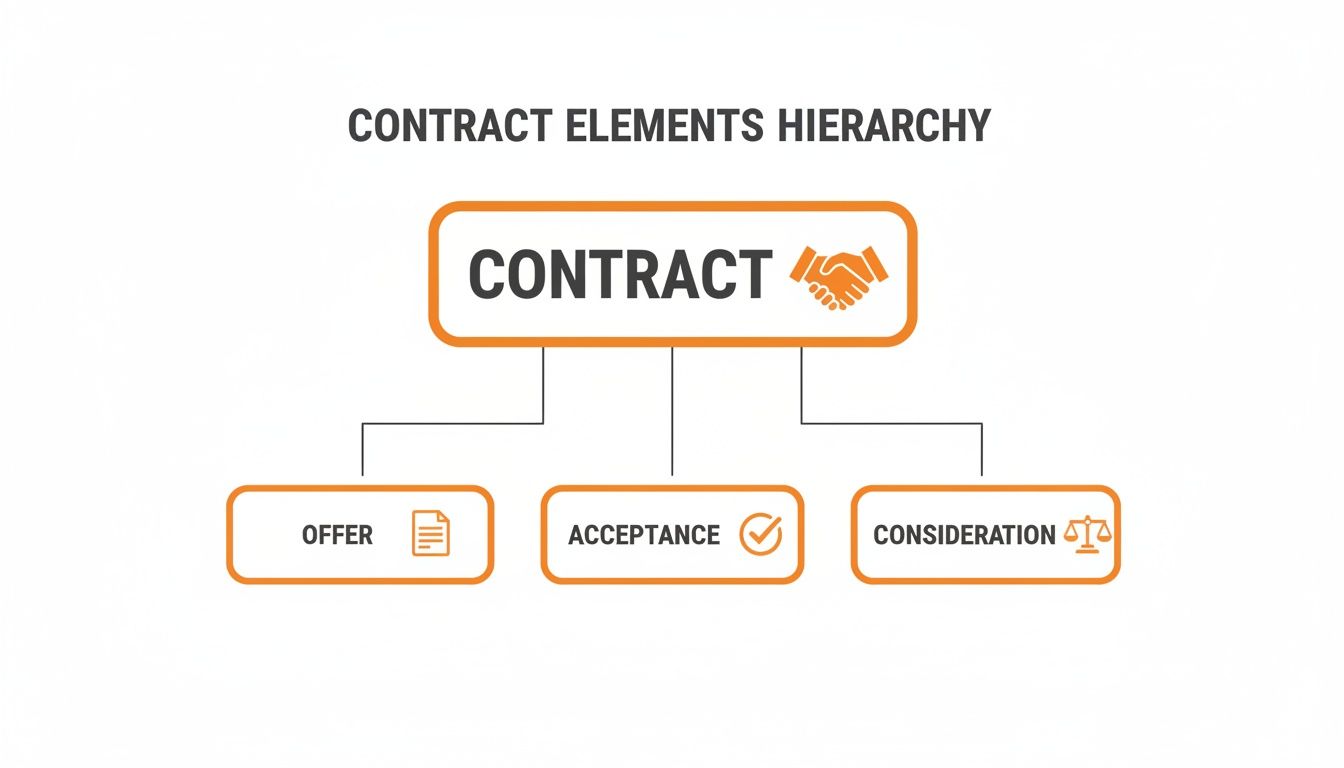
It’s a simple flow: an offer, followed by acceptance, and supported by consideration, creates a contract. The legal principles behind this are so robust that English law, which meticulously defines these elements, underpins an astonishing 40% of all global business transactions. That's a huge testament to how critical these concepts are in worldwide commerce, a trend highlighted by The Law Society.
A contract is really just a documented "meeting of the minds." Each element is a piece of proof showing that both parties understood the deal, agreed to it willingly, and knew what was expected of them.
Whether you're a freelancer taking on a new project or a business owner signing a major vendor agreement, these principles are the same. This is where modern tools come in handy for making sure everything is properly documented. For example, it's worth taking a moment to learn more about how electronic signatures are legally binding, as they provide rock-solid evidence of the "acceptance" part of the equation.
The Offer and Acceptance Handshake
At the heart of every contract, you'll find a simple, foundational exchange. Think of it as a formal handshake, the moment where two parties align. This all starts with one person making a clear offer and the other giving an unambiguous acceptance. This mutual agreement, often called a "meeting of the minds," is the bedrock upon which a valid contract is built.
An offer isn't just a casual suggestion. It has to be a concrete, definite proposal. If the other person says "yes," that proposal should be enough to lock in the deal. For example, when a freelance graphic designer sends a client a detailed quote outlining the exact scope, deliverables, timeline, and a total project cost of $5,000, that’s a formal offer. It's on the table, ready to be accepted.
Distinguishing a Real Offer from an Invitation
Here's where things can get a little tricky. You need to know the difference between a real offer and what lawyers call an "invitation to treat." An invitation to treat is basically just opening the door for someone else to make you an offer. It’s the start of a negotiation, not the end of one.
You see these all the time:
- Price tags in a shop: This isn't the store offering to sell you the item; it's inviting you to offer to buy it at the register.
- Advertisements and catalogs: These are generally considered invitations for the public to come in and make an offer on a product or service.
- Auction listings: The auctioneer is inviting bids (which are offers), and they have the power to accept or reject them.
The crucial difference boils down to intent. A true offer shows a readiness to be legally bound the second it’s accepted. An invitation is just testing the waters.
Acceptance: The Mirror Image Rule
So, a clear offer has been made. What's next? Acceptance. To be legally valid, the acceptance must be a straightforward "yes" to the exact terms presented. This principle is famously known as the "mirror image rule"—the acceptance has to perfectly reflect the offer.
If the response tries to change any of the original terms—like tweaking the price, moving a deadline, or altering the scope—it's not an acceptance. Instead, it becomes a counter-offer. A counter-offer kills the original offer and puts a brand new one on the table, essentially hitting the reset button on your negotiations.
Let’s go back to our designer. If the client replies to the $5,000 proposal with, "I accept, but can you do it for $4,500?" they haven't actually accepted anything. They've just made a counter-offer. The original $5,000 offer is now off the table, and it's up to the designer to accept, reject, or counter back.
This back-and-forth is precisely why it's so important to document the final, agreed-upon terms. Knowing how to send a document for signature ensures that when you finally reach that "yes," you have a crystal-clear record of what everyone agreed to.
Consideration: The Value Exchange That Binds the Deal
So, we have an offer and a clear acceptance. But there's one more crucial piece needed to lock it all in and make the deal legally binding: consideration. This concept is absolutely vital, yet it’s one of the most frequently misunderstood parts of a contract.
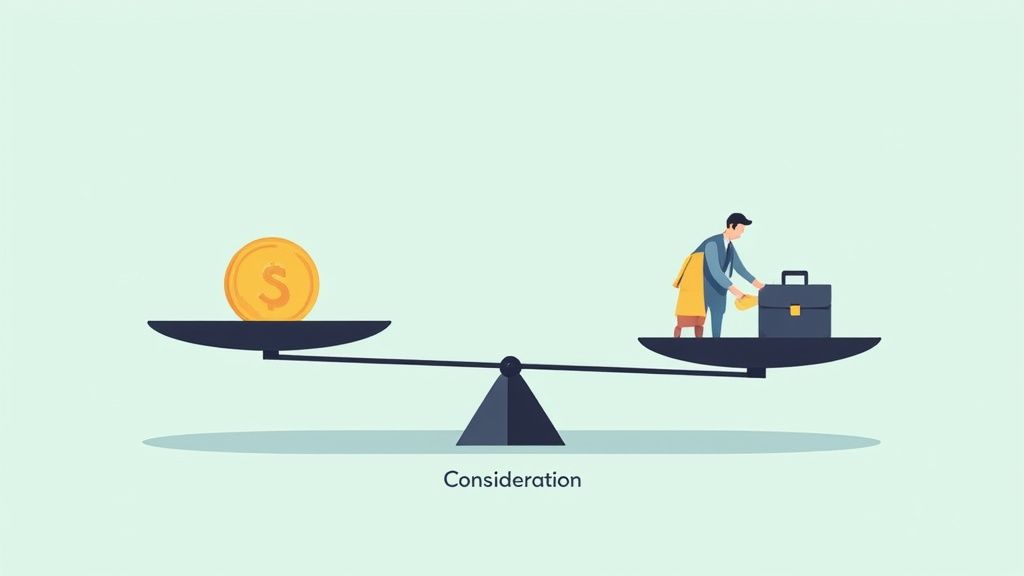
Simply put, consideration is what each party gives up. It’s the "price" each person pays to get what they want from the deal.
Think of it as the legal system's way of ensuring there’s a genuine exchange. It’s what separates a real contract from a casual, one-sided promise. If I promise to give you my old laptop, that's just a gift. But if I promise you the laptop in exchange for you helping me move next weekend? Now we have consideration—a mutual give-and-take.
And that "price" doesn't have to be cash. Value can come in many forms, as long as it creates a two-way street of obligation.
What Counts as Valid Consideration?
The law is actually pretty flexible here. As long as both sides are giving something up, courts usually don't get involved in judging the deal itself.
Common forms of consideration you'll see every day include:
- A Promise to Act: This is the classic service exchange. A graphic designer promises to create a logo, or a plumber promises to fix a leaky pipe.
- A Promise to Pay: The most common form—money for a product or service. You buy a coffee, you pay the price. Simple.
- A Promise Not to Act (Forbearance): This one is less obvious but just as powerful. It involves agreeing not to do something you have a legal right to do. Signing a non-disclosure agreement (NDA) is a perfect example; you're giving up your right to share certain information.
The real heart of the matter is that consideration must be part of a bargained-for exchange. My promise has to be the reason for your promise, and vice-versa. It’s the glue that holds everything together, proving both parties have real "skin in the game."
The "Sufficiency vs. Adequacy" Rule
There’s a well-known saying in legal circles: "Consideration must be sufficient, but it need not be adequate." It sounds like legal jargon, but the difference is incredibly important for anyone doing business.
Sufficient consideration just means the item being exchanged has to have some legally recognized value. Even a single dollar can be sufficient consideration to make a deal valid.
Adequate consideration is about whether the deal is fair. This is where the courts take a hands-off approach. They won't invalidate your contract just because you made a bad deal and sold your car for far less than it was worth. Freedom of contract means you’re free to make good deals and bad ones.
A major pitfall to watch out for is something called "past consideration." This is a classic mistake. If your neighbor helps you fix a fence out of kindness and you later say, "Thanks so much, I'll pay you $100 for that," your promise probably isn't enforceable. Why? Because the work was already done before you made the promise to pay. There was no exchange.
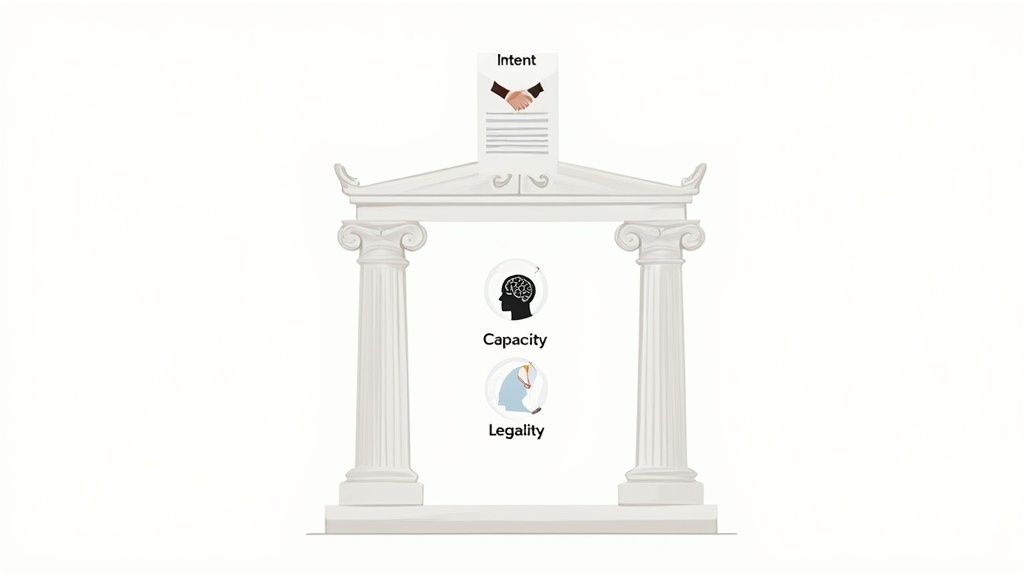
The Unseen Pillars: Intent, Capacity, and Legality
It’s easy to focus on the obvious parts of a deal—the offer, the acceptance, and the exchange of value. But underneath these visible elements, a contract relies on a few invisible pillars to hold it up. Without intent, capacity, and legality, even an agreement that looks solid on the surface can come crashing down.
Think of these as the background checks a court performs on a contract. They ensure the deal is serious, the people involved are competent, and the entire purpose is above board.
Intent to Create Legal Relations
First things first: did everyone involved actually intend to make a legally binding deal? This is what lawyers call the intention to create legal relations. It’s the critical difference between a formal business agreement and a casual promise you might make to a friend over coffee.
To figure this out, the legal system generally relies on a couple of common-sense assumptions based on the situation:
- Commercial Agreements: In a business setting, the law automatically assumes you mean business. When you sign a client agreement or a vendor contract, the default is that you intend for it to be legally enforceable.
- Social or Domestic Agreements: On the flip side, promises made between family or friends are generally presumed not to be legally binding. If you promise to pay your cousin back for dinner, a court isn't likely to treat that as a formal contract.
This distinction is key. It keeps everyday favors and promises out of the courtroom while making sure professional commitments have the legal weight they need.
The Capacity to Enter a Contract
Next up is capacity. In simple terms, everyone signing the contract must be legally and mentally capable of understanding what they're doing. This rule is a crucial safeguard, protecting vulnerable people from being locked into deals they don't fully comprehend.
Generally, someone is considered to lack the legal capacity to contract if they are:
- A minor (in most places, that means under the age of 18)
- Mentally incapacitated to the point where they can't grasp the contract's terms and consequences
- So impaired by drugs or alcohol that their judgment is severely compromised
When a person lacks capacity, the contract usually becomes voidable. This is a powerful protection—it means the person who lacked capacity gets to decide whether to go through with the deal or cancel it entirely.
Getting these foundational elements right is more than just a technicality; it has real financial implications. Recent studies from World Commerce & Contracting reveal that contracts with weak elemental foundations lose an average of 8.6% of their expected value. That’s because only 39% of business professionals feel their contracts actually deliver the results they were supposed to, showing a huge gap between what’s written and what happens.
The Legality of the Contract's Purpose
Finally, the entire point of the contract must be legal. An agreement is automatically void—as if it never existed—if its purpose is to break the law or goes against public policy. The courts simply won't step in to enforce a deal that involves illegal activity.
For instance, a contract to sell stolen goods or an agreement to commit fraud is unenforceable. It doesn't matter how clear the offer and acceptance were; the illegal purpose kills the contract from the start. This final pillar ensures that contracts serve to uphold the law, not undermine it.
So, beyond the "big three" of offer, acceptance, and consideration, these foundational rules are what give a contract its true legal strength. Here’s a quick summary of what makes them so important.
Key Elements for Contract Validity
| Element | What It Means | Common Example of a Problem |
|---|---|---|
| Intent to Create Legal Relations | Everyone involved must genuinely intend for the agreement to be legally binding and not just a casual promise. | Two friends informally agree that one will design a logo for the other, but there's no clear sign they intended it to be a formal business deal. |
| Legal Capacity | All parties must be legally competent (e.g., of age, mentally sound) to understand and commit to the contract. | A business owner signs a major supply contract after having several alcoholic drinks, impairing their judgment and understanding of the terms. |
| Legality of Purpose | The contract's objective and the actions it requires must be legal and not violate public policy. | A freelancer signs a contract that includes non-compete clauses so restrictive they are deemed illegal in their state, making that part (or all) of the contract unenforceable. |
Paying attention to these "unseen" elements ensures your agreements are built on solid ground and can be relied upon when it matters most.
Applying Contract Elements in the Digital Age
It’s one thing to understand the textbook elements of a contract, but how do these old-school rules hold up in a world of instant downloads and one-click agreements? Business today moves incredibly fast, and the way we make deals has changed completely. While the core ideas—offer, acceptance, consideration—are still the bedrock of any agreement, how we prove them looks very different.
Technology has stepped in to fill the gap left by paper trails and ink-stained fingers. Instead of just being a convenience, digital tools give us new, powerful ways to document and validate every component of a contract. It's about creating a clear, indisputable record that strengthens the agreement from day one.
Solidifying Offer and Acceptance with Technology
This is where modern e-signature platforms like QuickSign really shine. They're built to create a robust audit trail that captures the exact moment a deal is struck—that digital handshake of offer and acceptance. When you send a document out for a signature, the system is silently logging every single interaction.
This digital footprint typically includes details like:
- Who sent the document (making the offer).
- The exact time the other party opened and reviewed it.
- The precise moment they signed on the dotted line (the acceptance).
- Technical data like the IP address and device they used.
This log becomes undeniable proof of mutual agreement. It makes it incredibly difficult for someone to later claim they didn't see the terms or never actually agreed. If you’re making deals online, getting familiar with the legal requirements for electronic signatures isn't just a good idea; it's essential for making sure your contracts are enforceable.
An electronic signature, backed by a comprehensive audit log, serves as a powerful digital witness. It timestamps the meeting of the minds, confirming that a clear offer was met with an equally clear acceptance, fulfilling these foundational elements of a contract.
Managing Complex Agreements at Scale
For bigger businesses, the problem isn't just getting one contract right—it's managing thousands of them. When you're juggling that many agreements, things can get messy fast, opening the door to serious risks and inefficiencies. That's why contract lifecycle management (CLM) software has become so crucial.
The scale of the problem is staggering. Big companies in the Fortune 1000 can have 20,000 to 40,000 active contracts at any given time. The effort to manage them can eat up to 50% of a legal team's time. Gartner's research highlights that much of this time is wasted just trying to clarify poorly defined terms—the very same core elements we've been discussing. You can find more data on these challenges from resources like Juro.com.
CLM platforms act as a central hub for every agreement, making sure that key terms around consideration, intent, and legality are consistent and easy to find. By automating renewal reminders, tracking obligations, and flagging unusual clauses, these systems help companies avoid the confusion and oversight that often lead to expensive disputes. Technology doesn't change the rules of the game, but it gives you much better tools to win it.
A Practical Checklist for Reviewing Any Contract
Knowing the theory behind what makes a contract work is great, but looking at a real document can still feel like a test you didn't study for. This simple checklist is for anyone—freelancers, small business owners, you name it—who wants to feel confident before they sign on the dotted line.
Think of these plain-English questions as your guide. They'll help you turn those big legal ideas into a practical to-do list, making it much easier to spot potential issues and make sure your agreement is built to last.
Offer and Acceptance: The Core Deal
First things first: is the deal itself perfectly clear? Hazy language is where most future arguments start, so you want to be sure you and the other party have had a true "meeting of the minds."
Offer: Are all the key details spelled out? I’m talking about deliverables, timelines, payment schedules, and who's responsible for what. Watch out for vague words like "as needed" or "promptly," which can mean different things to different people.
Acceptance: Does this document actually match the final deal you shook hands on? Double-check that any verbal agreements or changes you discussed have made it into the final draft.
A contract should be a perfect snapshot of the final agreement. If any term looks unfamiliar or incorrect, it’s crucial to pause and clarify before proceeding. This is the moment to ensure the written words match your mutual understanding.
Consideration and Intent: The Binding Exchange
Next up, you need to confirm that the value exchange is clear and everyone involved is legally able to make the agreement. This is all about making sure the contract is a serious commitment, not just a casual promise that can’t be enforced.
Consideration: Is it obvious what each person is giving and getting? Whether it’s money for services, goods for goods, or even a promise not to do something, the trade-off has to be clearly stated.
Capacity and Legality: Is everyone involved of legal age and mentally sound? And is the whole point of the agreement legal and in line with public policy?
Once you’ve ticked these boxes, the last step is to make it official. Learning how to digitally sign a PDF properly gives you a secure and verifiable record of your acceptance, locking in the terms you’ve so carefully reviewed. This checklist helps you move from theory to confident action, safeguarding your interests in every agreement.
Questions We Hear All the Time
Contracts can feel complicated, but the questions people have are often surprisingly similar. Let's walk through a few of the most common ones that pop up when you're trying to make sure your agreements are rock-solid.
Does a Contract Really Have to Be in Writing?
Not necessarily. Lots of verbal agreements are perfectly legal and enforceable, provided they tick all the essential boxes—offer, acceptance, and so on. When you order a coffee, you're entering into a verbal contract.
But for your business, always get it in writing. Always. A written contract is your single source of truth, a clear record that prevents "he said, she said" arguments down the road. Plus, some types of contracts absolutely must be in writing to be valid, like agreements for the sale of land. These rules fall under a legal concept called the Statute of Frauds.
What if One of the Key Elements Is Missing?
If a core building block is missing, you don't really have a contract. The agreement is likely either void (meaning it was never a valid contract to begin with) or voidable (meaning one person has the legal right to back out).
Think about it this way: an agreement without consideration isn't a contract; it's just a promise to give a gift. Since nothing of value is being exchanged both ways, a court won't step in to enforce it. This is exactly why a quick check for every element is so important before you sign.
Can a Simple Email Exchange Form a Contract?
You bet it can. As long as that email chain clearly shows a specific offer, a direct acceptance of that offer, and a genuine intent from both sides to make a deal, it can absolutely be a binding contract.
A judge will look at the entire conversation to see if there was a true "meeting of the minds." While it's a completely valid way to form an agreement, the rules can get tricky depending on where you are. To be safe, it's a good idea to check out the specifics in our guide to electronic signature laws by state.
Ready to build contracts that leave no room for doubt? With QuickSign, you can create and sign agreements in minutes. Every document comes with a complete audit trail, giving you undeniable proof that every essential contract element was met and agreed to. Try QuickSign for free today and see how simple it can be.