Digital Transformation for Small Businesses: A Practical Guide to Growth
Discover digital transformation for small businesses with a practical, step-by-step roadmap to growth and efficiency.
"Digital transformation" sounds like a big, expensive term reserved for giant corporations, doesn't it? But for small businesses, it's actually much simpler. It's about strategically using technology to fix real-world problems, work smarter, and open up new avenues for growth.
This isn't about chasing every shiny new app. It's about making fundamental changes to how you run your business, connect with customers, and stay competitive.
What Digital Transformation Really Means for Your Business
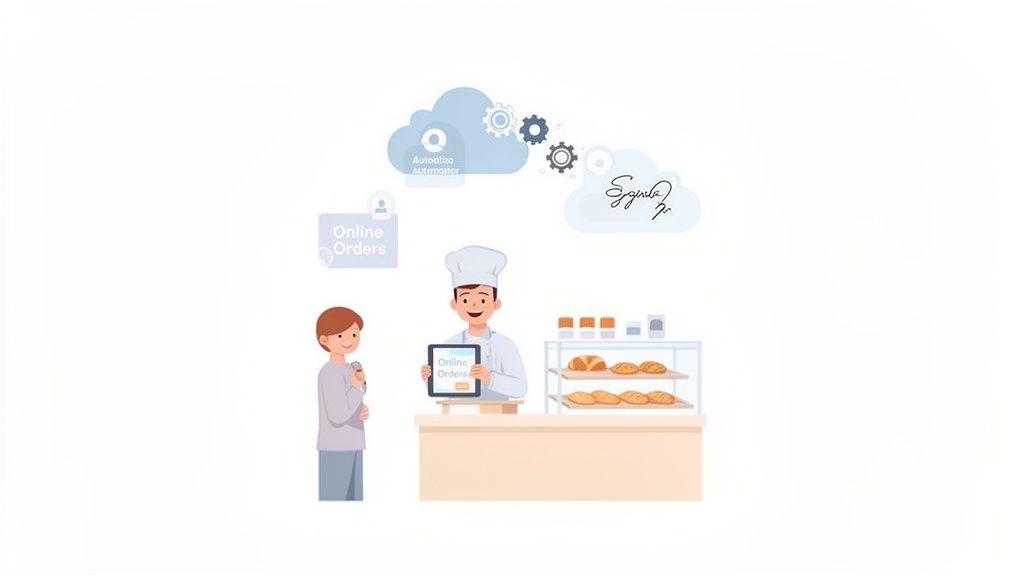
Let's cut through the jargon. Imagine you own a local bakery. Painting the walls and getting a new sign is like a simple upgrade—it looks nice, but you're still doing things the same way.
Digital transformation, on the other hand, is a complete operational rethink. It’s installing an online ordering system that cuts down the Saturday morning queue. It's using sales data to send a "we miss you" coupon for a customer's favorite pastry. It's setting up an inventory system that automatically orders more flour before you even realize you're running low.
It's a Mindset, Not Just New Software
This journey is about shifting your thinking, not just swapping out your tools. You start seeing technology as a core part of your team, one that can unlock efficiencies you never thought possible. The real goal is to get away from manual, repetitive tasks and move toward automated, data-informed processes.
This gives you back your most valuable asset: time. Time you can spend talking to customers, training your staff, or planning your next move.
And here’s the best part—it's more achievable now than ever. Tools that used to cost a fortune are now affordable and built for businesses just like yours. A few solid starting points include:
- Cloud-Based Software: Forget clunky, on-site servers. Cloud tools let you access everything you need from anywhere with an internet connection.
- Automation Platforms: Think about all the little things you do over and over—sending invoices, scheduling appointments, chasing leads. Automation handles that for you.
- Electronic Signatures: Stop the print-sign-scan-email cycle. With e-signatures, you can get contracts and agreements finalized in minutes, not days.
Digital transformation isn't just another expense on your balance sheet. It's a direct investment in your company's future, making it more resilient, scalable, and ready for whatever comes next.
This Isn’t a Fad—It’s the New Standard
Making these changes is no longer just for the early adopters; it’s essential for survival and growth. Recent surveys show that a huge majority—between 70% and 88%—of small and mid-sized businesses are already using digital tools like AI and cloud software.
Even better, they're connecting that adoption directly to stronger revenue and a better competitive edge. It’s clear proof that the investment pays off. The path of digital transformation for small businesses is paved with these kinds of high-impact, scalable solutions that deliver results you can actually see.
The Tangible Benefits of Going Digital
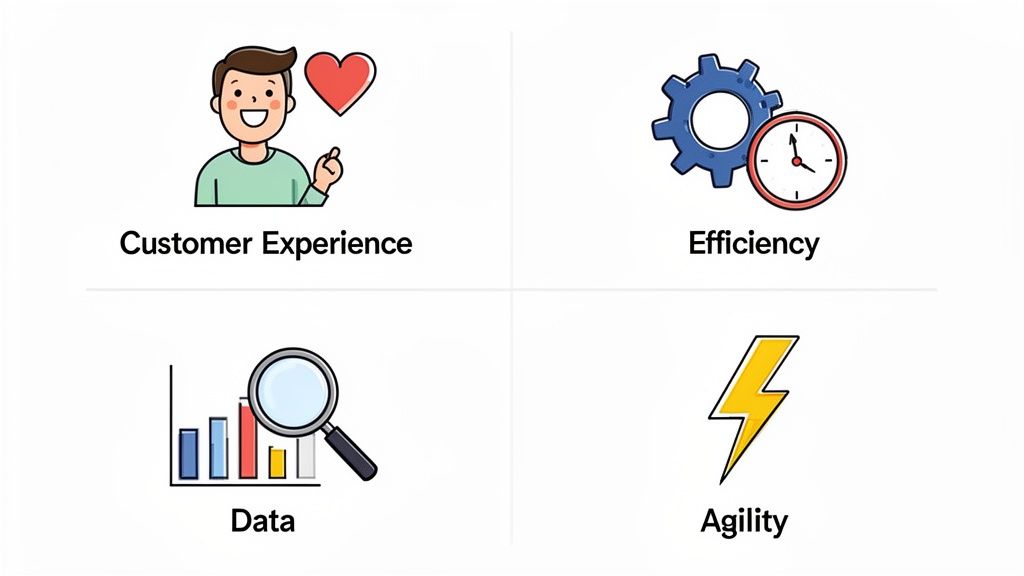
Bringing new technology into your business isn't just about keeping up with the times; it’s about achieving real, measurable results. A well-planned digital strategy gives you powerful advantages that show up in your bank account, in your team's day-to-day work, and in your company's staying power.
These aren't just abstract ideas. They’re concrete improvements you can see and feel, and they tend to fall into four key areas. Let's dig into what you can actually expect when you commit to going digital.
A Superior Customer Experience
Today, your customers want everything to be fast, easy, and tailored to them. Digital tools are the most direct way to deliver on that promise. Think faster service, more personal interactions, and showing up wherever your customers happen to be.
A local plumber, for example, could use an online scheduling tool that lets clients book an appointment at 10 PM on a Sunday, no phone tag required. An online boutique can use purchase history to suggest a new pair of shoes a customer is almost guaranteed to love. Getting the customer experience right builds the kind of loyalty that pays off for years.
Drastically Improved Operational Efficiency
If you're like most small business owners, you're probably drowning in repetitive admin work. This is where digital tools offer the clearest and most immediate return on your investment. They break the cycle by automating the manual chores that eat up your most precious resource: time.
Think about all the hours you spend creating invoices, chasing down signatures, or manually building employee schedules. Now, picture putting those tasks on autopilot.
- Automated Invoicing: A system can automatically create and send an invoice the moment a job is marked complete, then follow up with polite payment reminders.
- Streamlined Onboarding: A new client can receive their contract and sign it with an e-signature tool in minutes, not days.
- Centralized Communication: All project files and conversations live in one place, so you can stop digging through endless email threads to find what you need.
These aren't small wins. We're talking about freeing up hours every single week—time you can reinvest into growing the business and taking care of your customers.
Smarter Data-Backed Decision Making
Running a business on guesswork is a huge gamble. Digital tools give you the hard numbers you need to stop guessing and start making smart choices based on what your customers are actually doing.
By embracing digital tools, you transition from running your business on intuition alone to steering it with a clear, data-informed roadmap. This shift is fundamental to sustainable growth and adaptability.
Even basic analytics can unlock game-changing insights. Your website traffic can tell you which services people are most interested in, while sales data can pinpoint your most profitable customers. This intel helps you put your money where it matters most, fine-tune your marketing, and focus your energy for the biggest impact.
Enhanced Agility and Resilience
At the end of the day, a solid digital foundation just makes your business more nimble. When the market zigs or a new opportunity zags, you can react quickly without being weighed down by clunky, old-school processes. For instance, a business using a modern document workflow can adjust contracts or agreements instantly. For those looking to speed things up, exploring the benefits of digital signatures is a great place to start.
This resilience makes it easier to scale up when you're busy or trim things down during a slow spell. In a world full of surprises, that ability to adapt isn't just a nice-to-have—it’s a must-have for sticking around and thriving.
Where to Start Your Digital Transformation Journey
The very idea of a total business overhaul is enough to make anyone feel overwhelmed. That’s completely normal. The secret is to forget about doing everything at once. A smart digital transformation starts with small, strategic steps that deliver clear, immediate value.
Instead of one massive, disruptive project, think of it as a series of targeted upgrades. When you focus on the areas that cause the most friction or eat up the most time, you build momentum and see a return on your investment almost immediately.
Let's break down three high-impact areas to get you started.
First, Upgrade Your Customer-Facing Tools
These days, your first impression is almost always a digital one. A clunky website or a confusing online checkout can send potential customers straight to your competitors before they even speak to a soul. This is the lowest-hanging fruit for a reason—improving the customer experience directly impacts your bottom line.
Start by taking a hard look at your digital storefront. Is it easy for customers to find what they need? Can they actually buy from you or book a service without getting frustrated?
Here are a few foundational pieces to get right:
- A Modern, Mobile-Friendly Website: Your website is your 24/7 salesperson. It needs to look professional, be a breeze to navigate, and work flawlessly on a smartphone, which is where most of your customers are probably finding you.
- Simple E-commerce or Online Booking: Make it easy for people to give you their money. Whether you’re selling products directly or letting clients book appointments, removing barriers to that final transaction is a guaranteed win.
- Active and Engaging Social Media: You have to be where your customers are. Use social media not just to push sales, but to build a community, answer questions, and show the human side of your brand.
Next, Automate Your Back-Office Operations
Behind every small business is a mountain of administrative work—invoicing, scheduling, follow-ups, and endless paperwork. These repetitive, manual tasks are perfect candidates for automation. Reclaiming the hours you spend on admin is like hiring an assistant for a fraction of the cost, freeing you up to focus on growing the business.
This is where you can see some of the most dramatic efficiency gains. Begin by picking just one or two processes that consistently drain your time and energy.
The goal of back-office automation isn’t to replace people. It’s to free them from robotic tasks so they can focus on what humans do best—building relationships, solving complex problems, and thinking strategically.
For example, you could set up an accounting tool to automatically chase down late payments. A customer relationship management (CRM) system can send automated follow-up emails, making sure no lead ever falls through the cracks. These small changes add up fast, giving you back your most valuable asset: your time.
Finally, Modernize Your Document Workflows
Just think about how many of your most critical business processes still rely on a piece of paper. Sales contracts, new-hire forms, vendor agreements, client proposals—the list goes on. The old print-sign-scan-email cycle is slow, prone to errors, and a headache for everyone involved.
Modernizing this one area can have a ripple effect across your entire operation. This is where a tool like an e-signature platform becomes a game-changer. It takes a frustratingly manual process and turns it into a fast, secure, and completely digital workflow.
Imagine sending a sales contract and getting it signed and returned in under ten minutes, all while your client is on their phone. That’s the power you unlock when you focus on a single, high-impact workflow. With a tool like QuickSign, you can eliminate printing, scanning, and mailing for good, speeding up everything from closing deals to onboarding new team members. To really see the impact, you can learn more about how to get started with document workflow automation in our complete guide.
All of these foundational steps rely on secure, cloud-based solutions. It’s no surprise that by 2025, global spending on digital transformation hit around $2.5 trillion, with small businesses increasingly treating cloud and security-compliant tools as non-negotiable. For a deeper dive into establishing a solid foundation, check out these 10 Digital Transformation Best Practices.
A Practical Roadmap to Digital Success
Kicking off a digital transformation can feel a lot like planning a cross-country road trip without a map. To actually reach your destination, you need a clear route broken down into manageable legs. This phased approach does just that, breaking the process into four distinct and achievable stages, moving from foundational planning to intelligent, long-term growth.
This visual shows how the core elements of your business—your customers, internal processes, and documentation—are interconnected steps on this journey.
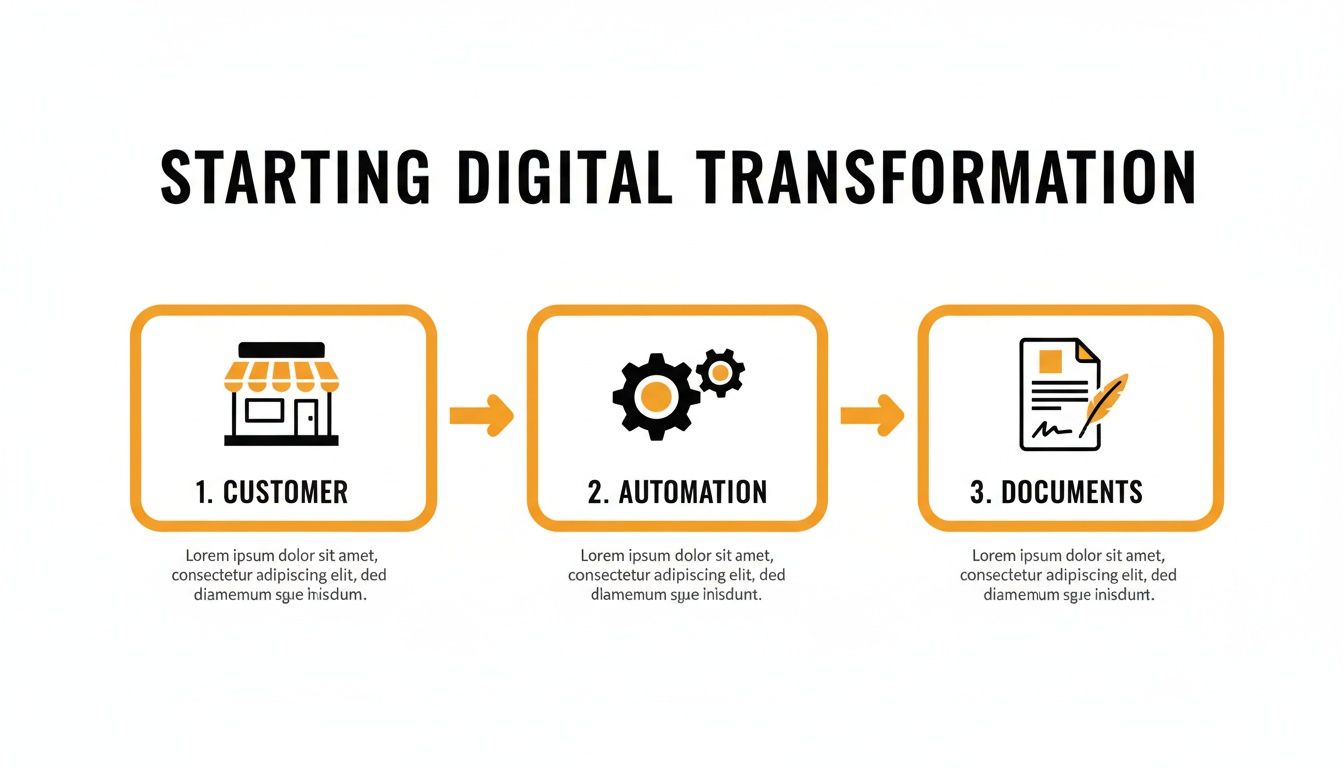
Starting with the customer experience, then automating internal operations, and finally digitizing document workflows creates a logical progression. You build real value at each step.
Phase 1: The Assessment
Before you buy a single piece of software or change one process, you have to know where you're starting from. This first phase is all about diagnosis. It's time to take an honest look at your business and identify the biggest bottlenecks, time-wasters, and points of friction—both for your team and your customers.
What tasks make your employees groan? Where do deals stall or get delayed? Answering these questions helps you pinpoint the highest-impact areas to tackle first. Your goal here is to set clear, specific objectives. Instead of a vague goal like "improve efficiency," aim for something you can actually measure, like "reduce the time it takes to get a new client contract signed from five days to one."
A solid assessment involves:
- Listing key business processes from start to finish.
- Identifying the top three pain points that slow down your operations.
- Setting one or two specific goals for your initial efforts.
Phase 2: Building The Foundation
With your goals locked in, it's time to lay the groundwork. This phase is all about putting essential, often low-cost, cloud-based tools in place to improve communication and collaboration. Think of this as getting your essential gear ready before a big hike—these foundational technologies are the building blocks for more advanced systems later on.
You’re not trying to overhaul everything at once. Instead, focus on tools that solve the immediate problems you uncovered in Phase 1. This could be a shared project management tool to get everyone on the same page, a simple customer relationship management (CRM) system to track leads, or a cloud storage solution to centralize important files securely.
The key to this phase is choosing tools that are easy to adopt and deliver immediate value. Quick wins are crucial for building momentum and getting your team excited about the changes.
Phase 3: Introducing Automation
Once your foundational tools are in place, the real magic begins. This phase is all about making those separate systems talk to each other to create seamless, automated workflows. Automation is what truly starts giving you back your time by getting rid of manual data entry and repetitive tasks. It connects the dots between different parts of your business.
For example, you could connect your online booking system to your invoicing software, so an invoice is automatically generated the moment an appointment is completed. Or, you could link your e-signature platform to your CRM, so a signed contract automatically updates a customer's status from "lead" to "client." These connections turn a series of clunky tasks into a smooth, efficient process that practically runs itself. If you're looking for ideas, our guide on how to streamline approvals with automated document signing is a great place to start.
Phase 4: Optimization And Scaling
The final phase is really a continuous cycle of improvement. Now that your new digital systems are up and running, they're generating valuable data. This stage is all about using that data to refine your processes, make smarter decisions, and prepare your business to scale intelligently.
Look at the analytics from your new tools. Which marketing channels are bringing in the most valuable customers? How long does your average sales cycle take now that you've digitized contracts? The insights you gather will highlight what's working and where there's still room for improvement. This data-driven approach allows you to double down on what works and adjust your course as needed, ensuring your digital transformation for small businesses becomes a long-term engine for sustainable growth.
Getting Your Team Excited About Change
Let's be honest: the best software in the world is completely useless if your team refuses to use it. The human element is the single most important—and most frequently forgotten—part of a successful digital shift. Your goal is to get your team on board as enthusiastic supporters, not roadblocks.
This is about more than just sending out a memo announcing a new system. It’s about managing expectations, calming fears, and demonstrating exactly how these new tools will make everyone's work life easier. When you lead with a clear vision and a bit of empathy, you can turn that potential resistance into genuine excitement.
Communicate The Why Before The How
The biggest mistake I see business owners make is jumping straight into the technical features of a new tool while forgetting the human benefits. Your team doesn't really care about API integrations; they care about getting rid of the annoying tasks that drive them crazy every day.
So, start with the "why." Clearly explain the problem you’re solving for them. Are you trying to kill off mind-numbing data entry? Or maybe speed up client approvals so they get their commissions faster? Frame every change as a way to empower your people, not replace them.
For example, a small marketing agency owner I know wanted to bring in a new project management tool. Instead of just announcing it, she called a team meeting and started with, "I know we're all sick of digging through endless email chains for client feedback. This new tool will put all of it in one place, so we can spend less time searching and more time creating." Now that gets people listening.
Turn Early Adopters Into Internal Champions
In any team, you've got a few people who get genuinely excited about new tech. Find these folks. They're your secret weapon. These are the people you can turn into internal champions who can pilot new software and give you priceless, on-the-ground feedback.
Get a small pilot group going. Give them early access to a new tool, train them well, and ask them to help you test it out on real projects.
Once they see the benefits firsthand, they'll start talking. Their positive stories and genuine enthusiasm are far more convincing to their skeptical colleagues than any top-down directive from a manager. This approach creates momentum from the inside out, pulling people along instead of pushing them.
Make Training and Feedback a Priority
Never, ever assume a new piece of software is "intuitive." Skimping on training is a surefire way to watch your investment fail, as frustrated employees will just go back to their old, comfortable spreadsheets.
Offer structured, hands-on training sessions that walk through the actual tasks your team does every day. At the same time, open up a clear and simple way for them to give feedback. Listen to their concerns, frustrations, and ideas.
Acknowledging your team's concerns and involving them in the solution is the fastest way to build trust. When people feel heard, they move from being passive recipients of change to active partners in its success.
This feedback loop isn't just about making people feel good; it helps you spot real problems with the new system. Fixing those issues shows your team that their input is valued and that you're all in this together, working toward the same goal.
How to Measure Your Digital Transformation ROI
Pouring money into new technology without tracking the results is like flying a plane without an instrument panel. You're definitely moving, but you have no clue if you're gaining altitude or headed for a nosedive. Measuring the Return on Investment (ROI) of your digital efforts is how you get your instruments working, allowing you to make smart, data-backed decisions that actually grow your business.
This isn't about getting lost in complicated spreadsheets. It's simply about connecting the dots between what you spend on technology and what you get back in real, tangible results. How do you know that new software is really worth it? You start by defining what "winning" looks like before you even begin, using a set of clear Key Performance Indicators (KPIs).
Setting Your Key Performance Indicators
KPIs are just specific, measurable numbers that tell you if you're on track to meet your goals. They need to be simple, relevant to your business, and easy to keep an eye on. The right KPIs depend entirely on what you’re trying to fix or improve.
Here are a few practical examples tied to common business goals:
- To Improve Customer Experience: Keep an eye on your average online review score. If you launch a new online booking system and your Google rating climbs from 4.2 to 4.8 stars, that’s a clear win.
- To Boost Operational Efficiency: A great KPI is hours saved per week. Let's say switching to e-signature templates cuts the time it takes to get a contract signed from two days down to two hours. That’s a huge efficiency gain you can put a dollar value on.
- To Increase Sales and Revenue: Your website's conversion rate is a perfect metric. This is the percentage of visitors who take a desired action, like making a purchase or filling out a lead form.
The goal is to shift your mindset from, "I feel like this is working," to "I know this is working because our customer response time has dropped by 50%." That kind of certainty is powerful. It justifies the expense and gives you the confidence to invest more in what's effective.
A Simple ROI Calculation Example
Once you’ve got your KPIs, you can do a quick ROI calculation. Don't let the term scare you; the math is simple.
The basic formula is: ROI = (Net Profit from Investment / Cost of Investment) x 100
Let’s walk through a real-world scenario. Imagine your business invests $1,200 for an annual subscription to an e-signature platform. By getting rid of the print-scan-email cycle, you save 10 hours of administrative time every month. If you value that time at $50 per hour, you’re saving $500 a month, which adds up to $6,000 over the year.
- Net Profit: $6,000 (Savings) - $1,200 (Software Cost) = $4,800
- ROI: ($4,800 / $1,200) x 100 = 400%
A 400% ROI is a home run. It's a concrete number that proves the investment was a smart business decision. In fact, recent e-signature statistics show heavy adoption for exactly this reason—the efficiency gains are undeniable. Applying this same logic to other parts of your business is key; for instance, it's just as important to learn how to measure marketing ROI to get a full picture of your digital success.
Got Questions About Going Digital? We've Got Answers.
Stepping into the world of digital tools is a big move, and it's totally normal to have a few questions. You're probably thinking about the cost, the effort, and whether your data will be safe. These are smart things to consider. Let's tackle the most common concerns we hear from small business owners so you can feel good about moving forward.
A lot of owners think a "digital overhaul" means a massive, budget-breaking expense. This is probably the biggest myth holding businesses back.
"Isn't This All Too Expensive for My Small Business?"
Not if you do it right. The trick is to forget about a massive overhaul and start small with tools that solve a real, immediate problem.
Think about it this way: many of the best tools out there, like e-signature platforms or project management software, run on simple monthly subscriptions. Some even have free plans to get you started.
Because these tools are cloud-based, you also get to skip the cost of buying and maintaining your own expensive servers. The goal isn't to spend a fortune overnight. It's to find a tool that saves you time or boosts your sales, paying for itself almost immediately. This is about taking small, smart steps—not one giant, expensive leap.
"I'm Completely Overwhelmed. Where Do I Even Start?"
That feeling is completely understandable. When everything feels like a priority, the best approach is to ignore the big picture for a minute and zoom in on one thing.
What's your single biggest operational headache right now? Is it the endless back-and-forth of getting contracts signed? The time you waste manually creating and sending invoices? Or maybe it's answering the exact same customer questions day after day?
Pick just one of those frustrating, time-sucking tasks and find a digital tool built to fix it. For instance, getting an e-signature solution is a quick, easy win. You'll immediately see how much faster you can close deals and onboard new clients. Solving that one problem will give you the confidence and momentum to figure out what's next.
"How Do I Keep My Business and Customer Data Secure?"
Security should absolutely be at the top of your list. The key is to partner with software providers who take security as seriously as you do. Don't hesitate to look under the hood of any tool you're considering.
Here are a few non-negotiables to look for:
- End-to-end encryption, which scrambles your data so no one else can read it.
- Secure cloud infrastructure hosted by a major, reputable provider.
- Compliance with industry standards like eIDAS, which is the gold standard for e-signatures in Europe.
Here's the thing: established cloud companies invest millions in security—far more than any small business could. A Verizon report even found that small businesses are four times more likely to suffer a data breach than larger ones, often because they have fewer resources. By choosing a reputable partner, you're often making your data safer, not putting it at risk. Always take a few minutes to read their security and privacy policies before you sign up.
Ready to take the first simple, secure, and high-impact step in your digital journey? QuickSign helps you modernize your document workflows in minutes. Start sending and signing documents securely today, for free. Find out more at QuickSign.it.