A Bulletproof Contract Template for General Contractors
Build a better contract template for general contractors. Learn the essential clauses and advanced strategies to protect your business and ensure you get paid.
A good contract template for a general contractor isn't just another piece of paperwork. It's the blueprint for your entire project, laying out clear expectations, protecting your cash flow, and heading off disputes before they even start. Think of it as your first line of defense against scope creep and late payments—it sets a professional tone right from the get-go.
Why a Solid Contract Is Your Most Important Tool
In the high-stakes world of construction, a handshake deal just won't cut it. Any ambiguity is a direct path to expensive headaches like scope creep, fights over payments, and soured client relationships. A professionally designed contract template is the foundation of a successful contracting business because it turns loose talk into a concrete, enforceable plan.
This is about more than just legal cover; it's about running a tighter ship. A well-built contract manages everyone's expectations by detailing everything from the exact scope of work to the payment schedule. So, when a client inevitably asks for "one more small change," you're not left scrambling. Your contract's change order clause gives you a clear process to document the new work, its cost, and how it affects the timeline.
From Legal Formality to Project Blueprint
When you start treating your contract as the project blueprint instead of just a legal hoop to jump through, your whole process changes. It becomes the central hub for communication, getting the client, your subs, and your own team on the same page. This proactive mindset stops small misunderstandings from blowing up into project-derailing conflicts that can tank your reputation. To really get why a strong contract is so critical, it helps to understand the full picture of what is contractor management.
The benefits aren't abstract—they're real and they hit your bottom line.
- Crystal-Clear Deliverables: A detailed scope of work section eliminates any guesswork about what’s included in the price and, just as crucially, what’s not.
- Rock-Solid Financials: A clear payment schedule tied to specific milestones keeps your cash flow healthy and prevents you from funding the project out of your own pocket.
- Smart Risk Management: Clauses for insurance, liability, and dispute resolution act as a shield, protecting your business from the unexpected.
Keeping Pace in a Growing Industry
The U.S. construction industry is massive, with the general contractor market expected to reach $2.24 trillion by 2027. But here’s the reality: up to 30% of all projects are plagued by payment delays or scope creep, almost always because of a weak initial agreement. This is where a standardized, professional template gives you a serious competitive edge. In fact, construction firms that have switched to digital templates report getting projects started 40% faster by cutting out the endless back-and-forth of manual paperwork.
You’ve probably seen these issues firsthand. A vague contract can quickly turn a profitable job into a nightmare. The table below breaks down some common contract weaknesses and the real-world problems they cause.
Common Contract Weaknesses and Their Business Impact
| Common Contract Weakness | Potential Business Impact | How a Strong Template Solves It |
|---|---|---|
| Vague Scope of Work | Uncontrolled scope creep, unpaid extra work, client disputes. | Defines exact deliverables, materials, and exclusions in writing. |
| Unclear Payment Terms | Delayed payments, cash flow crises, strained supplier relationships. | Establishes a clear draw schedule tied to project milestones. |
| No Change Order Process | "Small favors" add up, eroding profit margins and extending timelines. | Creates a formal process for documenting, pricing, and approving all changes. |
| Missing Dispute Resolution Clause | Minor disagreements escalate into costly legal battles. | Specifies a clear, low-cost method like mediation to resolve issues first. |
Looking at it this way, it’s clear that a solid contract isn’t an expense—it’s an investment in your project's success and your company's stability.
A well-structured contract does more than just outline legal obligations; it builds a foundation of trust and professionalism that makes clients feel secure and respected throughout the entire construction process.
Ultimately, a strong contract template puts you in the driver's seat. By embracing digital tools and following the https://quicksign.it/blog/best-practices-for-contract-management, you can transform a tedious administrative task into a streamlined, secure workflow. That frees you up to focus on what you do best: building great things.
The Core Clauses Your Contract Can't Afford to Miss
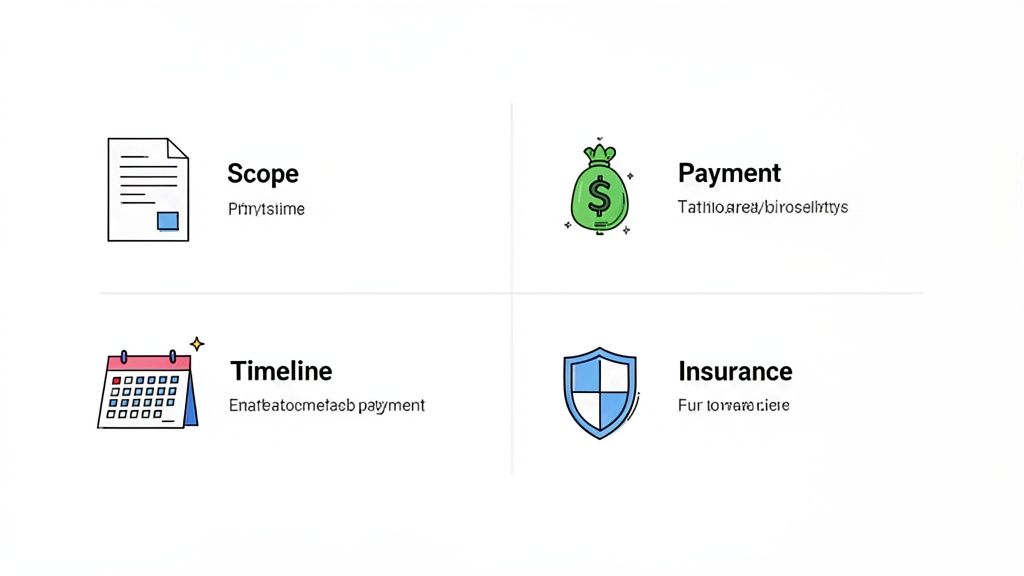
While no two construction projects are identical, the best contracts are all built on the same solid foundation. A bulletproof contract template for general contractors needs a handful of non-negotiable clauses that act as the project's rulebook. These aren't just legal fluff; they are your day-to-day tools for preventing headaches, keeping cash flowing, and pushing the job forward.
Think of these core clauses as the structural frame of your agreement. Without them, the whole project can start to wobble under the pressure of unspoken assumptions and misaligned expectations. Each one tackles a critical area where arguments often start, turning potential blow-ups into clear, manageable processes.
Nailing Down a Bulletproof Scope of Work
The Scope of Work (SOW) is, without a doubt, the most important part of your contract. Vague descriptions like "kitchen remodel" are just asking for scope creep and disagreements down the line. A truly effective SOW leaves zero room for guesswork.
You need to get granular, spelling out not just what you will do, but just as importantly, what you won't. This is how you sidestep those late-game arguments over whether that high-end faucet or extra landscaping was part of the deal.
A rock-solid SOW should detail:
- Specific tasks and deliverables: Get specific, from demolition and framing right down to the final paint colors and hardware installation.
- Materials and products: List brand names, model numbers, and quality standards whenever you can.
- Drawings and plans: Reference the exact architectural drawings (with version numbers), engineering specs, and permits the job is based on.
- Exclusions: Clearly state what's not included. This could be anything from appliance purchases and hazardous material abatement to final landscaping.
Your SOW is your number one defense against doing unpaid work. When a client asks for something that isn't in there, you have a signed document to point to, making it easy to pivot the conversation to your change order process. Knowing the fundamental elements of a contract is key to drafting a document that will actually protect you.
Structuring a Healthy Payment Schedule
Nothing kills a project's momentum like a payment dispute. Your contract has to lay out a payment schedule that keeps your cash flow healthy and lines up with the work being done. Just listing a total price won't cut it.
A milestone-based payment schedule is the industry standard for a reason—it works. This approach ties payments to the completion of specific, easy-to-verify stages of the project.
For instance, a typical payment schedule might be structured like this:
- 10% Deposit: Due at signing to get materials ordered and crews mobilized.
- 25% Milestone: Paid once the foundation and framing are complete and inspected.
- 25% Milestone: Due when you hit the "lock-up" stage (windows, doors, roofing are on).
- 30% Milestone: Paid after all interior rough-ins (plumbing, electrical, HVAC) are finished.
- 10% Final Payment: Due upon substantial completion and the client’s final walkthrough.
This system ensures you’re getting paid as you spend money, so you're not left financing the client's project out of your own pocket. Be sure to also specify payment terms (like "Net 15") and any late fees.
Handling Changes with a Clear Process
In construction, change is the only constant. It could be a client having a last-minute change of heart on tile selection or an unexpected issue hiding behind a wall. Your contract needs a formal process for handling these shifts. That's what the Change Order clause is for.
Without a strict process, those "little requests" can quietly eat away your profit margin and throw the entire schedule off track. Your Change Order clause should mandate that any and all changes are put in writing and signed by both you and the client before the extra work starts.
A Change Order isn't just a piece of paper; it's a mini-contract. It protects everyone by clearly documenting the new scope, the additional cost, and the impact on the project timeline.
This signed document is your proof. It confirms the client agreed to pay for the change and acknowledges any necessary schedule adjustments, heading off disputes about budget overruns or delays.
Setting Realistic Timelines and Completion Dates
The project schedule is another area that demands total clarity. Your contract must define a planned start date and, critically, a date of substantial completion. That term is key—it generally means the project is ready for its intended use, even if there are a few minor punch-list items left to tackle.
Your timeline clause also needs to account for the unexpected. It's smart to include language that allows for time extensions due to things you can't control, such as:
- Severe weather events
- Client-related delays (e.g., slow decisions on finishes)
- Major supply chain backlogs
- Permitting or inspection hold-ups
Putting these potential delays in writing from the start manages everyone's expectations and protects you from being penalized for things that are truly out of your hands.
Clarifying Insurance and Liability
Finally, a good contract protects everybody involved. The Insurance and Liability clause spells out the exact types and amounts of coverage required for the job. At a minimum, this includes General Liability insurance for property damage or injuries and Workers' Compensation for your team.
This clause should make it crystal clear who is responsible for carrying these policies. It's also standard practice to require that the client be named as an "additional insured" on your general liability policy, which gives them an added layer of protection. Think of this section as your financial safety net, ensuring one accident doesn't put your entire business at risk.
Advanced Clauses for Proactive Risk Management
Once you've nailed down the basics of your contract—the scope, payment schedule, and timeline—it's time to layer in the clauses that truly protect your business. Think of these advanced provisions as your project's insurance policy. They're what separate a decent contract template for general contractors from a professional-grade shield that anticipates the "what-ifs" that can derail a job.
These aren't just legal formalities; they are active risk management tools. I've seen firsthand how a single, well-crafted clause can save a contractor from a costly legal battle or protect their reputation. It’s the kind of foresight you see in the gold-standard documents from organizations like the AIA and AGC, and it's essential for any serious contractor.
The Power of an Indemnification Clause
Let’s be honest: on a busy job site, things can go wrong. An indemnification clause is arguably one of the most powerful risk-shifting tools in your entire contract. In plain English, it defines who foots the bill if a third party gets hurt or their property is damaged.
Imagine this real-world scenario: one of your subcontractors accidentally damages a neighboring property while operating heavy machinery. Without a strong indemnification clause, that property owner could sue you directly. A properly written clause forces the subcontractor (the one at fault) to cover your legal fees and any resulting damages, holding you harmless. You’re clarifying responsibility before an incident ever occurs.
A Smarter Path Through Dispute Resolution
Disagreements are a part of the business, but they don't have to escalate into a full-blown courtroom drama. A smart Dispute Resolution clause creates a tiered process for handling conflicts, saving everyone an immense amount of time, money, and headaches.
A tiered approach I always recommend looks something like this:
- Direct Negotiation: First, you and the client have to sit down and try to work it out directly. It’s a simple, mandatory first step.
- Mediation: If that fails, you bring in a neutral third-party mediator. Their job isn't to pick a winner, but to help you both find a compromise. It's not binding, but it's incredibly effective.
- Binding Arbitration: As a last resort before a lawsuit, an arbitrator hears both sides and makes a final, legally binding decision. It’s almost always faster and cheaper than litigation.
By laying out this roadmap from the start, you turn a potential crisis into a manageable process. It’s a proactive step that can keep a minor issue from spiraling out of control.
Defining Clear Termination Conditions
Sometimes, a project just isn't meant to be. Your contract absolutely must define the specific conditions under which you or the client can legally walk away. This isn't about planning for failure; it's about creating a professional and orderly exit strategy if things go south.
You need to address two distinct scenarios:
- Termination for Cause: This is when someone drops the ball. For example, if the client repeatedly misses payments or you consistently fail to meet critical deadlines without a good reason.
- Termination for Convenience: This clause gives the client an out for reasons unrelated to your performance. If you include this, it must specify exactly how you'll be compensated for all work performed, materials purchased, and the costs of demobilizing your crew.
Getting these terms right ensures that if a project ends early, you don’t end up holding the bag financially.
Setting Expectations with Warranties
A warranty clause is more than just a legal requirement—it’s a statement about the quality of your work. It tells the client you stand behind what you build by specifying the duration (usually one or two years) and scope of your guarantee.
Get specific here. Your warranty should clearly state what is covered (like defects in workmanship) and, just as importantly, what is not covered (like normal wear and tear, abuse, or defects in a manufacturer's product). This clarity heads off future arguments about what constitutes a valid claim. A detailed warranty, paired with a solid safety plan, can also be a real selling point. In fact, attaching a comprehensive workplace safety policy template to your proposal shows clients you're a pro who takes risk management seriously.
Ensuring Full Compliance with Laws
This clause might seem obvious, but never skip it. It's a simple declaration that all work will follow relevant federal, state, and local laws and building codes. It also needs to state who is responsible for pulling and paying for all permits and inspections.
Putting this in writing eliminates any gray area that could lead to fines or stop-work orders. It’s no surprise that projects with detailed agreements see 25% fewer disputes. This kind of standardization is why many contractors now use e-signature platforms to manage their contract templates.
Keeping track of every single one of these legal and regulatory obligations can be a huge chore. It’s why new tools are popping up to help contractors stay on top of it all. You can learn more about how AI-powered contract obligation tracking is helping smaller firms manage these complexities.
How to Customize Your Template for Any Project
A master contract template for general contractors is a fantastic starting point, but let’s be honest—it’s never a one-size-fits-all solution. Every single project has its own quirks, its own risks, and its own unique client. The real mark of a pro is knowing how to tweak that core template to fit the specific job in front of you.
If you don't, you're leaving yourself wide open. Using a simple residential remodel contract for a complex commercial build-out is a recipe for disaster. Likewise, you can't just swap a fixed-price payment structure for a cost-plus one without overhauling several key clauses. This is where you connect your legal protections to the reality on the ground.
Residential vs. Commercial: Two Different Worlds
The first big question you need to ask is whether the project is residential or commercial. The basic principles might be the same, but the legal hoops, client personalities, and risk levels are miles apart. Your template has to reflect that.
For Residential Projects:
- Keep it simple. Homeowners aren't construction lawyers. Your contract needs to use plain language and spell everything out, especially when it comes to allowances, finish selections, and how change orders will be handled. Clarity is your best friend here.
- Know the local rules. Many states have specific consumer protection laws for home construction, like "right to cure" statutes or mandatory warranty periods. Your contract must comply with these.
- Manage the emotions. A home remodel is deeply personal. Your agreement should set clear boundaries for communication and decision-making to keep expectations in check and the project moving forward smoothly.
For Commercial Projects:
- Get formal with compliance. These jobs usually come with stricter building codes, more frequent inspections, and heavy reporting requirements. Your contract needs to account for this, with clauses covering submittals, RFIs (Requests for Information), and regular progress reports.
- Double down on subcontractor management. Those flow-down clauses we talked about earlier? They're non-negotiable here. You have to ensure every agreement you sign with a sub mirrors the promises you made to the property owner.
- Beef up the insurance. Commercial clients will almost always demand higher liability insurance limits and may require you to secure performance or payment bonds. Your template should have a clear spot to specify these requirements.
Matching the Contract to the Money
After the project type, the pricing model is the next biggest factor that dictates how you need to customize your contract. The three most common structures—Lump Sum, Cost-Plus, and Time and Materials—each need a different contractual framework to keep your business safe.
For a Lump Sum (Fixed Price) Contract:
This is great for the client because they know the total cost upfront. For you, it means you're carrying all the risk of cost overruns. Your customized contract, therefore, must have a rock-solid, absolutely bulletproof Scope of Work. Any gray area is a direct threat to your bottom line. The SOW needs to be exhaustive, referencing specific plans, material specs, and a detailed list of what isn't included. Your change order clause has to be just as strict.
For a Cost-Plus Contract:
In this model, the client covers the actual costs of labor and materials, plus a fee for your overhead and profit. The financial risk shifts, but a whole new layer of administrative work appears. You'll need to modify your template to include:
- A crystal-clear definition of "reimbursable costs."
- Strict requirements for how you'll track and document every single expense.
- A clause giving the client the right to audit your project financials.
- A "Guaranteed Maximum Price" (GMP) if you’ve agreed to one.
For a Time and Materials (T&M) Contract:
T&M is perfect for smaller jobs or when the scope is a bit of a moving target. But to avoid invoice disputes, you need to be incredibly precise in your contract. It should clearly state:
- The exact hourly rates for every role on your team (e.g., project manager, carpenter, laborer).
- The specific markup percentage you’ll apply to materials.
- How time and materials will be documented—often requiring daily logs signed off by the client.
Customizing your contract isn’t just about changing a few words; it’s about strategically aligning the agreement’s mechanics with the project’s financial and operational realities. This attention to detail transforms a generic document into a precise tool for project success.
Knowing how to tailor your agreements is a skill that sets seasoned contractors apart. If you’re just getting started or work on smaller-scale jobs, it can be really helpful to look at a solid freelance contract template to see how these foundational clauses are structured.
Before you start your next project, use this checklist as a quick guide to make sure your contract is tailored correctly.
Template Customization Checklist by Project Type
| Contract Clause | Lump Sum (Fixed Price) | Cost-Plus | Residential Remodel |
|---|---|---|---|
| Scope of Work | Hyper-detailed. List all inclusions, exclusions, plans, and specs. No ambiguity. | Detailed, but allows for some flexibility. Focuses on the overall project goals. | Extremely clear. Use simple language. Detail allowances for finishes (flooring, tile, etc.). |
| Payment Schedule | Tied to project milestones (e.g., foundation complete, framing up, rough-in). | Regular invoicing (e.g., monthly) based on actual costs incurred plus your fee. | Clear initial deposit, progress payments, and final payment tied to completion. |
| Change Orders | Strict process. Must be in writing, signed by all, with cost/schedule impact defined. | Process for client approval of costs that exceed initial estimates or alter the scope. | Simple, written process. Explain how changes affect cost and timeline in easy terms. |
| Cost Tracking | Internal tracking is key for you. Not typically shared in detail with the client. | Transparent and mandatory. Must define reimbursable vs. non-reimbursable costs. | Document all allowance spending and overages clearly for the homeowner. |
This table isn't exhaustive, of course, but it highlights the most critical areas where a one-size-fits-all approach just won't cut it. Taking a few minutes to make these adjustments is one of the smartest things you can do to protect your business and ensure a smooth project from start to finish.
Putting Your Contract Template to Work with Digital Tools
Having a bulletproof contract template for a general contractor is one thing, but making it easy to use is where the real magic happens. Let's be honest, the old routine of printing, scanning, and chasing down signatures is a huge time-waster. When you bring your contract into a digital workflow, it stops being just a piece of paper and becomes a tool that actually saves you time and gets work started sooner.
Shifting from a simple Word doc or PDF to a reusable digital template isn't just a minor upgrade. It’s a smarter way to run your business. It creates one official version of the agreement, cuts down on mistakes, and makes you look sharp and professional to clients right from the get-go.
From Static Document to Active Workflow
First things first, you need to get your masterpiece of a template into a secure e-signature platform. This is easier than it sounds and instantly gives you capabilities that a paper contract never could. Once it's uploaded, you can start defining who needs to fill out and sign what—the client, your key subs, you, etc.
This is where you start clawing back your time. Your main template can be set up with permanent, reusable fields for:
- Signatures and Initials: No more missed spots. You designate exactly where everyone needs to sign.
- Dates: These can be set to auto-fill the moment someone signs, so there’s no confusion.
- Project Details: Create simple fillable boxes for the client’s name, the job address, and the total contract price.
- Checkboxes: Perfect for clients to initial optional services or confirm they’ve received the final set of plans.
Setting this up once means you never have to worry about missing crucial information again. It walks everyone through the document step-by-step, making the whole process foolproof.
Automation That Actually Helps
Modern contract platforms do more than just collect a signature; they build an entire automated workflow around your agreement. This is what really kills the manual follow-up that eats into your day.
When you automate the contract paperwork, you free yourself up to focus on what you're actually paid to do: run the job site, manage your crew, and deliver a fantastic project for your client.
A game-changing feature is setting a specific signing order. For example, you can set it up so the client has to sign first. Once they do, the document automatically routes to you for your signature. No more manually forwarding emails and wondering who has the ball.
Smart reminders are another lifesaver. If a client hasn’t signed the contract after a couple of days, the system can send a polite nudge for you. This simple trick prevents projects from getting stuck in limbo and helps you get to work faster.
Get Paid Faster and Kick Off Projects Sooner
For any GC, one of the best features is the ability to collect the initial deposit right when the contract is signed. You can build a payment field directly into your template to securely collect that first payment the second your client signs on the dotted line.
This has a few massive benefits:
- Boosts Your Cash Flow: The money you need for materials and mobilization hits your account right away. No more waiting for a check to clear.
- Lowers Your Risk: You eliminate the chance of a client signing the contract but then dragging their feet on the deposit, which can derail your whole schedule.
- Makes It Easy for the Client: They get a simple, all-in-one process, which just reinforces that you're a pro who is easy to work with.
Different project types, of course, mean different contract setups. Your digital template needs to be flexible enough to handle them all before you hit send.
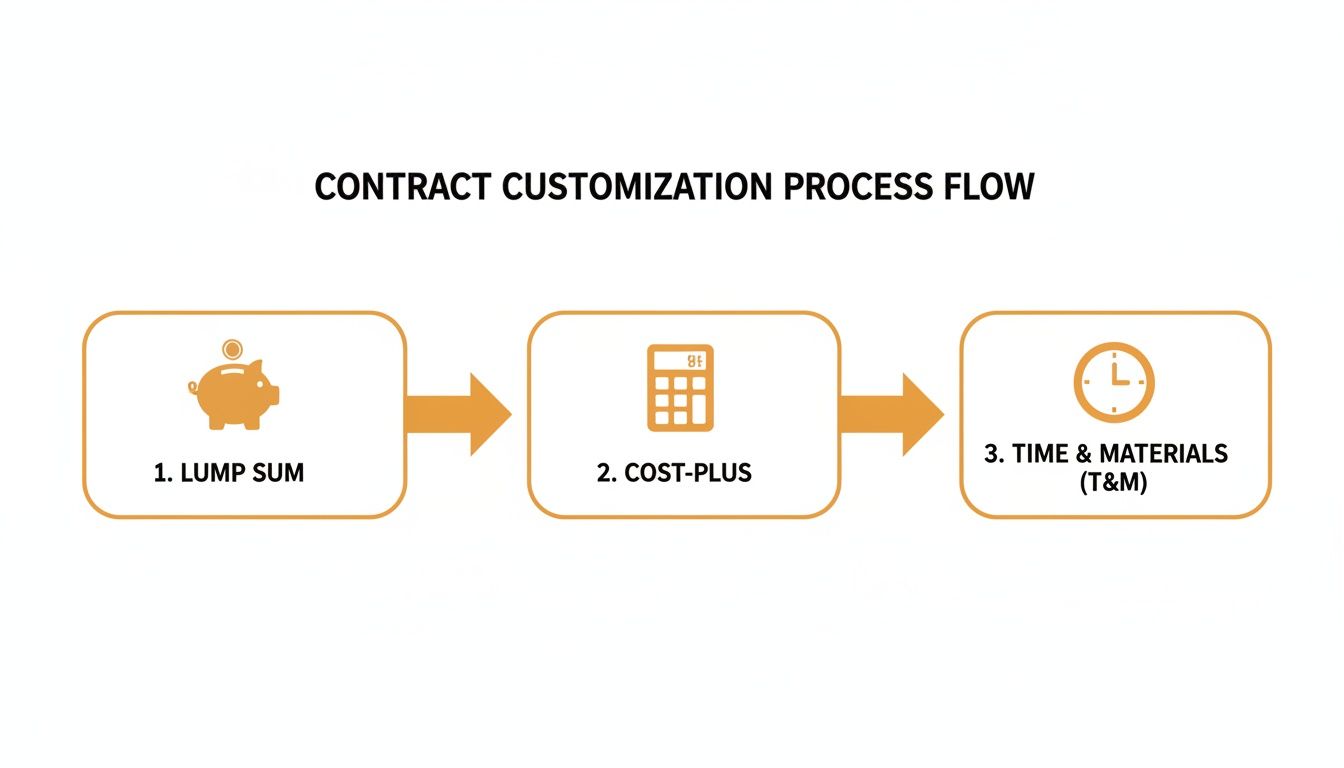
As you can see, whether you're bidding a Lump Sum, a Cost-Plus, or a Time & Materials job, your core template can be quickly adjusted with the right terms before it goes out the door.
By using these digital tools, you’re not just sending a contract—you're creating a smooth, secure, and professional onboarding for your clients. This efficiency leads directly to faster project starts and a stronger reputation. For those looking to make the process even faster, new tools can help with the initial drafting, too. To learn more, take a look at this guide on how to generate contracts with AI using QuickSign.
Got Questions About Your Contract? You're Not Alone.
Even with a rock-solid contract template for general contractors, you're going to get questions. It's just part of the business. Every project has its own quirks, and every client has their own set of concerns. Handling these conversations with clear, confident answers doesn't just smooth things over—it shows you’re a pro who knows their stuff.
Let's walk through some of the most common questions you'll likely face. This is your playbook for handling those final, sometimes tricky, details before the real work begins.
"Can We Make a Few Changes to Your Contract?"
When a client asks to change your template, don't panic. This is a normal part of the negotiation process, not a red flag. The trick is having a system for dealing with it.
First, take a close look at what they're asking. Is it a simple wording preference, or are they trying to overhaul the scope, liability clauses, or payment schedule? For minor tweaks, you can often just edit the document for that one project and move on. But if the changes get into the weeds on risk, payment, or other major terms, that's when you should bring in your lawyer. It's a small investment that can save you a massive headache down the road.
Here's a non-negotiable rule: document every single change. Whether it's a formal amendment or a fully revised contract, get it in writing and make sure both you and the client sign the updated version before a single hammer swings. This eliminates any "he said, she said" arguments later.
"Are Digital Signatures Actually Legit?"
Yes, 100%. Thanks to the federal ESIGN Act passed way back in 2000, electronic signatures carry the same legal weight as a pen-and-ink signature for almost every kind of business deal. This isn't some new-fangled idea; it's the standard for how business gets done now.
Modern e-signature platforms like QuickSign provide a secure audit trail that’s often more robust than a physical signature. It tracks things like:
- Who signed the document
- The exact time and date it was signed
- The IP address of the person who signed
That digital paper trail can be your best friend in a dispute, making e-signatures a reliable, efficient, and legally sound choice for any contractor.
"How Often Should I Update My Contract Template?"
You should give your master contract template a thorough review at least once a year. Things change. State laws, building codes, insurance requirements, and lien regulations are always evolving, and an annual check-in ensures your agreement is still protecting you and keeping you compliant.
But don't just stick to a calendar. The best time to revisit your template is right after a difficult project or a dispute. Those real-world experiences are gold because they expose the weak spots in your contract. Tightening up those clauses is just smart risk management.
"Can't I Just Use a Free Template I Found Online?"
I get the appeal, but grabbing a free, generic template off the internet is a huge gamble. It might look like a contract and feel like a contract, but it rarely offers the kind of real, enforceable protection your business needs.
These one-size-fits-all documents are almost never tailored to your specific state and local laws, which can get you into hot water with regulations around residential construction or mechanics' liens. The smart play is to start with a high-quality template, then pay a lawyer to help you customize it for your business, the types of projects you do, and the laws where you operate.
Ready to stop chasing paperwork? With QuickSign, you can turn that master template into a secure, digital document your clients can sign in minutes. You can even collect deposits and send automated reminders to get projects off the ground faster. See how QuickSign can streamline your entire workflow.