Your Guide to the Memorandum of Understanding Form
Create a clear memorandum of understanding form with this expert guide. Get actionable tips, essential clauses, and a fillable template to start today.
Think of a memorandum of understanding form as a formal handshake on paper. It's not the final, legally binding contract, but it's the crucial first step that maps out the big picture of an agreement between two or more parties.
What a Memorandum of Understanding Really Means
An MOU isn’t meant to be a rigid, iron-clad document. Instead, it’s a foundational blueprint for your collaboration. It’s the perfect tool for getting the broad strokes down on paper, making sure everyone is aligned before you sink significant time and money into drafting a formal contract.
Getting this right from the start builds clarity and trust, which goes a long way in preventing headaches and misaligned expectations down the road. For anyone managing a project, running a business, or working as a freelancer, an MOU is that first practical step toward a solid partnership. It lets everyone agree on the core objectives and responsibilities in a low-stakes way.
Real-World Applications of an MOU
An MOU is most valuable when you need to solidify intentions, even if the nitty-gritty details are still being hammered out. I’ve seen them used effectively in all sorts of situations.
Here are a few common examples:
- Startup Collaborations: Imagine two tech startups planning a joint marketing campaign. An MOU is perfect for outlining the campaign's goals, who's responsible for what promotions, and a basic timeline—all without getting tangled in dense legal jargon.
- Consulting Projects: A freelance consultant and a new client can use an MOU to define the initial project scope, list the key deliverables, and agree on payment terms before committing to a full-blown service agreement.
- Non-Profit Partnerships: Two community organizations wanting to host a joint fundraiser can draft an MOU to clarify roles, who’s contributing which resources, and how the proceeds will be split.
This isn’t just for small-scale projects, either. In November 2023, the World Bank and the Global Fund signed an MOU to strengthen health systems. It shows how even massive global initiatives use these agreements to get things moving without the delays of a full-blown treaty.
The real purpose of an MOU is to document goodwill and a shared vision. It serves as a guidepost for future negotiations, which makes the actual contract drafting process much smoother for everyone involved.
Now, it's crucial to understand where an MOU stands legally. While it outlines a common understanding, it is fundamentally different from legally binding documents like formal partnership agreement forms. This distinction is critical because an MOU usually doesn't contain the specific language that makes an agreement enforceable in court.
To help clear things up, here’s a quick breakdown of how an MOU and a formal contract differ.
MOU vs Contract Key Differences at a Glance
| Aspect | Memorandum of Understanding (MOU) | Formal Contract |
|---|---|---|
| Legal Status | Generally non-binding. Expresses intent and goodwill. | Legally binding and enforceable in a court of law. |
| Purpose | To outline a framework for a future agreement. | To create a firm, enforceable set of obligations. |
| Level of Detail | Broad strokes, focuses on objectives and principles. | Highly detailed, includes specific terms, conditions, and remedies. |
| Consequences | Typically no legal recourse for breach. | Breach can lead to legal action, such as damages or specific performance. |
| Language | Often uses phrases like "will cooperate" or "intend to." | Uses definitive language like "shall" and "must." |
Knowing the key elements of a contract will help you recognize when your agreement is about to cross the line from a simple understanding to a binding obligation. Always be clear about which type of document you're creating.
Getting to the Heart of Your MOU
Moving past a generic template is what separates a truly useful MOU from a document that just goes through the motions. A well-thought-out memorandum of understanding isn't about filling in blanks; it's about turning a handshake and a shared idea into a clear, practical roadmap. Each part of the document has a job to do, and that job is to head off misunderstandings before they start.
I like to think of it like building a piece of flat-pack furniture. You need all the right parts—the legs, the tabletop, the little bag of screws—for it to be stable and do its job. An MOU is no different. It needs its core components to give your collaboration real structure and support. The whole point is to create something that actually mirrors what you and your partners intend to do together.
Nailing Down the Purpose and Scope
Every solid MOU has to start with a clear "why." This opening section, which you’ll often see labeled as the Preamble or Purpose, is where you set the stage for everything that follows. It needs to briefly explain the backstory of your partnership and what you're ultimately trying to accomplish.
This is not the place to be vague. Instead of a fuzzy statement like, "the parties will collaborate on marketing," get specific. Try something like, "Party A and Party B intend to co-host a joint webinar series in Q3 to generate qualified leads for their respective software products." That kind of clarity gets everyone on the same page right from the get-go and acts as a compass for the partnership.
Sorting Out Who Does What
With the "why" established, the next crucial piece is detailing who is responsible for what. This is how you avoid that all-too-common problem of, "Wait, I thought you were doing that." You need to break down the specific duties, tasks, and resources each party is bringing to the table.
For instance:
- Party A’s Role: Will handle all social media promotion and email campaigns for the webinar series.
- Party B’s Role: Is responsible for creating the slide deck, providing the main speaker, and managing the webinar platform logistics.
- Shared Efforts: Both parties will work together on the landing page copy and will equally share the final list of registrants.
Dividing up the labor like this cuts through any potential confusion and creates clear expectations, which just makes the whole collaboration run more smoothly.
The best MOUs I've seen leave zero room for assumption. When you explicitly outline what everyone is contributing, you build a mutual sense of accountability that really strengthens the partnership from day one.
Outlining the Ground Rules
Beyond just the roles, your memorandum of understanding form needs to lay out the practical terms of your arrangement. This is where you get into the nitty-gritty operational details that will guide how you work together. A few absolutely essential clauses to include cover the timeline, confidentiality, and any financial points.
The Term clause simply defines how long the agreement will last. Is it tied to a specific project timeline, say, six months? Or is it an ongoing thing until one of you decides to end it? Nailing this down prevents the agreement from dragging on indefinitely.
A Confidentiality clause is almost always a good idea. It protects any sensitive information you share with each other, which is fundamental for building trust, especially if you're dealing with proprietary data or business strategies.
Finally, the Signature section is where everyone formally shows their commitment. Even though an MOU isn't usually legally binding, the signatures represent a serious, good-faith promise to follow through. Getting this last part right is important, and you can get some great tips on formatting a signature page for a contract to make sure it looks professional and is easy to understand.
How to Securely E-Sign Your MOU
Once your draft is finalized, the old cycle of print, sign, scan, and email is thankfully a thing of the past. Modern e-signature platforms don't just save a ton of time; they add a layer of security and traceability that paper methods could never offer. Using a tool like QuickSign takes your memorandum of understanding form from a simple document to a live, trackable agreement.
The whole process is pretty simple. You start by uploading your finished MOU—usually as a PDF or Word file. Then, you just drag and drop fields for signatures, initials, and dates right onto the document for each person. This is a small step, but it's crucial for making sure everyone signs exactly where they need to, avoiding those annoying missed signatures that can stall your project.
Setting the Signing Order
For agreements that involve a few different people, controlling who signs when is incredibly important. Think about a project with a freelancer, an agency, and the final client. You probably want the freelancer and agency to be on the same page before the document ever lands in the client's inbox.
This is where setting a signing order is a total game-changer. Instead of blasting the document out to everyone at once and causing chaos, you create a clear workflow.
- First up, the Freelancer: They get the document first and sign off.
- Next, the Agency: The document is automatically sent to them only after the freelancer has signed.
- Finally, the Client: They receive the last notification to sign once the other two have done their part.
This kind of controlled process cuts out the confusion and makes sure the agreement moves forward in a logical, professional way. Everyone gets a notification only when it's their turn, which keeps the whole thing clean and efficient.
A compliant, secure e-signature platform is more than just a convenience. It creates a digital audit trail, capturing every single action from the moment the document is sent to the final signature. This gives your non-binding agreement a verifiable record and a serious dose of professionalism.
This process is the final step after you've nailed down the core components of the agreement.
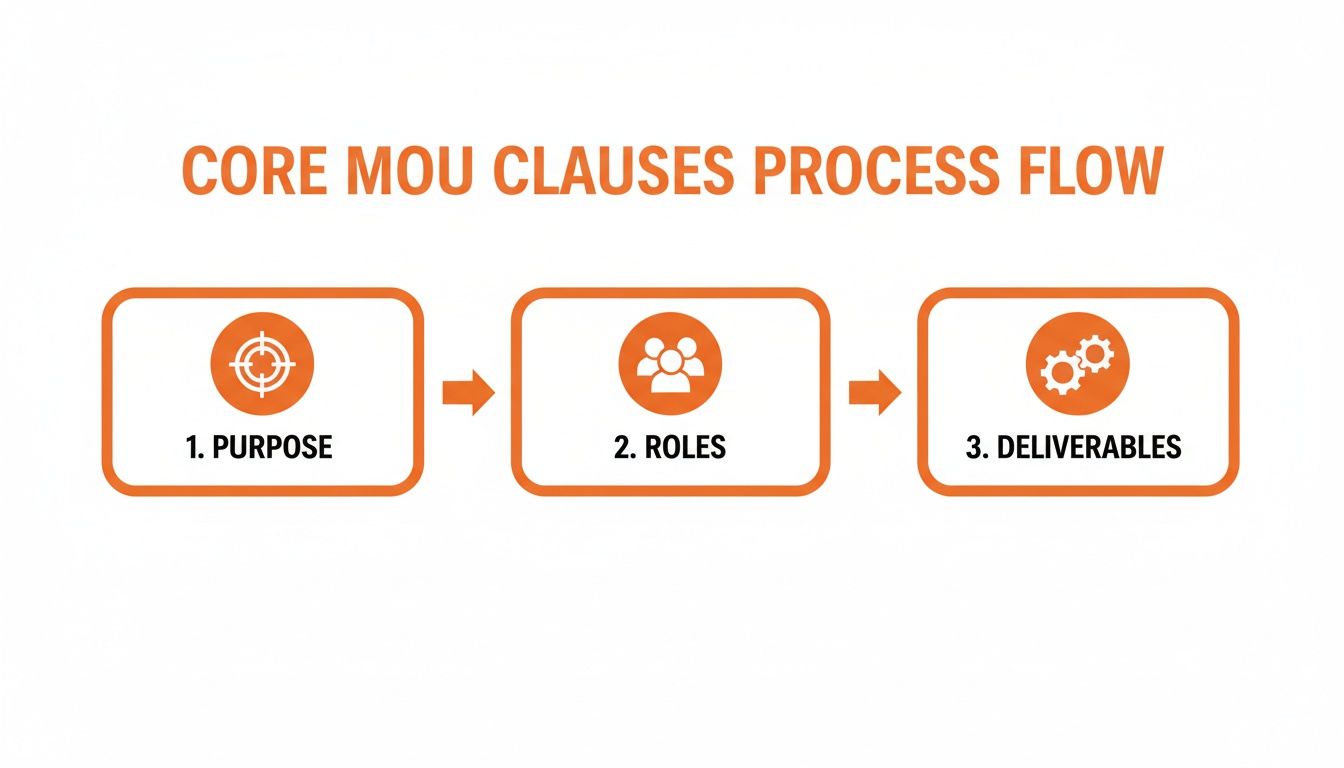
As you can see, defining the purpose, roles, and deliverables is what builds the foundation of your agreement, which naturally leads to the signing stage.
Why the Digital Audit Trail Matters
Beyond just being easy, a dedicated platform gives you some serious security benefits. Every interaction with the document—who opened it, when they viewed it, and the exact time and IP address of their signature—is time-stamped and logged. This creates a rock-solid audit trail. If you want to get into the weeds on compliance, check out our guide on the https://quicksign.it/blog/legal-requirements-for-electronic-signatures.
Having this level of detail is invaluable if any questions about the agreement's execution ever come up down the road. Once your MOU is drafted and ready, exploring effective tools to sign your PDF documents electronically is the final, essential step to get things done securely and on time. The goal here is to formalize your shared understanding with confidence.
This kind of efficiency isn't just for small businesses; it mirrors how large-scale international agreements work. Take the Paris Memorandum of Understanding on Port State Control, for example, which expanded in 2023. It relies on coordinated digital processes across 28 states to improve maritime safety. In the same way, QuickSign’s features—like signing orders and shared templates—help standardize workflows, cutting signature delays from days to mere minutes for companies managing complex operational agreements.
Common MOU Mistakes and How to Avoid Them
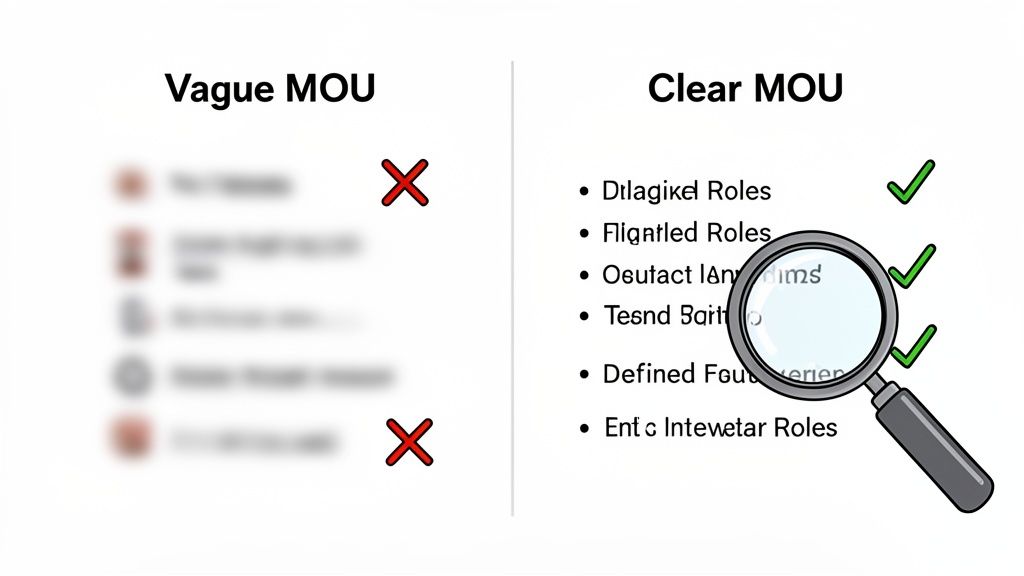
I’ve seen it happen time and again: a well-intentioned MOU backfires, creating more confusion than clarity. Even with everyone on the same page initially, a few common slip-ups can easily derail a partnership before it even starts. Knowing what these pitfalls are is the best way to protect everyone involved.
The most common mistake by far is relying on vague language. Terms like "provide marketing support" or "collaborate on development" are classic offenders. They sound good on paper, but what do they actually mean? Does "support" mean a few social media posts or a full-blown ad campaign? Without specifics, each party is left to interpret their commitments, and those interpretations rarely match.
The Danger of Accidental Contracts
Here’s a big one: accidentally creating a legally binding contract. An MOU is supposed to be a gentleman's agreement, a framework of intent. But if you use definitive language like "Party A shall deliver..." or "Party B must complete...", a court could see that as a firm, enforceable promise. Suddenly, your flexible handshake agreement has teeth, which is almost never the goal at this early stage.
To keep your MOU from becoming an accidental contract, stick to non-binding language. It's a subtle but crucial difference.
- Good: "The parties intend to..." or "It is understood that..."
- Risky: "The parties agree to..." or "This agreement requires..."
This simple shift in wording is what keeps the MOU in its lane as a statement of mutual goals. Keeping that distinction clear is fundamental, and it's a principle we cover more deeply in our guide to the best practices for contract management.
Expert Tip: Always include a specific disclaimer clause. A simple sentence like, "This Memorandum of Understanding is not intended to be legally binding and does not create any legal rights or obligations," is your best defense against accidental commitments. It’s a must-have.
Forgetting an Exit Strategy
Finally, so many MOUs are missing an exit plan. People get excited about starting a collaboration and forget to define how it can end. What happens if a key person leaves, the project's goals pivot, or one side simply can't hold up their end of the bargain anymore? Without a termination clause, trying to dissolve the arrangement can get messy and damage professional relationships.
Your MOU should clearly state how either party can walk away. This could be by mutual consent or with a certain amount of written notice, like 30 days. It provides a clean, professional off-ramp if things don't go as planned, allowing the partnership to end amicably. Thinking about the end at the beginning can save you a world of trouble later on.
Advanced MOU Strategies for Growing Businesses
When your business starts to take off, the complexity of your deals and partnerships grows right along with it. The simple memorandum of understanding form that worked for a quick two-party agreement suddenly feels inadequate when you're juggling multi-stakeholder projects or international collaborations. This is the point where you need to stop just drafting MOUs and start building a strategic workflow around them.
Instead of reinventing the wheel for every new handshake deal, a huge time-saver is creating a library of reusable templates for your most common partnerships. Imagine having a go-to template for joint marketing ventures, another for technology integrations, and a third for event sponsorships. Using a tool like QuickSign to build and store these templates means every new partnership begins from a solid, pre-vetted foundation.
This approach isn't just about speed; it injects much-needed consistency into your deal-making. It cuts down on the mental heavy lifting for your team and ensures critical clauses don't get overlooked when things are moving fast.
Scaling Up with Automation and AI
For a business on a steep growth curve, creating documents manually can become a serious drag on momentum. This is where modern tools can completely change the game. For example, QuickSign’s AI Document Generation can spit out a solid first draft of an MOU in just a few seconds from a couple of simple prompts.
This gets you about 80% of the way there, freeing up your team to focus on the nuances of the deal itself, not wrestling with boilerplate language and formatting. It’s about empowering your people to jump on opportunities the moment they arise. When you combine AI-powered drafts with your library of saved templates, you can turn around a professional memorandum of understanding form in minutes. You can get a deeper look at this in our guide on document workflow automation for modern businesses.
These aren't just abstract concepts for private companies. Look at the Global Memorandum of Understanding on Zero-Emission Vehicles, which brings entire nations together to work toward ambitious sales goals. It’s a perfect example of how a preliminary agreement can set the stage for massive change without the rigidity of a binding contract. E-signature platforms make it possible for even small businesses to participate in these kinds of large-scale initiatives by simplifying compliance and providing a secure, auditable trail for every agreement.
For a growing agency or startup, a standardized MOU process isn't just an operational improvement—it's a strategic asset. It allows you to engage more partners, explore more opportunities, and secure commitments with greater confidence and speed.
Managing Complex Multi-Party Agreements
So, what happens when your MOU involves more than just two parties? Think of a three-way partnership between a software developer, a marketing agency, and a major retailer. Keeping the flow of information and signatures organized in these situations is absolutely critical to preventing chaos and delays.
This is where setting a clear signing order is non-negotiable. With advanced features, you can control the exact sequence, ensuring Party A signs off before Party B even sees the document, who must then sign before it's sent to Party C. This kind of controlled workflow eliminates confusion and keeps the process moving forward in a logical, step-by-step manner.
Let's break down how specific tools can help manage these more advanced MOU workflows.
QuickSign Features for Advanced MOU Management
Here's a quick summary of how specific QuickSign tools can streamline and secure your MOU workflow from creation to completion.
| Feature | Benefit for MOU Process | Ideal for |
|---|---|---|
| Reusable Templates | Ensures consistency and speeds up creation for frequent collaborations. | Agencies with repeat client types. |
| AI Generation | Creates a strong first draft in seconds, overcoming writer's block. | Startups needing to move quickly. |
| Signing Order | Manages complex workflows by dictating who signs and when. | Multi-stakeholder projects. |
| Real-Time Audit Trails | Provides a secure, verifiable record of every action on the document. | All businesses seeking compliance. |
By bringing these more advanced strategies into your process, your memorandum of understanding form transforms from a simple document into a powerful engine for business growth.
Common Questions About MOUs
Even when you've got a solid plan, a few questions always seem to come up when you're drafting or signing a memorandum of understanding. Let's walk through the most common ones I hear, so you can move forward with confidence.
So, is an MOU Actually Legally Binding?
This is, without a doubt, the number one question people ask. The short answer is usually no.
By its very nature, an MOU is about outlining a shared vision and mutual goodwill. It's that "handshake on paper" we talked about earlier, not a document meant to create legally enforceable promises.
But—and this is a big but—you have to be careful with your wording. If you start throwing in definitive language like "shall" or "must," or if the document outlines a clear exchange of value (what lawyers call "consideration"), a court could decide that some parts are, in fact, binding.
The best practice is to always include a straightforward disclaimer that explicitly states the MOU is non-binding. This simple step can save you a world of headaches down the road.
What Happens If Someone Breaks the Agreement?
Since most MOUs aren't legally binding, there aren't usually any legal repercussions if one party doesn't follow through. You can't sue for "breach of an MOU" like you would for a formal contract.
The real damage is to trust and reputation. An MOU is a signal of good faith. Backing out can burn bridges and send a message that you might not be a reliable partner for future, more serious collaborations. The professional fallout is often more costly than any legal penalty would be.
Can We Change the MOU After It's Been Signed?
Absolutely. In fact, it's pretty common. As partnerships and projects evolve, the original terms you agreed upon might need a tweak. The key is to handle changes professionally.
Any adjustments should be made through a written amendment that everyone agrees to and signs. This keeps the process transparent and ensures you’re all still on the same page. Treating amendments with the same level of care as the original MOU keeps the relationship on solid footing.
How Do You End an MOU the Right Way?
Ending an MOU should be a clean and simple process, as long as you thought ahead and included a termination clause. This clause is your exit strategy, outlining exactly how the agreement can be dissolved.
Typically, an MOU can be terminated in a few standard ways:
- By Mutual Agreement: All parties simply agree in writing that the MOU is no longer needed.
- By Giving Notice: One party can provide written notice, often with a set waiting period like 30 days, before the termination is effective.
- Upon Completion: The MOU might naturally end once the goals or the project it was created for are successfully completed.
Having these clear off-ramps in place prevents awkward disputes and helps everyone part ways professionally, even if the collaboration didn't pan out as planned.
Ready to create, sign, and manage your MOUs with confidence and speed? QuickSign offers everything from AI document generation to secure, eIDAS-compliant e-signatures, making your entire agreement workflow simple. Start for free at QuickSign and see how easy professional document management can be.